Azure Functions hosted skills: Customer returns review
A return request lands on a queue. A hosted skill on Azure Functions reads it, looks up the order, the return policy, and the customer's support history, then records a recommendation — approve, approve as an exception, decline, or escalate — with its reasons, evidence, and a reply draft for a support agent to send.
This is the customer returns scenario as a runnable template: azd up, send the sample requests, and read the recommendations.
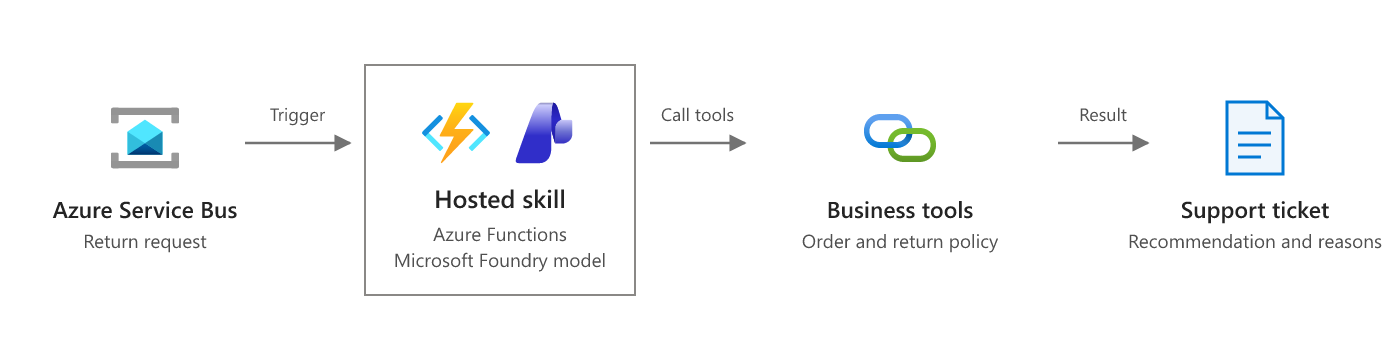
Scenario overview from Process customer requests from messages on Microsoft Learn. The diagram below shows how this template implements it.
 return request ──► Storage queue ─┐
   (JSON)           or Service Bus ┴─► customer_returns.agent.md ──► Blob: return-recommendations/{request_id}.json
                                         │  hosted skill (Flex Consumption)
                                         ├─ get_order            (days since delivery, computed in code)
                                         ├─ get_return_policy    (window + exceptions)
                                         ├─ get_support_history  (tickets, account flags)
                                         └─ record_return_recommendation (idempotent, approval rule enforced in code)
Why this scenario fits a hosted skill
Return requests rarely fit the rule exactly. "It's past 30 days, but it arrived broken and I emailed you right away" needs someone to read the message, find the ticket, and apply the policy's exception. The hosted skill does that judgment; the tools keep the facts and the side effects deterministic.
The three samples show the range:
| Sample | Situation | What a reviewer would expect |
|---|---|---|
RR-1001 |
48 days after delivery, but damage was reported on day 2 (ticket T-2207) | approve_exception (policy OG-EX-1), replacement, needs approval |
RR-1002 |
11 days, tags still on | approve_standard, refund |
RR-1003 |
72 days, "defective", but a ticket shows the stove was used and the account is flagged | decline or escalate, needs approval |
Prerequisites
- An Azure subscription with access to a Microsoft Foundry model deployment (the template deploys one).
- Azure Developer CLI (
azd) 1.10 or later, and Azure CLI (az). - Python 3.13.
- For local runs: Azure Functions Core Tools 4.x and Azurite.
Deploy to Azure
git clone https://github.com/Azure-Samples/azure-functions-hosted-skills-samples
cd azure-functions-hosted-skills-samples/customer-returns-queue
azd auth login
azd up
azd up creates a resource group with:
- A Flex Consumption function app running the hosted skill, with a user-assigned managed identity.
- A storage account (no shared key access) for the app, the
customer-returnsqueue, and thereturn-recommendationscontainer. - A Microsoft Foundry project with a model deployment.
- Application Insights and Log Analytics.
All connections use the managed identity. Your signed-in account also gets data-plane roles so you can run the demo and the app locally.
Use Service Bus instead of a Storage queue
azd env set QUEUE_PROVIDER servicebus
azd up
This adds a Service Bus namespace (Basic tier, Entra ID only) with a customer-returns queue and switches the hosted skill's trigger to service_bus_queue_trigger. Nothing else changes: the trigger type and connection come from app settings that the skill file reads as $RETURNS_TRIGGER_TYPE and RETURNS_QUEUE_CONNECTION.
Try it
python -m venv .venv
# Windows: .venv\Scripts\activate    macOS/Linux: source .venv/bin/activate
pip install --pre -r requirements-dev.txt

python scripts/demo.py send               # send all three samples
python scripts/demo.py results --wait 300 # wait for and print the recommendations
Example output:
RR-1001: approve_exception / replacement (needs approval)
  - Return requested 48 days after delivery, outside the 30-day window.
  - Damage was reported 2 days after delivery (T-2207), so exception OG-EX-1 applies.
Each recommendation is a JSON document in the return-recommendations container, named after the request's request_id. Send one sample with --sample RR-1003. python scripts/demo.py e2e sends uniquely named copies plus two different malformed messages, and checks that each sample was recorded with reasons and the approval rule and that each malformed message got its own escalate record.
Watch the run in Application Insights, or stream logs with func azure functionapp logstream <app-name>.
Run locally
Start Azurite (
azurite, ordocker run -p 10000-10002:10000-10002 mcr.microsoft.com/azure-storage/azurite).Create the settings file and point it at a Foundry project. After
azd up,azd env get-value FOUNDRY_PROJECT_ENDPOINTprints the endpoint.cp src/local.settings.json.sample src/local.settings.json # set FOUNDRY_PROJECT_ENDPOINT in src/local.settings.jsonStart the app from
srcwith the virtual environment active, then send messages to Azurite from another terminal:cd src && func start python scripts/demo.py send --local python scripts/demo.py results --local --wait 300
Locally the app uses your az login identity for Foundry.
Make it yours
| To change | Edit |
|---|---|
| Decision rules, tone, escalation criteria | src/customer_returns.agent.md |
| Order, policy, and CRM lookups | src/tools/get_*.py — replace the src/data/*.json reads with calls to your systems |
| Where recommendations go (ticketing system, Teams, Cosmos DB) | src/tools/record_return_recommendation.py and _recommendation_store.py |
| Model | azd env set FOUNDRY_MODEL ... (and the deployment in infra/app/foundry.bicep) |
| Queue technology | azd env set QUEUE_PROVIDER storage|servicebus |
Guardrails built in
- Recommend, don't act. The skill records a recommendation. Refunds and replacements stay in your order system behind its own approval flow.
- Approval enforced in code.
record_return_recommendationforcesrequires_human_approvalfor every decision other thanapprove_standard, whatever the model says. - Idempotent. Queue messages can be delivered more than once. The recommendation is written with
overwrite=False; a retry returnsduplicateinstead of a second write. - Malformed messages are never collapsed. A message that is not valid JSON or lacks
request_id/order_idis stored asmsg-<trigger message ID>(the Storage queue messageidor the Service Busmessage_id), which is distinct per message and stable across redelivery. A Service Busmessage_idis a free-form string, so an ID with characters other than letters, digits,-and_(for exampletenant-42:order.1234) is stored asmsg_<SHA-256 of the ID>instead, and the original ID is kept in the record. The tool rejects placeholder IDs such asunknownand always records these asescalate. With Service Bus, set amessage_idwhen you send (the demo does). The skill copies the trigger message ID from the trigger data, because the runtime doesn't yet pass trigger context to tools (Azure/azure-functions-agents-runtime#292). - Facts from code.
days_since_deliveryis calculated byget_order, not by the model. - No extra reach.
web_requestand MCP are disabled for this skill; it can only call its four tools. - Poison messages. After 5 failed attempts the message moves to
customer-returns-poison(Storage) or the dead-letter queue (Service Bus).
Test
From the repository root:
python scripts/test.py --template customer-returns-queue               # Bicep build, skill/tool loading, unit tests
python scripts/test.py --template customer-returns-queue --level local # + func start against Azurite
python scripts/test.py --template customer-returns-queue --level deploy --down  # + azd up, e2e, azd down
Troubleshooting
azd upfails while uploading the package with403 ... not authorized to perform this operation. The app's role assignments were just created and haven't reached Storage yet. Wait a minute and runazd deploy.- No recommendations appear. Check the function's logs in Application Insights. Messages that fail 5 times move to
customer-returns-poison(Storage) or the dead-letter queue (Service Bus).
Clean up
azd down --purge