Note
Access to this page requires authorization. You can try signing in or changing directories.
Access to this page requires authorization. You can try changing directories.
This article helps security and technology teams establish and modernize a Security Architecture discipline that provides a clear, end‑to‑end technical vision for security across the organization.
Security disciplines are groupings of related security work that help organizations consistently deliver security outcomes across the entire technology estate. Within the security adoption model, disciplines help provide a bridge between business scenarios and technical implementation, ensuring that security investments translate into real measurable outcomes as part of the security adoption model.
Why this discipline?
Access and identity is the security discipline that most people interact with first—and most often. Every user experiences it every time they sign in to a device, access an application, share a file, connect remotely, or use physical credentials to enter a building.
Because access controls sit at the intersection of security and productivity, they directly influence both organizational risk and user experience.
The Access and Identities discipline:
-
- Reduces risk by shaping and governing access paths to business assets, ensuring the right entities have the right access under the right conditions, while preventing abuse by attackers.
- Enables productivity with consistent, low‑friction access that discourages insecure workarounds and shadow IT
- Provides a common strategy that security leaders and practitioners can align to and execute consistently across the organization
This is a strategic priority because identities are the most common entry point for attacks, and because privileged access compromise dramatically amplifies attack impact. Techniques such as password spray, phishing, and token theft are routinely used to gain an initial foothold. Pass‑the‑hash, pass‑the‑ticket, and similar identity compromise attacks are regularly used to move laterally, escalate privileges, and reach high‑value assets.
Without an effective Access and Identities discipline, organizations face increased risk from:
- External compromise: Attackers can rapidly take over legitimate user or service identities, including privileged accounts, and use them to discover and exploit business assets.
- Insider abuse and privilege misuse: Malicious, negligent, or compromised insiders can abuse elevated privileges to access sensitive systems and data.
- Productivity loss and insecure workarounds: Overly restrictive or inconsistent access controls frustrate users and drive the adoption of shadow IT with weaker controls and limited visibility, increasing risk and blast radius.
Mission and outcomes
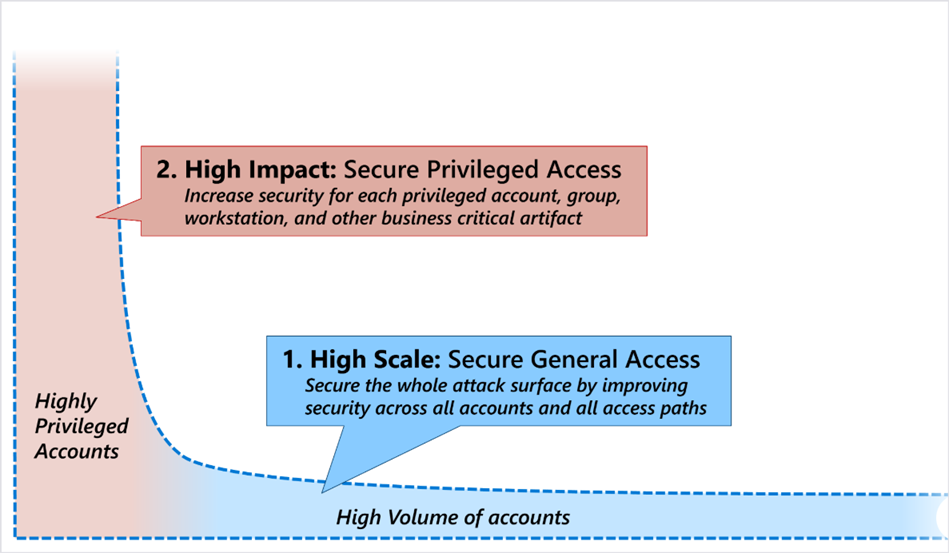
An effective Access and Identities discipline is built around two complementary strategic objectives:
- Secure general access - Increase baseline security across all organizational assets by consistently enforcing minimum security assurances for everyday access.
- Secure privileged access - Protect access that can have material business impact, including high‑value business assets, IT administrative accounts, workload identities, and artifacts that grant broad or deep control.
Together, these objectives ensure that access security scales with business value and risk, providing strong protection where it matters most, without unnecessarily obstructing routine work.
The following diagram illustrates these two complementary goals:
How to apply this discipline
To apply the Access and Identity discipline effectively, focus on establishing a consistent, identity-centric approach to how access is managed across the organization:
- Define an identity-centric access model aligned to business risk
Establish a clear approach for how users, devices, applications, and workloads access organizational resources based on risk and business impact. - Ensure consistent verification of access across all environments
Apply a uniform approach to validating identity, device, and access conditions regardless of location, application, or network. - Standardize access controls and policies across the organization
Provide clear guidance to ensure that access decisions are applied consistently and reduce fragmentation across systems and environments. - Align access management with business scenarios and critical assets
Prioritize access controls that protect high-value assets and support key scenarios such as secure remote work and protection of critical systems. - Continuously monitor and refine access based on risk and activity
Use insights from access patterns, risk signals, and security events to strengthen controls and reduce exposure over time.
Manage change
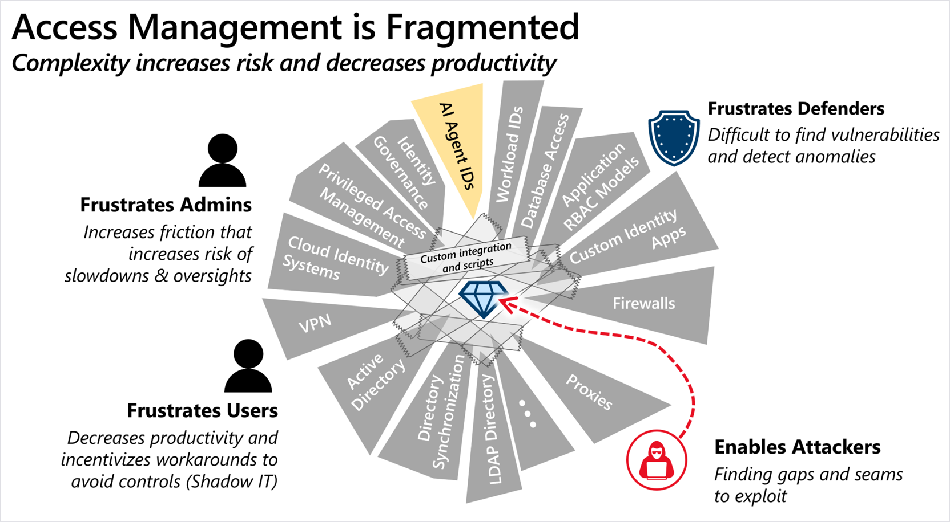
Traditional access control models focused on network perimeters, layering identity systems, and VPNs around a trusted internal network. These models no longer meet the needs of modern enterprises that operate across cloud, SaaS, mobile, AI, and hybrid environments. Legacy approaches often result in:
- Fragmented solutions across identity, network, and application layers.
- Weak or inconsistent privileged access protection.
- Poor integration with security operations and detection.
- Gaps that attackers routinely exploit.
The following diagram illustrates this limitation:
A modern Access and Identities discipline goes beyond individual technologies. It focuses on business priorities, integration, and completeness across all access paths, while enforcing a single, coherent access strategy. Modern access control must be:
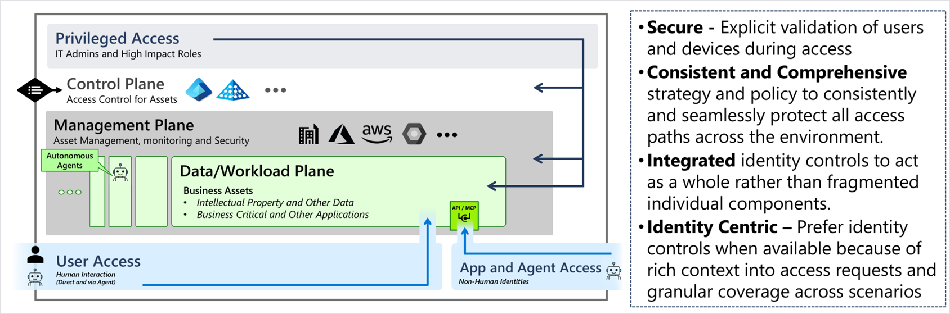
- Secure: Explicitly validate users, devices, and workloads using rich signals. Prevent unauthorized privilege escalation, and protect privileged access.
- Consistent and comprehensive: Cover all access paths—human and nonhuman—and apply security assurances uniformly to eliminate gaps and improve user experience.
- Integrated: Use centralized policy and a minimal number of policy engines to enforce controls consistently at scale, avoiding configuration drift.
- Identity-centric: Prioritize identity‑based controls, which provide richer context than network‑only signals. Use network controls as a complementary layer, not the primary trust boundary.
This diagram from the Enterprise Access Model illustrates all of the different types of access paths an organization must secure across multiple workloads, multiple clouds, various business sensitivity levels, and access by both people and devices.
Discipline roles and collaborators
Planning and delivery of the Access and Identities discipline is typically owned by teams responsible for identity, access, and networking. In larger organizations, responsibilities are distributed across formal roles and processes. In smaller organizations, roles might be combined and handled more informally. In all cases, documenting access and identity strategy as it evolves is recommended.
Primary roles include:
- Access architects: Define end‑to‑end access strategy and design across identity, networking, application, and platform layers.
- Identity and networking engineers and operators: Implement, operate, and maintain identity systems, access enforcement, and supporting infrastructure.
Architects must understand all access technologies holistically. Engineers typically have deep expertise in identity and/or networking systems.
Key internal collaborators include:
- Security and enterprise architects, to align access controls with broader security architecture and priorities
- Engineering and operations teams, who implement access requirements in platforms and workloads**
- Security leaders (CISO and delegates), who provide direction and oversight
- Developers, who design and build applications using modern identity and access patterns
No single role owns access in isolation. Successful access control depends on shared responsibility and coordination across teams.
Strategy components
An effective access and identity strategy secures the full lifecycle of authorized actions. Conceptually, this mirrors the structure of a sentence:
- Identity subject – who or what is requesting access.
- Access verb – the action being performed.
- Access object – the asset being accessed.
Identity subject (who)
Access security starts with knowing who or what is requesting access:
- All identity types: Secure human user accounts, workload identities, AI agents, applications, service principals, certificates, and cryptographic keys.
-
- The full identity lifecycle1: Manage identities from no access to identity creation, through changes and privilege elevation, to deprovisioning and returning to no access when it's no longer required.
- Identity sources: Define which internal and external identity providers are trusted, how identities are governed, and how lifecycle controls are enforced across those sources.
Access verb (how)
Access enforcement must cover all assets and access paths across the entire access cycle.
- Comprehensive coverage: Enforce policy for cloud, on‑premises, SaaS, AI, OT/IoT assets, across interactive access, APIs, and machine‑to‑machine communication.
- Intermediary systems: Secure devices, directories, gateways, VPNs, and access proxies that mediate access.
- Consistent policy: Apply policy uniformly across general access, privileged access, network access, external access, and workload‑level authorization models.
- Adaptive access: Continuously evaluate whether identities are known, trusted, and allowed using real‑time signals, and terminate sessions if risk changes.
- Strong authentication: Enforce phishing‑resistant authentication and mechanisms that mitigate password‑based attacks.
- Modern access mechanisms: Enforce least privilege at the application level and replace legacy perimeter technologies with identity‑centric approaches such as Security Service Edge (SSE).
Access object (what)
Access policy must reflect business value, sensitivity, and governance requirements:
- Align policy to business: Classify assets and align access controls to their value and risk.
- Manage control relationships: Access strategies must account for transitive control relationships in the security graph. If A controls B and B controls C, A effectively controls C—dramatically increasing blast radius.
- Reduce technical debt: Retire insecure legacy protocols and cryptography (such as LM/NTLM) that undermine access assurances. This often requires coordinated action across identity, endpoints, and infrastructure.
Alignment with other disciplines
The Access and Identities discipline doesn't operate independently. It aligns closely with other security disciplines, including:
- Strategy, Integration, and Governance. Access decisions shape business risk and prioritization.
- Security Architecture: Access controls enforce architectural decisions.
- Security Operations: Identity telemetry and access signals feed detection, investigation, and response.
- Endpoint Security: Device posture directly influences access trust.
- Data Security: Access policies reflect data sensitivity and governance.
This alignment ensures access decisions support end‑to‑end security outcomes, not fragmented controls.
Alignment with technology pillars
The Access and Identities discipline spans all technology pillars and serves as a unifying control layer across them, as shown in this diagram.
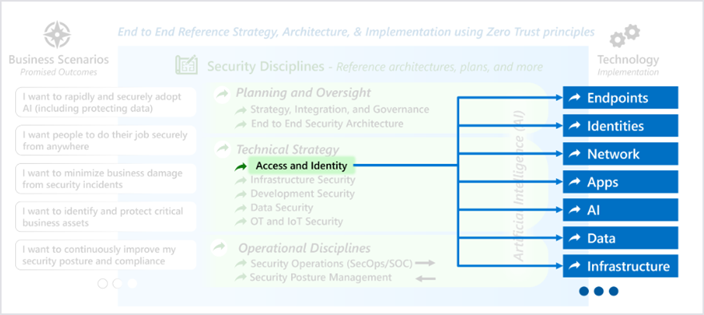
The discipline aligns as follows:
- Identities: Authentication, authorization, lifecycle management, and privilege controls define who can access assets and under what conditions.
- Endpoints: Endpoint posture and credential protection influence access trust decisions. Compromised devices undermine identity controls.
- Infrastructure: Identity systems and administrative interfaces run on infrastructure and require strong privileged access protection.
- Apps: Applications must use modern identity patterns and enforce least‑privilege access for users, APIs, and pipelines.
- Data: Identity‑based access controls govern who can read, modify, or exfiltrate sensitive data.
- Network: Network controls complement identity‑centric access by mitigating legacy attacks and supporting Security Service Edge (SSE) patterns.
- AI: AI agents and services introduce new identity types that require lifecycle management, least privilege, and monitoring.
Next steps
Microsoft Unified offers cybersecurity reference architectures, Zero Trust guidance, and expert-led workshops to help organizations with end to end security architecture. Learn more.

Review other security disciplines.
