Note
Access to this page requires authorization. You can try signing in or changing directories.
Access to this page requires authorization. You can try changing directories.
Security disciplines are groupings of related security work that help teams to consistently deliver security outcomes across the entire technology estate. They're used in our security adoption model to provide a bridge between business scenarios and technical implementation, ensuring that security investments translate into real, measurable outcomes.
The Security Architecture discipline establishes a cross-organizational strategy for controlling and governing access paths to business assets.
As you establish the Security Architecture discipline, this article provides guidance for creating a privileged access architecture.
Privileged access strategy
Designing a privileged access strategy should be treated as a top security priority because compromise of privileged users and systems is likely and has high-impact consequences. Privileged users typically have control over business‑critical assets, and attackers frequently exploit weaknesses in privileged access during targeted data theft and human-operated ransomware incidents.
A privileged access strategy is designed to:
- Reduce organizational risk by controlling, minimizing, and protecting high‑impact access paths. This requires applying rigorous security controls across the full security lifecycle (identify, protect, detect, respond, recover, and govern) using Zero Trust principles.
- Progressively reduce attacker opportunities while preserving the organization’s ability to operate and administer critical systems.
Strategic goals
Key strategic goals are summarized in the table.
| Goal | Details | Action |
|---|---|---|
| Limit exposure of privileged credentials | Privileged credentials are high‑value targets wherever they are used or stored. Exposure occurs when privileged users authenticate from lower‑security devices or environments, creating opportunities for credential theft and system compromise. | Reduce risk by applying least privilege through a combination of: - Just Enough Access: Grant only the permissions required to perform specific tasks. - Just‑in‑Time access: Provide elevated access only when needed, often with approval workflows. - Elevated protections: Apply stronger security controls to privileged accounts, devices, and data than to standard users. |
| Isolate and monitor privileged access pathways | An effective privileged access strategy seals off unauthorized escalation paths and leaves only a small number of approved, tightly controlled, and closely monitored pathways for privileged activity. | Action requires a holistic, end‑to‑end approach that includes: - Stronger authentication and device trust requirements. - Continuous monitoring for anomalous activity. - Priority detection and response when privileged access is involved |
| Reduce the number of privileged assets | A sustainable strategy minimizes how much privilege exists in the environment. Reducing the number of privileged identities directly lowers the attack surface and attacker return on investment. | Organizations should actively identify and remove unnecessary privileged access by: - Eliminating unused or excessive permissions. - Redesigning support and operational processes. - Removing accounts from privileged groups where elevation is not required. |
| Separate workflows | Using the same accounts or workstations for productivity activity and administrative activity potentially introduces a dangerous bridge between common attack vectors and enterprise‑wide control. | Organizations must clearly separate high‑exposure productivity activities (email, web browsing, collaboration) from high‑impact administrative activities. People who perform privileged tasks should use separate accounts, devices, and workflows for administrative access, preventing attackers from moving from low‑risk environments into high‑impact systems. |
Strategic design principles
Design a privileged access architecture around the following principles:
Treat privileged access as an end-to-end system: Privileged access risk spans identities and role assignments, devices and execution environments, intermediary components such as gateways and management agents, elevation workflows and approval processes, and monitoring/response mechanisms. Attackers will find and chain weaknesses across these elements. A resilient strategy assumes attackers are goal‑oriented and technology‑agnostic and therefore requires a complete, integrated approach.
Assume attackers are persistent, adaptive, and goal‑oriented: Attackers do not target technologies, they target outcomes. They'll probe for small weaknesses, combine multiple techniques, and shift to the easiest available path when blocked. They are looking for a good return on their investment. The strategy must be resilient to this behavior by eliminating entire classes of unauthorized access paths, not just hardening individual components.
Understand no single control is sufficient: A sustainable strategy must blend multiple technologies and controls into a holistic approach that covers multiple attacker entry points. There's no silver bullet. Implementing a Privileged Identity Management / Privileged Access Management (PIM/PAM) solution is valuable, but not sufficient on its own, because attackers don’t operate within the boundaries of a single product. A resilient strategy builds a solution that works across identities, devices, intermediaries, workflows, and detection/response. Single‑layer defenses leave exploitable gaps.
Apply Zero Trust principles consistently: The strategy must apply Zero Trust principles across the entire privileged access lifecycle, as a design requirement.
- Explicit verification for every privileged session.
- Least privilege through Just‑Enough‑Access and Just‑In‑Time processes.
- Assume breach, limiting blast radius and detecting abuse quickly.
Prefer centralized, cloud‑based control planes: Privileged access strategies depend on consistent policy enforcement, visibility, and rapid evolution as attacker techniques change. Using cloud‑based identity and security services as the control plane enables:
- Centralized policy enforcement across environments
- Continuous logging, analytics, and detection
- Faster rollout of new protections with less operational drift
Execution might occur on devices, intermediaries, or workloads, but governance and decision‑making must remain centralized.
Design for incremental improvement, not perfection: Privileged access strategy is a journey, and sustainability is as important as strength. Design choices should:
- Deliver immediate risk reduction
- Support phased adoption
- Avoid brittle or overly complex solutions
- Improve security posture continuously without disrupting operations
Make authorized privileged access low-risk and observable: The goal is to enable necessary administrative work, but in a way that is tightly controlled, high assurance, and continuously monitored—because privileged access is foundational to all other security assurances.
Understand privilege access pathways
We recommend deploying a "closed loop" system for privileged access, so that only trustworthy clean devices, accounts, and intermediately systems are allowed. There are two goals around privileged access pathways:
- Strictly limit the ability to perform privileged actions to a few authorized pathways.
- Protect and closely monitor those pathways.
Types of pathways
There are two primary pathways used to access enterprise systems:
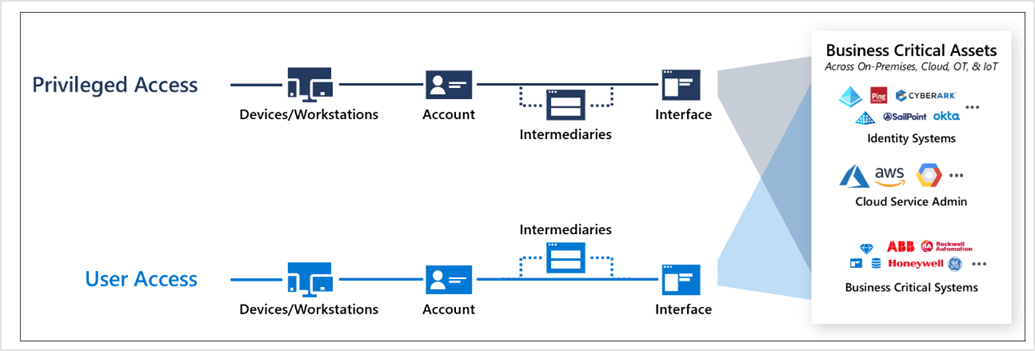
- User access: Standard user accounts performing productivity tasks such as email, collaboration, web browsing, and line‑of‑business applications. Privileged access: High‑impact access used to manage systems, data, and infrastructure. Compromise of this pathway enables widespread damage.
The following diagram illustrates these pathways.
- User Access depicts a standard user account performing general productive tasks.
- Privileged Access depicts privileged accounts accessing business-critical system and data.
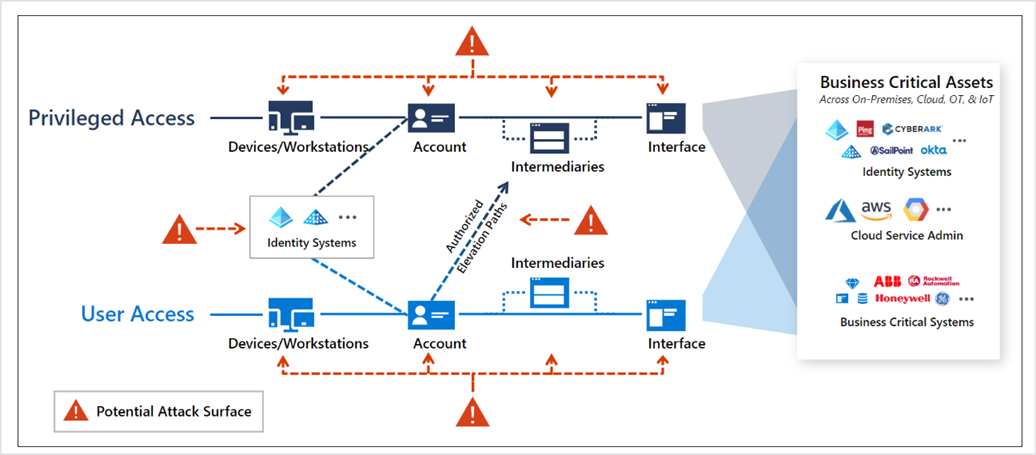
Within these paths, identity systems provide identity support functions for standard and privileged users. Authorized elevation paths provide standard users with the means to interact with privileged workflows. These components together make up the privileged attack surface that adversaries might target to gain elevated access.
This diagram shows a simple cloud architecture. For on-premises systems, or IaaS systems with customer-managed operating systems, complexity grows, and attack surfaces increase.
Minimizing attack surface
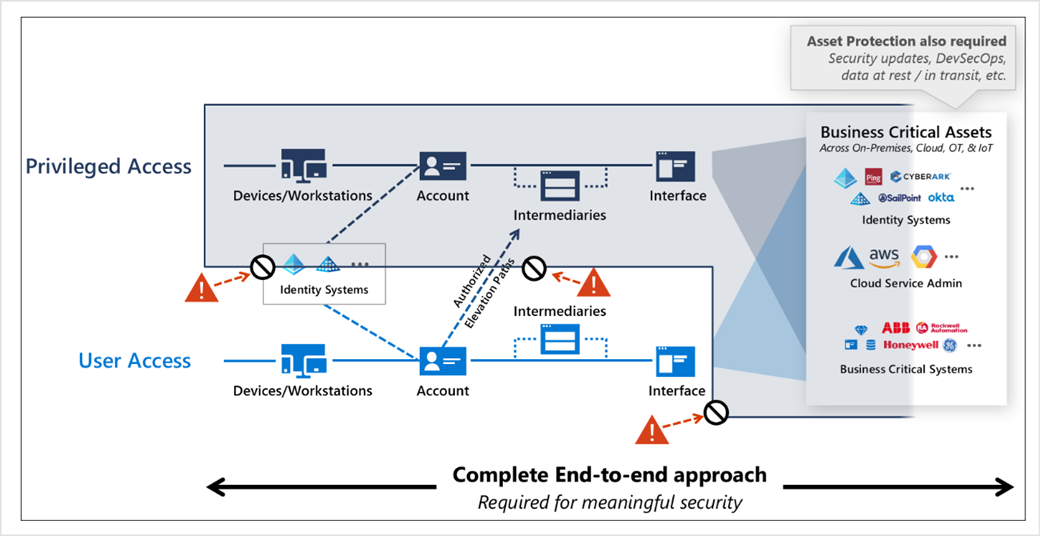
Creating a sustainable and manageable privileged access strategy requires closing off all unauthorized vectors using a combination of:
- Zero Trust access controls.
- Protection against direct asset attacks with good security hygiene practices to these systems. This typically includes things like rapid application of security updates/patches, configuring operating systems using manufacturer/industry security baselines, and protecting data-at-rest and in- transit.
Strategic initiatives
Implementing this strategy requires four complementary initiatives, each with clear outcomes and success criteria. These initiatives work together to prevent attackers from gaining, expanding, or abusing privileged access.
| Initiative | Details | Success criteria |
|---|---|---|
| Establish end-to-end session security | Establish explicit Zero Trust validation for privileged sessions, user sessions, and authorized elevation paths. | Each session validates that each user account and device are trusted at a sufficient level before allowing access. |
| Protect and monitor identity systems | Protect and monitor identity including directories, identity management, admin accounts, and consent grants. | Each of these systems is protected at a level appropriate for the potential business impact of accounts hosted in it. |
| Mitigate lateral traversal | Protect against lateral traversal with local account passwords, service account passwords, or other secrets. | Compromising a single device won't immediately lead to control of many or all other devices in the environment |
| Response to threats quickly | Deploy rapid threat response to limit adversary access and time in the environment. | Incident response processes impede adversaries from reliably conducting a multi-stage attack in the environment that would result in loss of privileged access. Measured by reducing the mean time to remediate (MTTR) of incidents involving privileged access to near zero, and reducing MTTR of all incidents to a few minutes so adversaries don't have time to target privileged access. |
Next steps
Microsoft Unified offers cybersecurity reference architectures, Zero Trust guidance, and expert-led workshops to help organizations with end to end security architecture. Learn more.

Review other security disciplines.
