Note
Access to this page requires authorization. You can try signing in or changing directories.
Access to this page requires authorization. You can try changing directories.
This article describes how to establish or modernize a Security Strategy, Integration, and Governance discipline. This discipline provides direction, coordination, and sustained oversight across a security modernization program, enabling organizations to move beyond fragmented controls toward a cohesive, outcome‑driven security posture.
Security disciplines are groupings of related security work that help organizations consistently deliver security outcomes across the entire technology estate. Within the security adoption model, disciplines help provide a bridge between business scenarios and technical implementation, ensuring that security investments translate into real measurable outcomes as part of the security adoption model.
Why this discipline?
Many organizations approach security governance through traditional governance, risk, and compliance (GRC) models that prioritize audits and external compliance. While necessary, these classic GRC approaches often fail to manage risks of real-world incidents that cause that operational disruption, data loss, recovery costs, and reputational damage.
The Security Strategy, Integration, and Governance discipline modernizes this model by making security an integral part of organizational decision‑making and operations, rather than a standalone or reactive function.
The discipline brings together three essential elements:
- Strategy: Defines security outcomes, priorities, trade-off, and success measures aligned to business objectives, risk tolerance, and regulatory obligations.
- Integration: Embeds security into business strategy, operating models, technology environments, governance processes, and the broader business ecosystem.
- Governance: Sustains and continuously improves the security program through clear decision rights, accountability, measurement, and oversight.
Without effective strategy, integration and governance in place, security programs often lack clear direction and coordination. This gap leads to poor prioritization, inconsistent execution, wasted and duplicate work, increased incident frequency and impact, and elevated organizational risk.
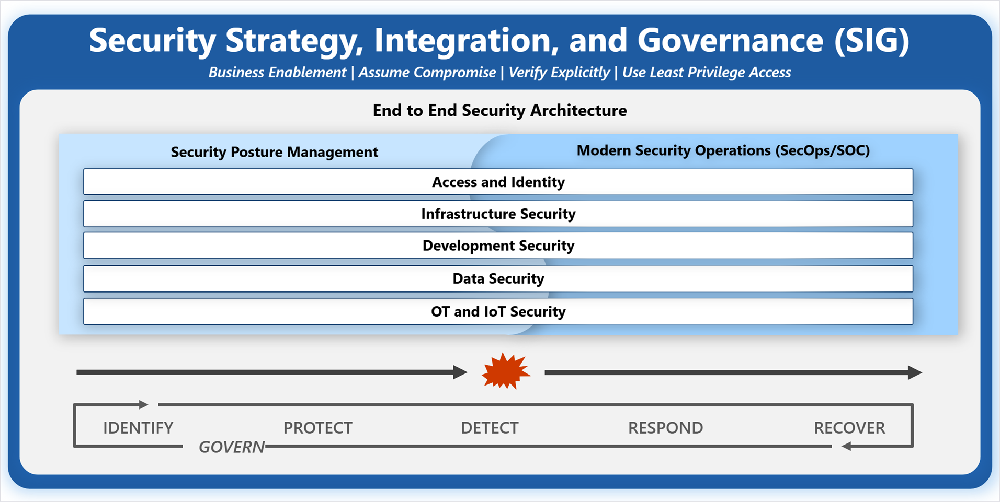
To be effective, this discipline ensures that Zero Trust principles are applied consistently across all security disciplines and across the full security lifecycle. Rather than enabling isolated technical solutions, SIG aligns decisions, controls, and operations to a shared security model.
The following diagram illustrates how the Security Strategy, Integration, and Governance discipline enables security resilience by consistently applying Zero Trust principles across security disciplines and across the full security lifecycle.
Mission and outcomes
The Security Strategy, Integration, and Governance discipline provides direction, integration, and oversight across the full lifecycle of the security program. It enables organizations to:
- Set clear security vision and direction: Define security outcomes, priorities, and trade‑offs aligned to business objectives, risk tolerance, and regulatory obligations. Establish a shared understanding of what good security looks like for the organization, and how success is measured. Update that understanding as needed.
- Integrate security into the organization: Embed security into business planning, technology strategy, architecture, development, operations, and partner ecosystems so it is not treated as an afterthought or standalone function.
- Govern security decisions and investments: Establish decision rights, accountability, policies, standards, and success measures that drive consistent prioritization and execution across security and technology teams.
- Enable better, faster business decisions: Act as a central hub for security risk context, helping leaders balance opportunity, risk, and cost and say “yes, safely” to new initiatives.
- Improve prioritization and focus: Translate business priorities into actionable security strategy, policies, and standards so teams focus on the most important risks rather than the most visible or urgent issues.
- Adapt to change: Continuously update strategy, roadmaps, architectures, and governance to address evolving threats, new technologies (including AI), regulatory changes, and shifting business priorities.
- Reduce incident impact: Improve consistency, coordination, and accountability across the security program, reducing the frequency and severity of incidents and improving recovery outcomes.
How to apply this discipline
To apply the Strategy, Integration, and Governance discipline effectively, focus on establishing clear direction, accountability, and alignment across the organization:
- Define security strategy aligned to business priorities and risk
Establish clear objectives that reflect organizational goals, critical assets, and the most significant risks to the business - Establish governance and accountability across teams
Define roles, responsibilities, and decision-making structures to ensure security efforts are coordinated and consistently executed - Set policies and standards that guide consistent execution
Provide clear expectations that ensure security controls and practices are applied consistently across the organization. - Align security efforts across disciplines and initiatives
Ensure that architecture, operations, and engineering efforts work toward shared outcomes rather than operating in isolation. - Measure progress and continuously improve
Use metrics, risk insights, and operational feedback to track effectiveness, drive prioritization, and refine strategy over time.
Manage organizational change
This discipline helps organizations shift from checkbox compliance toward business‑aligned risk management, while still meeting regulatory obligations.
Modernizing in this way reduces wasted effort on low‑value controls, clarifies accountability, and ensures security decisions are made by the right stakeholders with the right context. Over time, this makes security easier to operate, more effective, and more sustainable.
Organizations can also shed legacy burdens—such as maintaining ineffective controls or informally absorbing accountability for decisions made elsewhere—and replace them with a clearer, more resilient operating model.
Discipline roles and collaborators
This discipline is primarily owned by security leadership responsible for setting direction, integrating security into the organization, and governing execution. In larger organizations, these responsibilities are distributed across formal roles and processes. In smaller organizations, roles may be combined and strategy developed more informally. Regardless of scale, documenting strategy as it evolves is strongly recommended.
Primary roles commonly include:
- Chief Information Security Officer (CISO)
- Business Information Security Officers (BISO)
- Security Directors
- Security Architects
These roles are supported by functions such as security strategy, integration and governance, education and engagement, insider risk management, security posture management, and security compliance management.
Effective delivery depends on close collaboration across the organization:
- Business leaders provide context on priorities and risk tolerance.
- Technical leaders integrate security into technology strategies and operating models.
- Architecture roles translate strategy into standards and guardrails and provide feasibility feedback.
- Engineering and IT teams operationalize requirements through implementation and maintenance.
- Security operations (SecOps) provide continuous feedback from incidents, threats, and attacker behavior to inform strategy and governance.
Discipline components
The Security Strategy, Integration, and Governance discipline encompasses a broad set of capabilities that together ensure consistent, measurable security outcomes.
| Capability | Details |
|---|---|
| Continuous prioritization | Continually prioritize requirements for: - Business alignment: Ensure that security is a business enabler. Drive the business changes needed for security. - Technology alignment: Align security risk assessment and management with organizational technology. - Secure by design and by default: Ensure that security is an integral aspect of all system and process design. - Ensure privacy by design/default: Ensure that privacy is an integral aspect of all system and process design. - Compliant by design/default: Ensure that compliance is an integral aspect of all system and process design. |
| Continuous planning | Maintain intentional, regularly updated security roadmaps and success metrics. |
| Business/technology operating model integration | Embed security into ideation, business requirements definitions, design, build, and operations rather than applying controls after deployment. |
| Enterprise risk integration | Integrate security into how risk is identified, managed, and reported to leadership, regulators, and stakeholders. |
| Lifecycle and technical debt management | Manage security risk from outdated, unsupported, and legacy technologies. |
| Strategic security simulations | Strengthen tabletop and crisis‑management processes through regular simulations. |
| Core governance components | Define organizational structure, decision rights, accountability, policies, standards, architectures, guardrails, and compliance management. |
| Security intelligence sharing | Add business context to threat intelligence and share insights across security, business, and technology teams. |
| External risk management | Manage supply chain, partner, open‑source, and merger and acquisition risks. |
| Education and engagement | Ensure roles across the organization understand why security matters, what is required, and how to act. |
| Insider risk management | Manage risks from authorized users who may intentionally or unintentionally cause harm. |
| Security operations oversight | Provide oversight of posture management, operations, and architecture, and measure whether controls are effectively deployed and sustained. |
Alignment with other disciplines
The Security Strategy, Integration, and Governance discipline works across all of the other security disciplines. Its role is not to replace or duplicate their responsibilities, but to provide oversight that enables, integrates, prioritizes, and monitors consistent outcomes across the security program.
| Discipline | Role |
|---|---|
| End-to-end security architecture | Translates strategy and policy into a coordinated technical approach. It helps to ensure that strategy is actionable, prioritized, and clearly communicated to technology teams. |
| Technical strategy disciplines | Ensures technical decisions align to business priorities, risk tolerance, and policy, with trade‑offs made intentionally rather than in isolation. |
| Operational disciplines | Connects operational signals—incidents, detections, attacker behavior—back to leadership decisions, enabling continuous improvement of strategy and controls. |
Alignment with technology pillars
At the technology pillar level, the Security Strategy, Integration and Governance discipline ensures that:
- Controls align with organizational strategy, policy, and standards.
- Implementation remains consistent over time and doesn't drift.
- Continuous improvement is driven across strategy, integration, and governance.
It aligns with these technology pillars:
- Identities: Defines identity risk priorities, access policies (including privileged access), lifecycle standards, and success measures aligned to Zero Trust.
- Endpoints/Infrastructure: Sets lifecycle, maintenance, and retirement requirements to manage security risk across endpoints and infrastructure platforms.
- Apps: Establishes consistent sourcing, development, deployment, and lifecycle standards across SaaS and custom applications.
- Data: Defines data protection priorities, classification, access models, and governance aligned to business value and risk.
- Network: Ensures network configurations and controls support identity‑centric strategies while managing legacy and modern network risks.
- AI: Updates security strategy, skills, tooling, and governance to address risks introduced by AI usage and AI‑assisted threats.
Next steps
We recommend taking the CISO workshop.
The CISO Workshop helps accelerate modernization of security strategy, integration, and governance. The workshop is available as an expert-led engagement from Microsoft Unified.
Workshops available include:
- CISO Briefing - A less than four-hour discussion focused on key learnings and best practices.
- Full CISO Workshop - A two-day workshop that provides additional details, a Microsoft case study, maturity model discussions, and reference modernization plans.
Contact your customer success account manager for more information.
The CISO workshop is also available for self-service as a series of videos. Learn more