Note
Access to this page requires authorization. You can try signing in or changing directories.
Access to this page requires authorization. You can try changing directories.
Adopting a Zero Trust security model is a strategic transformation that affects the entire organization, and requires clear ownership and coordination across business, security, and technology teams. It's not a single technology deployment or a one-time project. Successful adoption and operation depend on sustained leadership and the alignment of roles that plan, implement, and operationalize Zero Trust at scale.
This article describes the key organizational roles involved in Zero Trust adoption and explains how these roles work together to plan, implement, and operationalize Zero Trust at scale.
Why roles matter in adoption
Zero Trust shifts security from a perimeter-based model to one that continuously verifies users, devices, applications, data, and more. This shift affects business processes, user experiences, IT operations, and risk management.
Without clear roles and responsibilities:
- Security initiatives stall or fragment.
- Technology teams optimize locally instead of aligning to business and security priorities.
- Leaders lack visibility into security modernization progress and outcomes.
Defining role ownership helps translate Zero Trust strategy into coordinated action and measurable security improvements across the organization.
Security is everyone's job
Security is fundamentally a human discipline that manages risk from human threat actors. While automation and AI play important roles, people remain central to security outcomes.
- Security is an intrinsic part of every business area. It has fiduciary and risk implications, impacts business capabilities and execution, and all technologies.
- Security is everyone's job. From the board of directors to technology teams, nontechnical teams such as finance and legal, and information/frontline workers.
- For effective security risk management, every person must understand security in the context of their role, and actively support security objectives.
- Since anyone in the organization can create or amplify security risk, everyone must apply security principles in their daily actions and decisions.
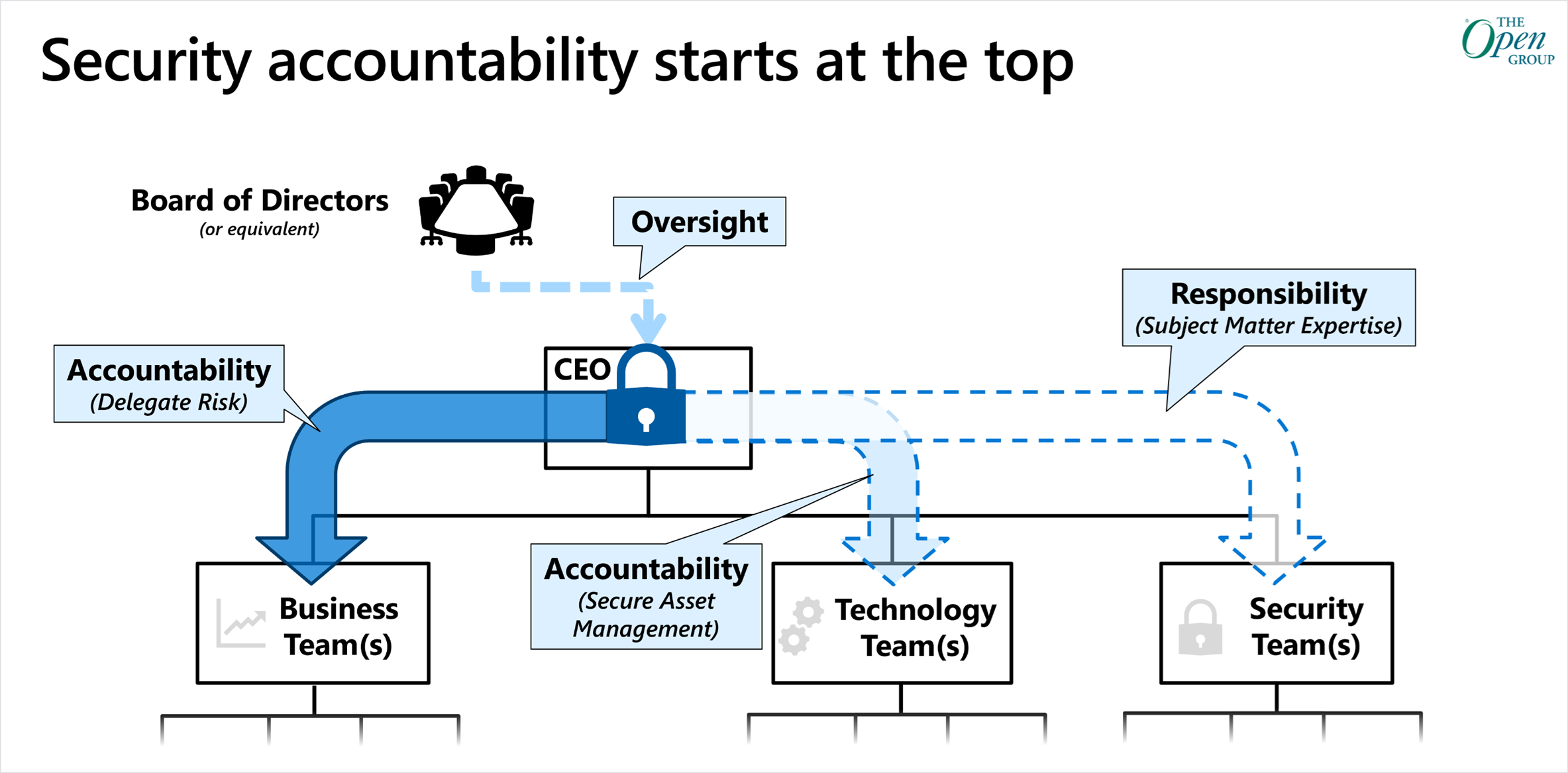
This diagram from the Open Group security roles and glossary standard illustrates how to delegate security accountability and responsibility across an organization:
Security is a team sport
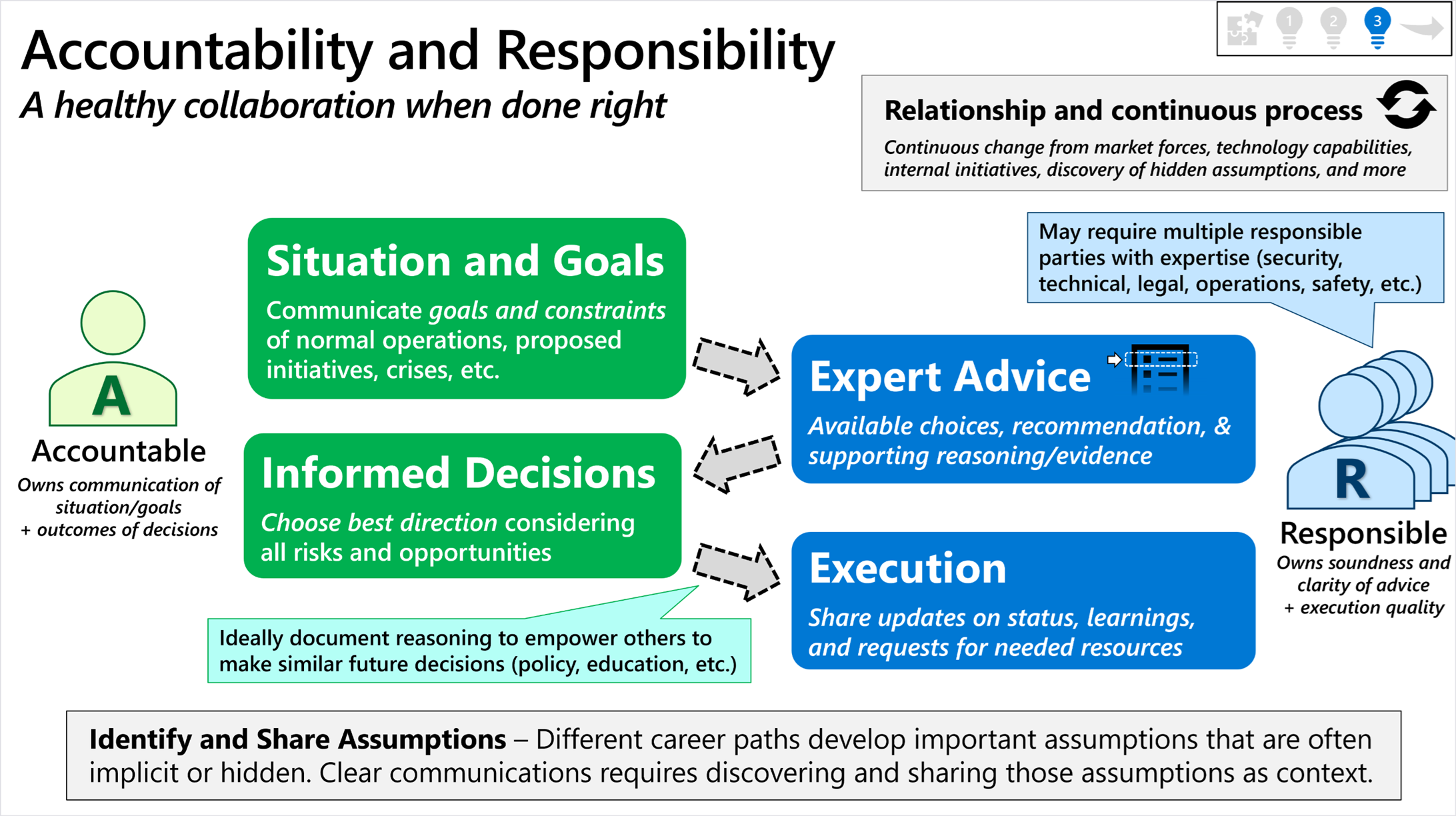
Managing security risk effectively requires accountability and collaboration:
- Collaboration between accountable and responsible parties is critical.
- Making good security decisions requires a healthy and relationship. Accountable decision-makers and security experts must be able to share ideas safely and challenge assumptions.
With these tenets in mind, security risk should be managed in a similar way to financial and legal risk. Each role has policies and education/training that guide their daily decisions, rather than assigning responsibility and even blame to security teams only.
Role definition outcomes
When roles are clearly defined, aligned, and connected:
- Leadership sets priorities and accountability.
- Business and risk functions align security to outcomes.
- Architecture and technical leadership design scalable solutions.
- Engineering and operations implement and sustain security controls.
- Security operations validate effectiveness.
- Everyone participates in protecting the organization.
Clear ownership and shared responsibility turn Zero Trust from an aspiration into a durable, measurable security strategy.
Roles and terminology
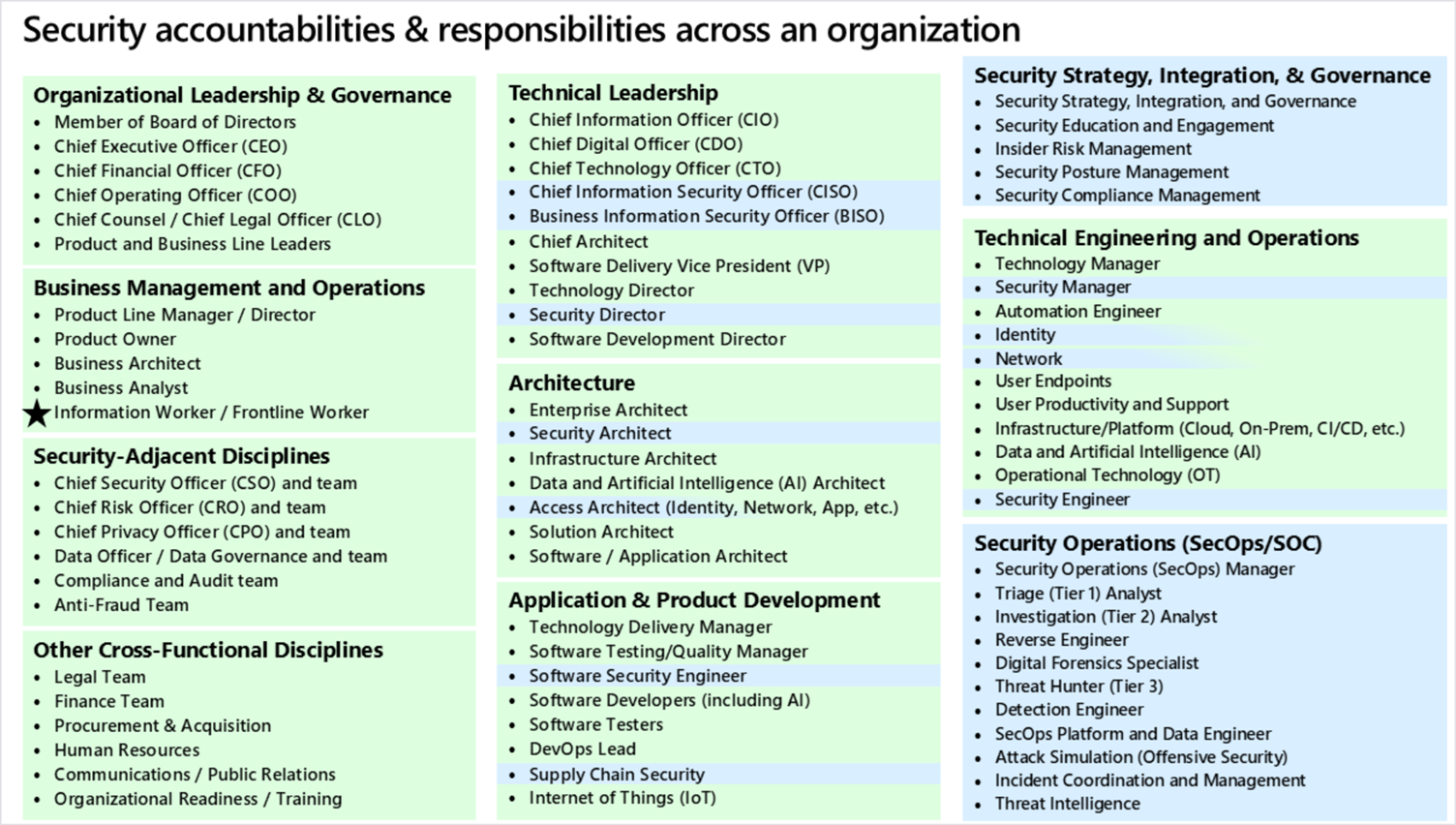
Role terminology and definitions are based on the Open Group Security Roles and Glossary Standard. This graphic illustrates the list of roles.
Role responsibilities
Organizational leadership and governance
Purpose: Establish organizational direction, priorities, and governance, including decision rights and accountabilities. Executive leadership establishes Zero Trust as an organizational priority and creates the conditions for long-term success.
Accountabilities include:
- Sponsoring Zero Trust as a business and risk-management strategy.
- Aligning security objectives with business goals, regulatory obligations, and risk tolerance.
- Providing sustained funding, staffing, and organizational support.
- Establishing governance models and accountability structures.
- Holding leaders responsible for measurable security outcomes.
When leadership treats Zero Trust as a business enabler rather than a technical project, adoption gains momentum and durability.
Business management and operations
Purpose: Embed Zero Trust into day-to-day business execution. Business leaders and operational managers ensure that Zero Trust supports productivity, customer trust, and operational resilience.
Accountabilities include:
- Integrating Zero Trust requirements into business processes and workflows.
- Balancing security controls with user experience and operational efficiency.
- Identifying critical business assets, processes, and data to prioritize protection.
- Supporting change adoption across teams and functions. Measuring business impact of security decisions.
Zero Trust succeeds when security enables business operations instead of being perceived as an obstacle.
Security-adjacent leadership
Purpose: Security-adjacent leadership roles such as Chief of Staff, Chief Product Officer, Chief Compliance/Audit officer align security strategy with enterprise risk, compliance, and privacy objectives.
These roles connect Zero Trust to broader enterprise risk management and assurance functions.
Accountabilities include:
- Translating Zero Trust principles into risk, compliance, and privacy requirements.
- Ensuring alignment with regulatory, legal, privacy, and other industry obligations.
- Validating controls through audit, assessment, and assurance activities.
- Advising leadership on risk tradeoffs and residual risk.
- Coordinating across security, compliance, and governance domains.
Their involvement ensures Zero Trust is defensible, auditable, and aligned with organizational obligations.
Other cross-functional disciplines
Purpose: Non-technical disciplines such as legal, finance, PR, and communications align Zero Trust adoption across nontechnical business support functions. Zero Trust impacts contracts, budgets, communications, and external trust.
Accountabilities include:
- Legal: supporting data protection, contracts, regulatory interpretation, and incident management processes.
- Finance: funding models, cost governance, investment prioritization, and security risk quantification.
- Communications and PR: internal and external messaging during incidents or changes.
- HR and people teams: policy enforcement, training alignment, and workforce engagement.
These roles help ensure Zero Trust adoption is sustainable, compliant, and well-communicated.
Technical leadership
Purpose: Translate strategy into executable technical direction. Technical leaders bridge business intent and engineering execution.
Accountabilities include:
- Defining strategic requirements aligned to Zero Trust outcomes, and approving strategic roadmaps and strategy.
- Ensuring coordination on Zero Trust approaches across domains and engineering teams.
- Advising business stakeholders on tradeoff decisions between security, performance, and usability.
- Ensuring consistency across identity, endpoint, application, data, and infrastructure domains.
- Supporting modernization of legacy systems.
Strong technical leadership prevents siloed implementations and fragmented security posture.
Architecture
Purpose: Design scalable, coherent solutions that align to Zero Trust principles. Security and enterprise architects collaboratively define enterprise-wide architecture and solutions.
Accountabilities and responsibilities include:
- Defining target-state Zero Trust architectures.
- Aligning platforms, services, and workloads to Zero Trust principles and concepts.
- Identifying architectural gaps, dependencies, and integration points.
- Providing design guidance and reference patterns.
- Ensuring solutions scale with business and technology change.
Architecture turns principles into systems that can evolve over time.
Application and product development
Purpose: Build Zero Trust into applications and services by design. Development teams play a critical role in enforcing Zero Trust at the application layer.
Accountabilities include:
- Designing applications that verify explicitly and enforce least privilege.
- Integrating identity, access control, and data protection into applications.
- Supporting secure APIs, service-to-service access, and workload identities.
- Partnering with security teams to reduce risk without harming velocity.
- Addressing security early in the development lifecycle.
- Using secure workstations and CI/CD systems.
Zero Trust is strongest when applications assume no implicit trust.
Security strategy roles and responsibilities
Purpose: Security strategy roles such as security education, insider risk, posture, and compliance management help shape long-term security behavior and maturity. These roles focus on people, policy, and sustained security effectiveness.
Responsibilities include:
- Defining security strategy, standards, and roadmaps.
- Managing insider risk and user-related threats.
- Driving security awareness, education, and culture.
- Monitoring security posture and driving improvements.
- Overseeing security compliance and policy enforcement.
- Measuring maturity and progress against Zero Trust objectives.
They ensure Zero Trust becomes embedded in how the organization operates, not just how it deploys technology.
Technical engineering and operations
Purpose: Implement and operate Zero Trust controls. Engineering and operations teams turn designs into functioning systems.
Responsibilities include:
- Deploying security controls across identity, devices, applications, data, and infrastructure.
- Integrating security into operational workflows and platforms.
- Managing change, testing, and roll out to minimize disruption.
- Maintaining system reliability, availability, and performance.
- Continuously improving controls based on feedback and telemetry.
These teams make Zero Trust real and reliable.
Security operations (SecOps / SOC)
Purpose: Apply an asset-centric Zero Trust approach to threat detection and response. Security operations teams respond to attacks that evade preventative controls.
Responsibilities include:
- Monitoring telemetry and signals across users, devices, and workloads.
- Detecting threats, policy violations, and anomalous behavior.
- Responding to incidents and coordinating containment and recovery.
- Feeding operational insights back into policies, architecture, and automation.
- Measuring effectiveness through detection, response, and impact metrics.
Zero Trust assumptions are tested and refined through daily operations.
Next steps
- Select a business scenario, and then review the disciplines and roles associated with the scenario.
- Alternatively, review the breadth of disciplines involved in security adoption.