Note
Access to this page requires authorization. You can try signing in or changing directories.
Access to this page requires authorization. You can try changing directories.
Applies to: Developer
Add the SharePoint Embedded MCP server to a coding agent with one click:
Using the pre-release build? Add the server to Visual Studio Code Insiders.
For other MCP clients, register the server with the same npx command:
# Claude Code
claude mcp add spe -- npx -y @microsoft/spe-mcp start

# OpenAI Codex CLI
codex mcp add spe -- npx -y @microsoft/spe-mcp start
Install the SharePoint Embedded extension for Visual Studio Code to create a container type, configure the owning app and billing, register the container type, create containers, and load a sample app from a guided view in the editor:
Create a SharePoint Embedded container type for your application to create containers or store files. A container type defines access, billing accountability, and selected behaviors for containers created by your app.
If you're just starting, complete Quickstart: Build your first app with VS Code. Then use this article for trial, standard, and pass-through decisions.
To decide between single-tenant and multitenant models first, see Choose an app model.
Understand the container type relationship
A container type is strongly coupled with one Microsoft Entra ID application, called the owning application.
SharePoint Embedded requires a one-to-one relationship between one owning application and one container type.
The container type ID is stored on each container as an immutable property.
SharePoint Embedded uses the ID for access authorization, trial exploration, billing, and configurable behaviors.
Note
The Microsoft Graph API — Create fileStorageContainerType — is delegated-only and can be called by any non-guest owning-tenant user. The caller doesn't need an administrator role and is automatically assigned as an owner of the new container type.
Choose trial or production
Choose the container type purpose when you create it.
You can't convert a trial container type to production later.
You can't change a container type from standard billing to pass-through billing later.
| Use case | Container type |
|---|---|
| Local proof of concept | Trial container type |
| Developer tenant pays | Container type with standard billing |
| Consuming tenant pays | Container type with pass-through billing |
Important
If you choose the wrong purpose or billing model, you must recreate the container type.
Prerequisites
Before you create a container type, make sure you have:
- A Microsoft 365 tenant with SharePoint available.
- A Microsoft Entra ID app registration for the owning app.
- A non-guest member account in the owning tenant.
- For standard billing, an Azure subscription and resource group.
- To manage billing for an existing standard container type as a non-administrator, be an owner of that container type. SharePoint Embedded Administrators and Global Administrators can manage any standard-billed container type in the developer tenant.
- For standard billing setup, Owner or Contributor access to the Azure subscription.
Note
Creating a container type through Microsoft Graph requires only the
FileStorageContainerType.Manage.Alldelegated permission. Any non-guest user in the owning tenant can create one and is automatically assigned as an owner of that container type. For tenant-wide administrative operations, see Create apps with PowerShell.Users who authenticate into containers must exist in Microsoft Entra ID as members or guests. An Office license isn't required to collaborate on Office documents stored in a container, except for documented exceptional experiences such as mentions.
Create a trial container type
Use a trial container type for evaluation.
You can create one with the SharePoint Embedded Visual Studio Code extension or Microsoft Graph.
The Visual Studio Code path is fastest for a first app. See Quickstart: Build your first app with VS Code.
For Microsoft Graph, create the container type with the trial billing classification.
The following restrictions apply to trial container types:
- The tenant can have up to five containers of the container type. This includes active containers and those in the recycle bin.
- Each container has up to 1 GB of storage space.
- The container type expires after 30 days, and access to any existing containers of that container type is then removed.
- The developer must permanently delete all containers of an existing container type in trial status to create a new container type for trial. This includes containers in the deleted container collection.
- The container type is restricted to work in the developer tenant. It can't be deployed in other consuming tenants.
Create a container type with standard billing
Use standard billing when the developer tenant pays for consumption.
Each tenant can create up to 25 container types in total. One of these can be a free trial container type; the rest are standard (billed) container types.
- Create or identify the owning Microsoft Entra ID application.
- Create the container type with the
standardbilling classification. - Manage billing on the container type. The SharePoint Embedded Visual Studio Code extension and the SharePoint Embedded Model Context Protocol (MCP) server enable billing management for standard-billed container types. SharePoint Embedded Administrators and Global Administrators can also use PowerShell to manage billing.
- Record the container type ID.
- Continue to registration in the consuming tenant.
Note
If billing setup fails with SubscriptionNotRegistered, wait several minutes and retry. The Microsoft.Syntex resource provider registration can take time.
Create a pass-through billing container type
Use pass-through billing when the consuming tenant pays for consumption.
- Create or identify the owning Microsoft Entra ID application.
- Create the container type with the
directToCustomerbilling classification. - Register the container type in the consuming tenant.
- Have a Billing Administrator or Global Administrator in the consuming tenant activate pay-as-you-go services.
Important
The consuming tenant must complete billing setup before a pass-through application can be used successfully.
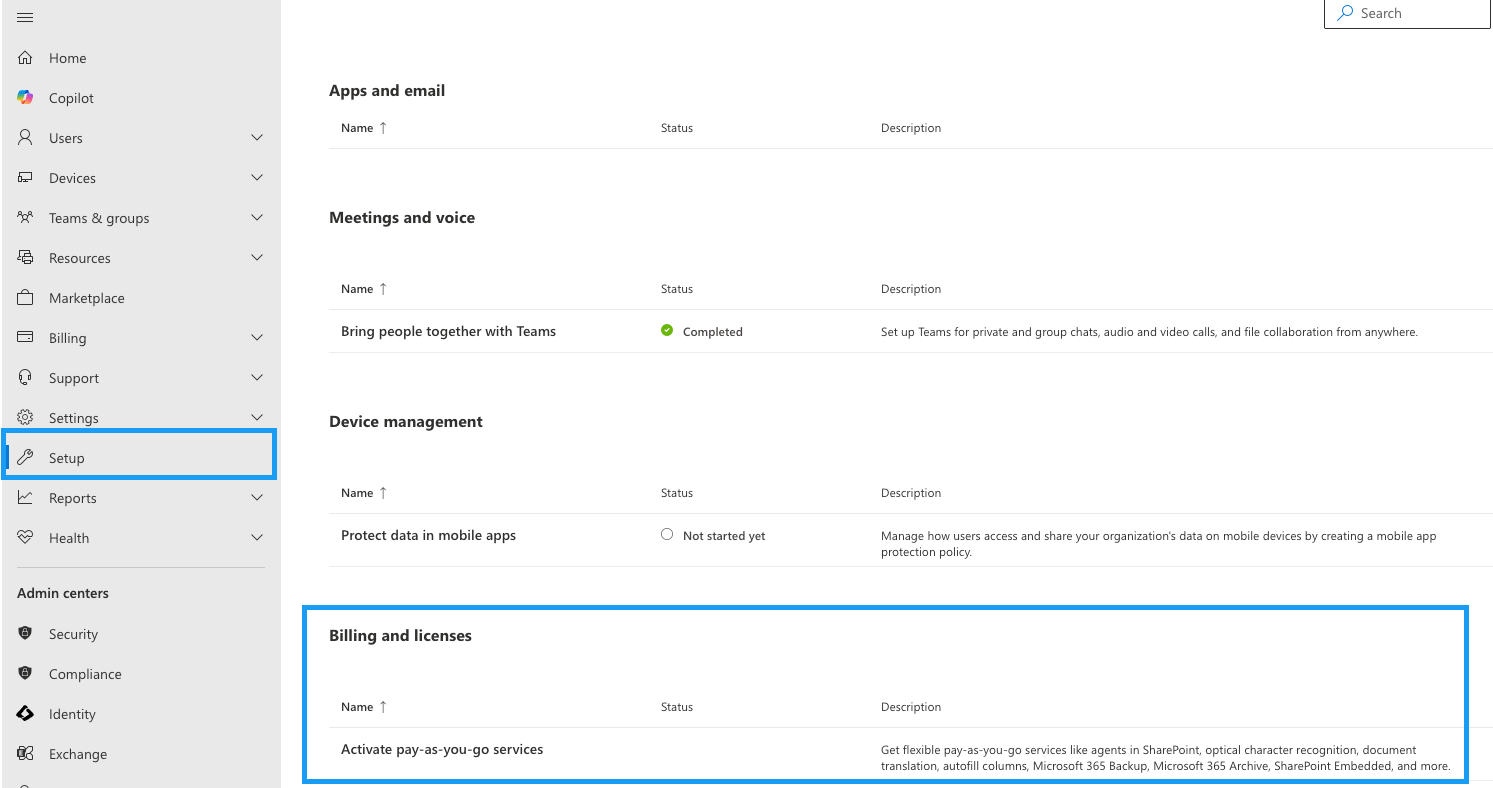
A Billing Administrator or Global Administrator in the consuming tenant activates pay-as-you-go services in the Microsoft 365 admin center. In Setup > Billing and licenses, select Activate pay-as-you-go services.
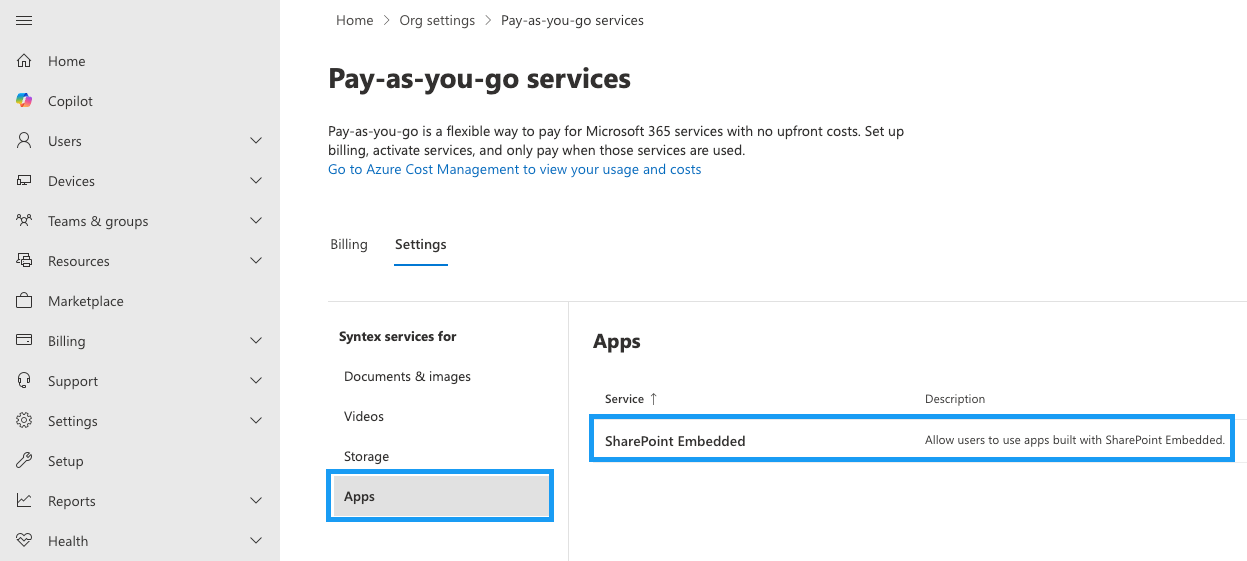
Under Syntex services for, select Apps, then select SharePoint Embedded to enable billing for the app.
Configure the owning Microsoft Entra ID app
Configure the app so it can own exactly one container type.
Request Microsoft Graph permissions for SharePoint Embedded access.
Request Microsoft Graph FileStorageContainerTypeReg.Selected application permission for container type registration on consuming tenants.
Use redirect URIs that match your development and production clients.
Use credentials appropriate for delegated or app-only flows.
For auth details, see Configure authentication and authorization.
Set basic properties
| Property | Guidance |
|---|---|
| Container type name | Use a durable name that maps to your workload. |
| Owning application ID | Use the app registration that owns this type. |
| Application redirect URL | Use the URL where files from this app should redirect. |
| Billing model | Choose trial, standard billing, or pass-through billing at creation time. |
Caution
The container type ID and owning application ID can't be updated later.
Configure container type behavior
Developers can configure selected behaviors after creation.
Available settings include:
urlTemplateisDiscoverabilityEnabledisSharingRestricted
Use the Microsoft Graph Update fileStorageContainerType API for supported container type updates. For tenant-wide administrative settings, see Create apps with PowerShell.
Important
Updating settings on a container type can take up to 24 hours to replicate to all consuming tenants. If a consuming tenant applied setting overrides, those overrides remain in place. Some settings apply only to new content, not to existing content.
View and update container types
Use Microsoft Graph to list and update container types.
A non-administrator container type owner can update container types they own. They can also create and manage the standard billing profile.
The owner needs Owner or Contributor access to the Azure subscription for billing changes.
Manage container types with Microsoft Graph
You can also manage container types with the fileStorageContainerType Microsoft Graph APIs.
| Operation | API |
|---|---|
| Create a container type | Create fileStorageContainerType |
| List container types | List fileStorageContainerType |
| Update a container type | Update fileStorageContainerType |
| Delete a container type | Delete fileStorageContainerType |
List results are filtered by ownership. Non-administrator users see only the container types they've been granted permission on, while SharePoint Embedded Administrators and Global Administrators see every container type in the tenant. For the settings you can configure, see fileStorageContainerTypeSettings.
You can delete only trial container types; deletion of standard container types isn't yet supported. Before you delete a container type, remove every container of that type, including containers in the deleted container collection.
Understand billing dependency
For standard billing, the developer tenant attaches an Azure subscription and resource group.
For pass-through billing, the consuming tenant activates pay-as-you-go services.
For details, see SharePoint Embedded meters and SharePoint Embedded billing management.
Link to multitenant onboarding
A multitenant app usually has an owning tenant and one or more consuming tenants.
Use this sequence for each consuming tenant:
- Create the container type in the owning tenant.
- Ask the consuming tenant admin to grant admin consent.
- Register container type application permissions.
- Configure pass-through billing when the consuming tenant pays.
- Validate container creation and access.
Next steps
Register permissions in Register application permissions.