Introduction
Contoso Financial Services has dozens of AI agents operating across its Microsoft environment. Some created by IT, others built by business units using Copilot Studio, and a few introduced by external integrations. The security team can name some of them—but not all. And when the Security Officer asks what would happen if one of those agents was compromised, the team can't answer with confidence.
What data could an attacker reach through that agent? What systems could they pivot to? Without a clear picture of each agent's blast radius and potential attack paths, the team can't prioritize which agents present the greatest risk—or know where to start remediating.
Microsoft Defender XDR extends its asset inventory to include AI agents, giving security teams a centralized view of which agents are running in their environment and what risks they represent. The AI agent inventory surfaces agent identities, their associated product sources, and the risk signals that indicate how much damage a compromised agent could cause.
Learning objectives
In this module, you learn how to:
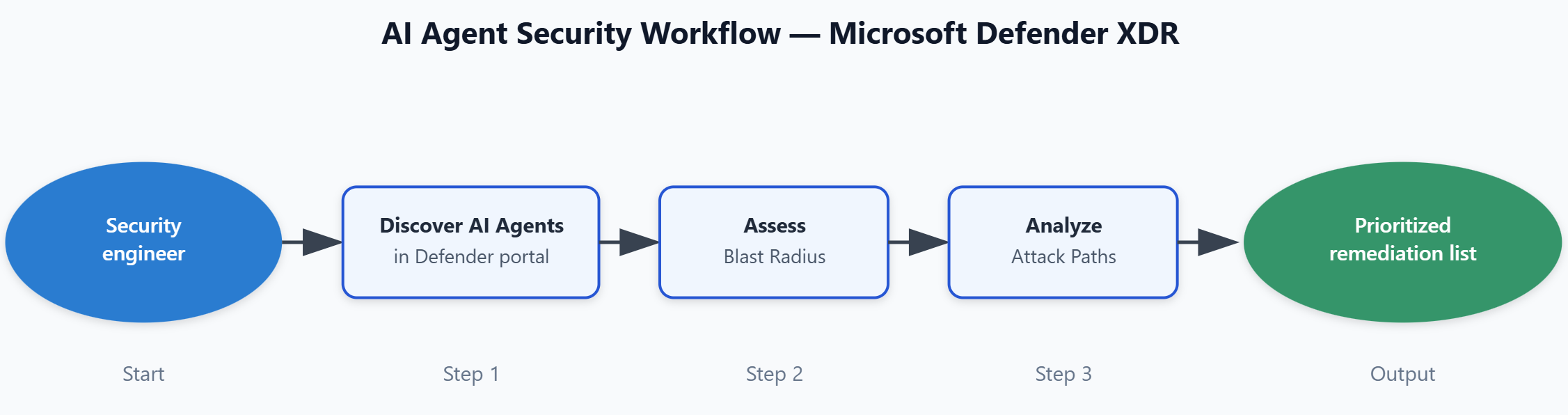
- Discover AI agents in Microsoft Defender XDR using the AI agent inventory
- Assess the blast radius of agent identities by examining permissions, knowledge sources, and blueprint configuration
- Analyze attack paths that could result in unauthorized access if an agent identity is compromised
Prerequisites
Before you begin, you should have:
- Understanding of Microsoft Entra Agent ID concepts
- Familiarity with Microsoft Defender portal navigation
- Basic knowledge of identity-based attack paths and risk assessment