Introduction
An application volume group is a framework designed to streamline the deployment of application volumes. Application volume group provides technical improvements to simplify and standardize the volume deployment process for your application, ensuring optimal placement in the regional or zonal infrastructure and in accordance with best practices for the selected application or workload.
Key components
Let's go over about the key components of application volume groups.
Volumes
The fundamental building blocks within an application volume group are individual volumes. These volumes store application data and are organized based on specific characteristics and usage patterns.
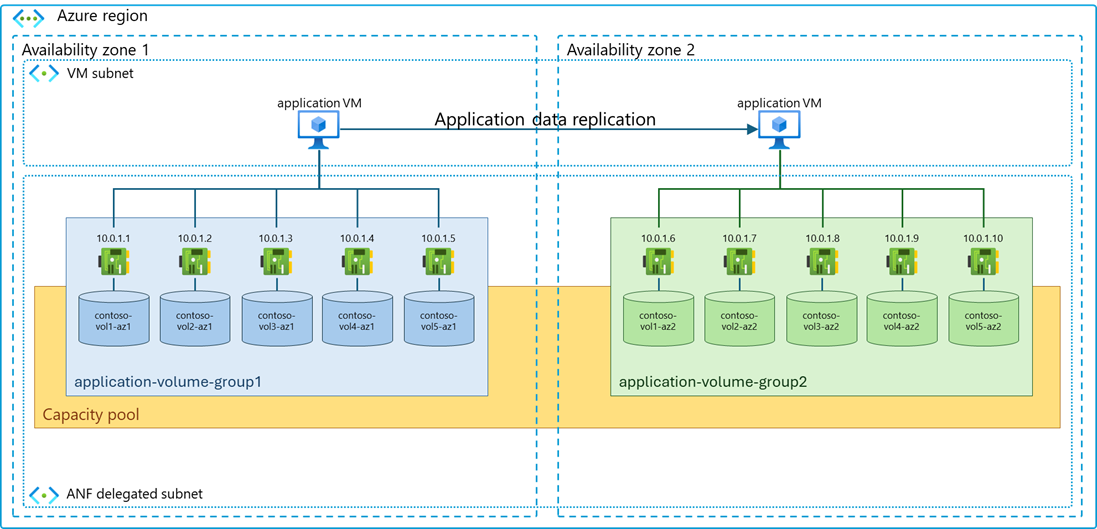
The following diagram shows an example layout of volumes deployed by an application volume group, which includes application volume groups provisioned in a secondary availability zone.
Grouping logic
Application volume group employs a logical grouping algorithm, allowing administrators to categorize and deploy volumes based on shared attributes such as application type and application specific identifiers.
The algorithm ensures that application load is spread over available resources for optimal results.
Volume placement
Volumes are placed in optimal infrastructure locations, following best practices, ensuring the best application performance from small to large scale deployments.
Infrastructure locations are determined based on the selected availability zone and available network and storage capacity. Volumes that require the highest throughput and lowest latency are spread across available storage endpoints to mitigate network contention.
Policies
Application volume group operates under predefined policies that govern the placement of the grouped volumes. These policies can include performance optimization, data protection mechanisms, and scalability rules, which can't be followed using individual volume deployment.
Performance optimization
Within the application volume group, volumes are placed on underlying storage resources to optimize performance for the application.
Availability and redundancy
Volume placement within the application volume group enables administrators to enhance availability and redundancy for critical application data. By distributing volumes across multiple storage resources, administrators can mitigate the risk of data loss or downtime due to hardware failures, network disruptions, or other infrastructure issues.
Data locality and latency optimization
Volume placement within the application volume group allows you to optimize data locality and minimize latency for applications with stringent performance requirements.
Cost optimization
Volume placement strategies within the application volume group enable you to optimize storage costs by matching workload requirements with appropriate storage tiers. By placing volumes on the most cost-effective storage tier that meets performance requirements, you can maximize resource utilization and minimize operational expenses.
Flexibility
After deployment, volume sizes and throughput settings can be adjusted like any other volume at any time without service interruption. This is a key attribute of Azure NetApp Files.
Compliance and data residency
Volume placement within the application volume group enables organizations to address compliance and data residency requirements by specifying the geographical location or Azure region where data should be stored.
Constrained zone resource availability
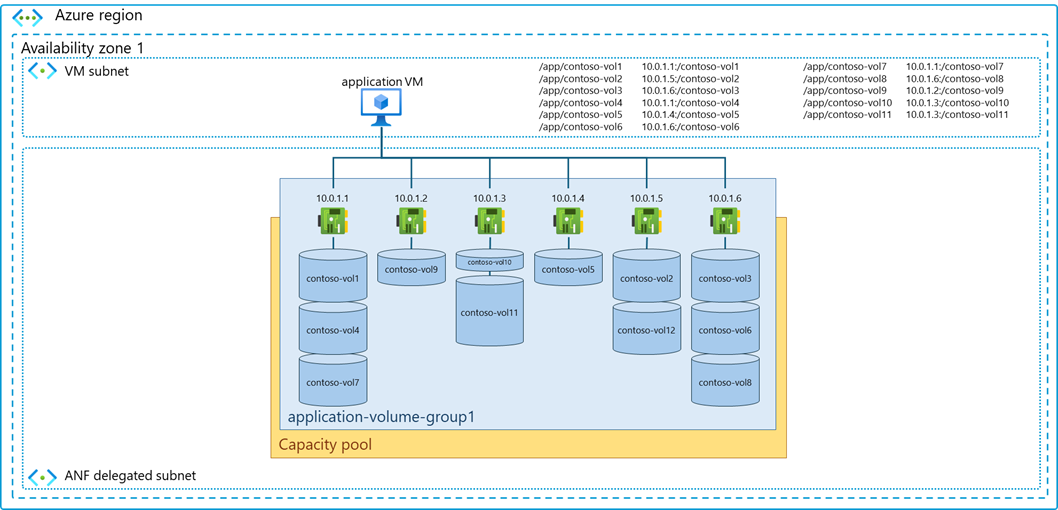
Upon execution of volume deployment, application volume group detects available resources and applies logic to place volumes in the most optimal locations. In resource-constrained zones, volumes can share storage endpoints:
The Azure NetApp Files application volume group feature empowers you to optimize deployment procedures, application performance, availability, cost, and compliance for application workloads.