Delegate responsibly
Priya's Autopilot is running now, and she isn't watching it. That's the point, and it's also why this part matters. Before you look away from something acting on your behalf, answer two questions. Can you trust what it produces, and what does it cost to leave running?
What stays with you
Autopilot has its own name and email address, and its work appears under that identity. Colleagues can tell its contributions from yours. That separation is useful, and it's easy to misread.
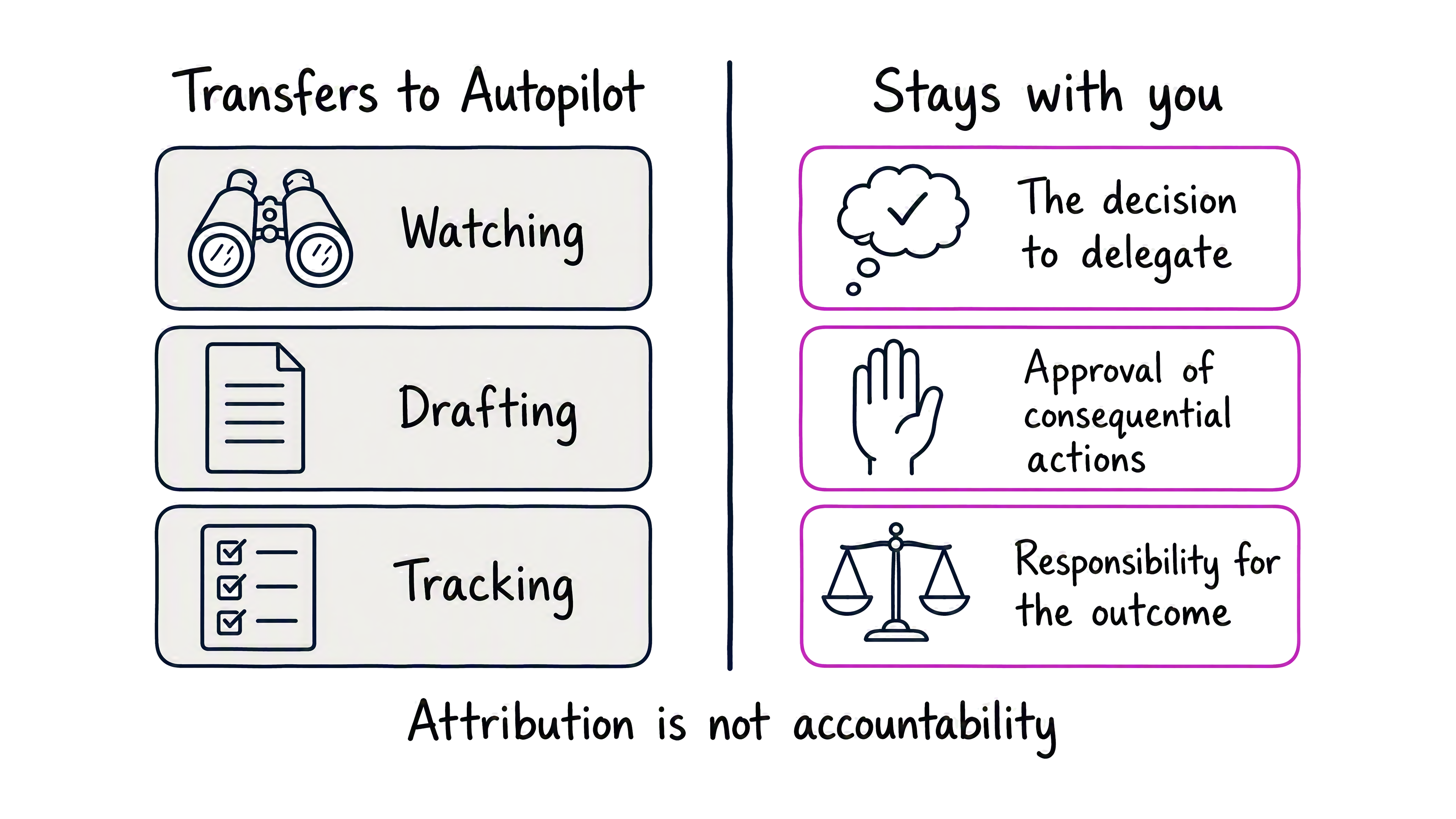
Attribution isn't the same as accountability. You decided what to delegate, how much authority to grant, and what to approve. Those decisions stay yours. Three things never move:
- The decision to delegate. Whether work suits an agent at all is your call, and nothing about the agent makes that call for you.
- Approval of anything consequential. Autopilot pauses before actions others would see, no matter how much authority you grant. That pause is there for your judgment.
- Responsibility for the outcome. Treat what it produces as a draft. AI-generated content can be incomplete or wrong, and a persistent agent produces more of it, not less.
What Autopilot can reach
Autopilot works inside the permissions you already have. It can't open a file, read a channel, or see a message you couldn't reach yourself. Your organization's policies apply to its work the same way they apply to yours.
That boundary is real, but it doesn't set your scope for you. You can already reach far more than any one project needs. An agent pointed at everything you can see will draw on everything you can see.
So point it at the work. Name the project, the channel, or the account. A narrow reach gives you sharper results, and it keeps information out of summaries where it doesn't belong.
Important
Review AI-generated content before you approve anything that sends, posts, or shares it. A persistent agent brings you more to review over time. The standard doesn't drop because the volume rises.
What it costs to keep running
Chat and Cowork spend when you ask. Chat answers a question. Cowork works through a task and finishes. In both, usage stops when the work stops.
Autopilot is different. It spends while you're away, because that's what you delegated it to do. Usage builds against your organization's Copilot budget every time it acts, not once when you set it up.
So scope isn't only about quality. It's about cost too. Three things drive the cost:
- Breadth. A brief that watches one project costs less than one that watches a portfolio.
- Sensitivity. A trigger that fires on any change costs more than one that fires only on changes that matter.
- Lifespan. An Autopilot still watching finished work spends on every pass and returns nothing.
If your organization hits its limit, work can pause until more budget is available. Check your usage from time to time. Treat a rising number as a prompt to narrow the brief rather than to ask for more budget.
Tip
The goal isn't to spend as little as possible. It's to keep what you spend proportionate to what comes back. A brief worth paying for is usually a brief worth reading.