How Study and Learn supports learning
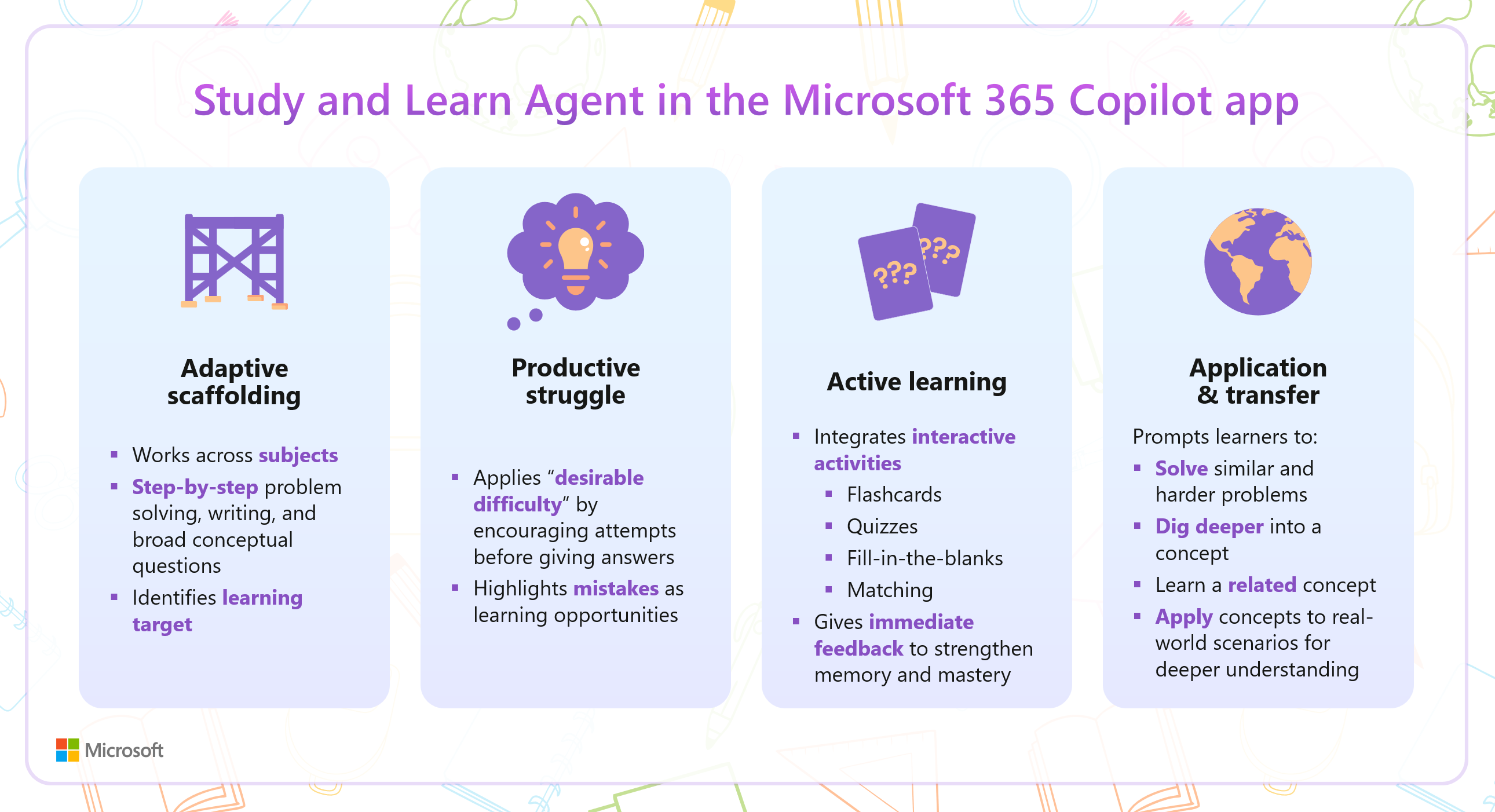
The Study and Learn Agent is intentionally built on core learning science principles to keep learners actively engaged in cognitive work. Its design emphasizes adaptive scaffolding, productive struggle, and retrieval-based practice, application, and transfer so learning feels supported, structured, and genuinely owned by the learner. The agent helps learners slow down their thinking just enough for deeper sense-making, without reaching frustration.
Adaptive scaffolding
Adaptive scaffolding supports learners by identifying learning goals, guiding them through step-by-step problem solving, working across subject examples, and assisting with writing and broad conceptual questions. This structure slows the thinking process just enough for learners to notice connections, build understanding, and stay focused without removing the productive effort required for learning.
Key elements:
- Prior knowledge checks connecting new learning
- Step-by-step guidance with actionable feedback
Productive struggle
Productive struggle introduces desirable difficulty by prompting learners to attempt explanations or solutions before receiving help. This encourages reflection, reveals misconceptions, and normalizes mistakes as essential learning opportunities. Redirection from the agent helps deepen conceptual clarity for learners.
Key elements:
- Attempts before solutions
- Opportunities to revise thinking
- Guided prompts that challenge understanding
Active learning
Active learning reinforces long-term memory by engaging learners with interactive tools like quizzes, flashcards, fill-in-the-blank tasks, and matching activities. Immediate feedback helps identify gaps early while strengthening fluency and mastery.
Key elements:
- Flashcards supporting spaced repetition
- Low stakes quizzes for retrieval
- Interactive activities to reinforce concepts
- Feedback loops that guide mastery
Application and transfer
Application and transfer activities guide learners to solve similar and harder problems. This process involves digging deeper into concepts, which allows learners to articulate and reinforce their understanding. By solving related problems, learners are encouraged to adapt and apply their knowledge in unfamiliar situations. Applying ideas to real-world scenarios further strengthens their ability to make connections and enhances the relevance of the material. Through these activities, learners are equipped to apply their learning in diverse settings as they develop a flexible and durable understanding that extends beyond the initial lesson.
Key elements:
- Teaching back concepts
- Applying ideas to new problems
- Real-world use cases for relevance
- Tasks that develop flexible thinking