Build community and enablement
Technology adoption is a people movement as much as a technology rollout. The most effective governance frameworks fail if the people using the platform don't understand it, trust it, or feel supported in using it. Building a community and delivering role-based enablement converts passive users into active, confident makers.
Build a maker community
A community of practice creates a self-sustaining engine for adoption. Makers help other makers, champions scale your enablement efforts, and the organization develops collective expertise that outlasts any individual team member.
Apply the flywheel strategy
The most effective communities operate as a flywheel: events attract participants, participants become champions, champions drive adoption, adoption creates demand for more events. Each cycle builds momentum that becomes increasingly self-sustaining.
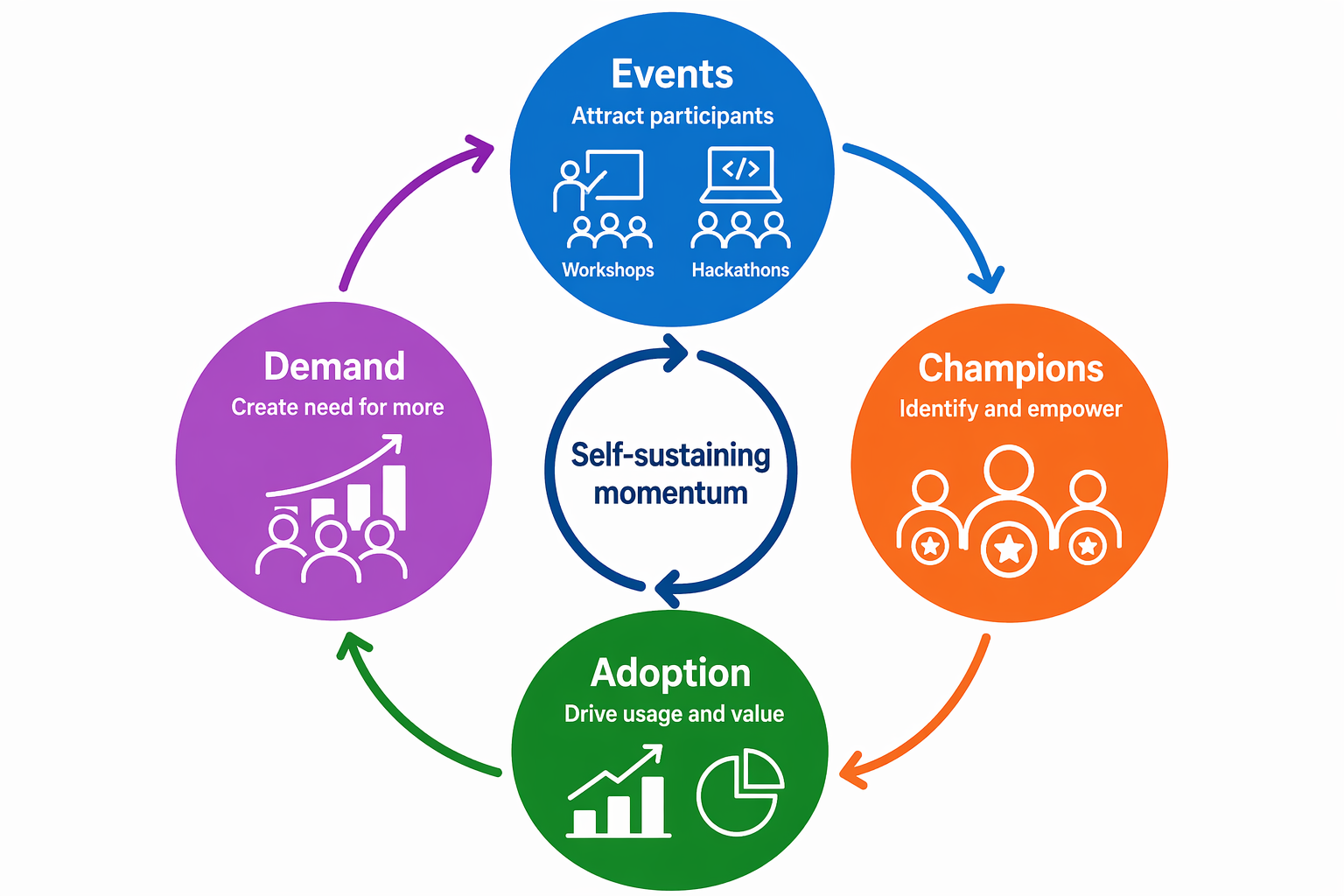
To launch the flywheel:
- Start with events - Host an initial workshop or hackathon that gives people hands-on experience with the platform in a supported environment.
- Identify champions - From those events, identify enthusiastic participants who show both skill and willingness to help others.
- Equip champions - Give champions early access to new features, dedicated communication channels with the platform team, and recognition for their contributions.
- Scale through champions - Champions become your distributed enablement network, answering questions, mentoring new makers, and evangelizing best practices in their departments.
Structure your community program
The Copilot Studio community framework identifies 10 strategic focus areas. For a Power Platform administrator standing up a community program, focus first on these foundations:
| Focus area | What to establish | Admin role |
|---|---|---|
| Purpose and alignment | Vision statement aligned to business priorities and AI adoption objectives | Define how the community connects to governance goals |
| Leadership and governance | Core team with defined roles (community lead, event coordinator, content creator) | Ensure community governance doesn't conflict with platform governance |
| Engagement programming | Regular cadence of Q&As, challenges, mentoring, and forums | Provide admin center access and sandbox environments for community use |
| Measurement and feedback | Track attendance, satisfaction, skills growth, and agent adoption | Supply platform analytics that show community impact on adoption metrics |
Create communication infrastructure
Use existing organizational tools to support your community at scale:
- Microsoft Teams - Dedicated channels for announcements, Q&A, show-and-tell, and office hours
- Viva Engage - Cross-organizational conversations that break down geographic and departmental silos
- SharePoint - Central hub for documentation, templates, governance guides, and training materials
- Microsoft Forms - Feedback surveys after events and training sessions
Tip
Don't build everything at once. Start with a single Teams channel for Q&A and a monthly event. Add infrastructure as participation grows and community needs become clearer.
Deliver role-based skilling
"Users" in Power Platform isn't one audience. Your enablement plan should explicitly skill the groups that introduce and experience change differently.
Skill by role and zone
| Role | Zone alignment | Skilling focus |
|---|---|---|
| New makers | Green zone | Safe defaults, guardrails, quick-start guidance, Personal Development Environments |
| Advanced makers and solution owners | Yellow zone | Collaboration patterns, solution ownership, lightweight ALM discipline |
| Professional developers | Red zone | Operational rigor, support readiness, controlled release practices, pipelines |
| End users | All zones | Trust, clarity about what agents and apps do, feedback mechanisms |
| Admins and platform operators | Cross-zone | Governance enforcement, monitoring, lifecycle controls |
Anchor skilling to moments that matter
Rather than treating training as a one-time event, design enablement around the decisions where users create risk or operational cost:
- Building - Where should I build? What's allowed in this environment and zone?
- Connecting - Which connectors and data sources are appropriate? What's restricted by policy?
- Sharing - Who can I share with? What ownership and support expectations change when I share?
- Promoting - How do I move from dev/test to production safely using solutions, pipelines, and validation?
- Incidents - How do I troubleshoot responsibly and escalate when something fails?
Each moment maps to a specific governance control you've already configured. Skilling connects the what (the policy) to the why (the risk it mitigates) and the how (the steps to follow).
Follow a phased training pattern
Structure enablement as a progression, not a single event:
- Onboarding - Tailored organizational skilling plan aligned to roles and business goals. Cover platform orientation, governance expectations, and where to get help.
- Skill building - Instructor-led training with real-time Q&A focused on the specific tools and patterns each role needs.
- Advanced enablement - Webinars, on-demand content, and hackathons for broad audiences ready to deepen their expertise.
Build a 90-day adoption plan
A structured 90-day plan gives you a repeatable framework for launching adoption initiatives, whether for a new team, a new capability, or a new governance policy.
| Phase | Timeline | Activities |
|---|---|---|
| Foundation | Days 1-30 | Identify champions, establish communication channels, run initial training, configure sandbox environments |
| Activation | Days 31-60 | First community event, champion onboarding, launch show-and-tell series, measure initial engagement |
| Scale | Days 61-90 | Expand champion network, introduce advanced training, publish first adoption dashboard, report business value |
Important
Skilling must be continuous. As policies evolve and solutions mature from personal productivity to shared and enterprise-managed use, refresh training materials and community guidance to reflect current governance expectations.
Overcome resistance to change
Resistance is a natural response to change, not a problem to eliminate. Address it by making governed behavior easier than ungoverned behavior:
- Reduce friction - Ensure governed paths (managed environments, pipelines, approved connectors) are faster and simpler than workarounds.
- Show value - Share success stories from makers who followed governed patterns and achieved faster deployment, fewer failures, or broader reach.
- Listen and adapt - Use feedback loops (surveys, office hours, community channels) to identify where governance creates unnecessary friction, then adjust policies to balance control with productivity.
- Celebrate early wins - Recognize makers and teams who demonstrate both innovation and compliance. Spotlight their work in community events and executive updates.