Plan a phased rollout across the organization
Relecloud ran a clean two-month pilot. Twenty early adopters used Copilot daily, feedback came back positive, and nothing went wrong during that window—the Marketing incident only surfaced once licenses reached the full 2,000-person tenant. That timing isn't a coincidence. A pilot of twenty hand-picked users never touches the same range of sites, permissions, and edge cases that 2,000 employees reach on day one. A clean pilot answers one specific question: does Copilot work well for a small, engaged group? It doesn't answer, and was never designed to answer, whether the tenant's full data estate is safe to expose at scale. Closing that gap takes a rollout that moves through three distinct phases, each doing a different job.
Sequence the three rollout phases
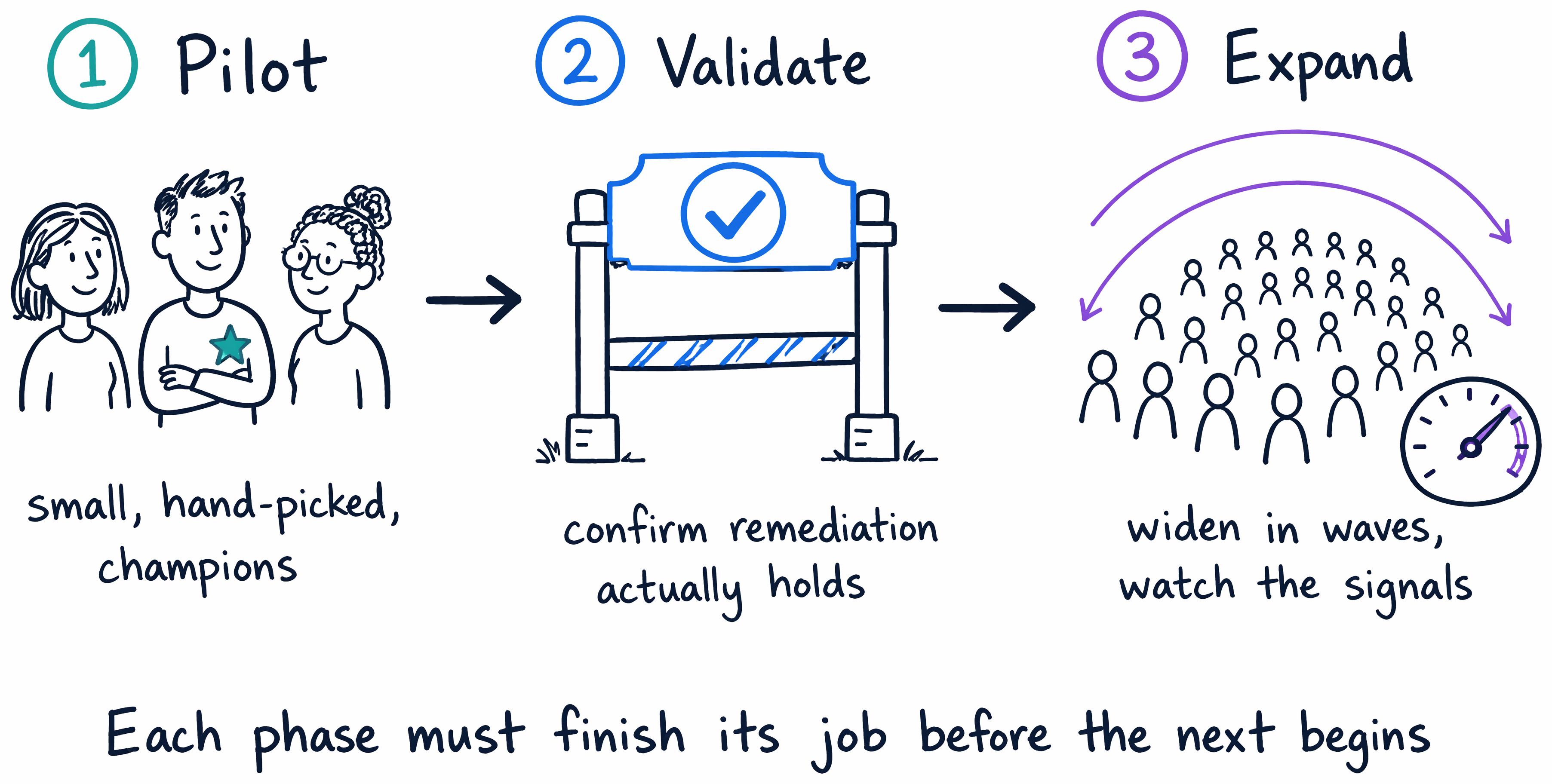
Pilot, validate, and expand each serve a different purpose in the rollout.
Pilot starts small on purpose. You identify early-adopter users across business groups—ideally people who already rely heavily on the Microsoft 365 features Copilot augments, such as Teams or Outlook—assign them licenses, and cultivate a handful of champions who can speak to Copilot's value in their own teams.
Validate confirms that what the pilot suggested actually holds up at scale. You interpret the Readiness and usage reports, gather structured feedback from pilot users, and confirm that the data-readiness remediation covered earlier in this module is actually in force, not just planned.
Expand assigns licenses to progressively larger groups. You monitor adoption and sentiment signals—the Copilot Dashboard in Viva Insights and the admin center's usage reports, for example—and adjust the pace based on what those signals show, instead of what the pilot predicted.
Each phase depends on the one before it completing its actual job, not just running out its clock. A two-month pilot that never validates its remediation work isn't a finished validate phase—it's a pilot that ran twice as long as it needed to.
Confirm remediation is real before you widen access
The validate phase is where this sequence earns its name as a risk-management tool rather than a project timeline. A positive usage report tells you Copilot is being adopted. It doesn't tell you the oversharing risk covered earlier in this module is actually closed. Those are two separate signals, and validate exists specifically to check both before expand puts a much larger population in front of whatever gaps remain.
Guiding question: Relecloud already ran a clean two-month pilot with strong feedback and no incidents. Does that mean it's safe to move straight to a company-wide expansion? Consider what the pilot's twenty users could actually test, and what expand exposes that they never did.
A clean pilot doesn't clear expansion on its own. The data-readiness remediation from earlier in this module still has to be complete first, regardless of how well the pilot performs, because the pilot's population was never the thing putting the tenant's full data estate at risk. The EEEU-shared support-ticket site was reachable by all 2,000 employees before the pilot even starts; twenty pilot users simply never open it. Only the remediation sequence—disabling EEEU, running access reviews, applying Restricted Access Control—actually closes that exposure. No amount of pilot success substitutes for that work.
Expand only after remediation holds
Once validate confirms the remediation is in force, expand becomes the phase where tenant-wide risk finally gets tested for real, because expand is what puts the full data estate in front of the full population. Assigning licenses in progressively larger waves—a department at a time, or a region at a time—gives you room to watch the Copilot Dashboard and admin center usage reports for anything the validate phase's smaller signal set couldn't reveal. If sentiment dips or a new access issue surfaces in one wave, you pause and investigate before the next wave goes out, rather than treating the rollout as a fixed calendar with a single go-live date.
That pacing is what turns phased rollout from a project-management convenience into a risk-management control. A single company-wide switch-flip exposes 2,000 employees to whatever gaps exist, all at once. A phased expansion, backed by a validate phase that already confirmed remediation, exposes that same population in stages you can actually monitor and correct.
Learn more about setting up Microsoft 365 Copilot and assigning licenses and the Microsoft 365 Copilot readiness report.
Bring the three checks together
Relecloud's Marketing incident doesn't come from a single mistake—it comes from treating three separate checks as one. Tenant readiness confirms that Copilot can reach its users. Data readiness confirms, only after deliberate remediation work, what Copilot can reach through those users. Phased rollout, sequenced through pilot, validate, and expand, confirms that expansion never outruns either of those checks. Each gate answers a question the other two can't, and clearing one never clears the others. A rollout that respects all three moves users onto Copilot at a pace the tenant can actually support, instead of a pace that only looks safe because nothing has gone wrong yet.