Why private cloud is back in the conversation
When organizations revisit their infrastructure strategy, it's not usually because existing systems have failed. It's more often because expectations around how infrastructure should operate have changed.
For instance, many Windows Server environments continue to be stable, reliable, and well understood by the organizations that use them. However, stability alone doesn't address emerging concerns around compliance, operational consistency, or long-term flexibility. When these pressures accumulate, private cloud scenarios are one natural answer.
Changing expectations for private cloud infrastructure
This simplified timeline takes a high-level view of how these concerns have shifted over time.
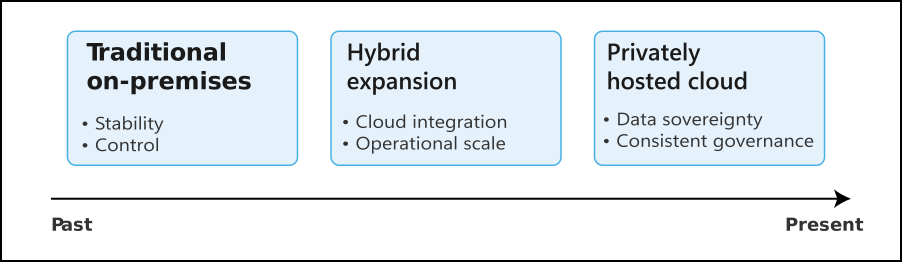
With that perspective in mind, here's a more detailed look at the elements shaping modern infrastructure conversations.
Changing pressures on infrastructure decisions
Several factors, which often overlap, contribute to a growing interest in private cloud approaches:
- Data residency and sovereignty requirements: Organizations operating across regions might be required to keep certain data within specific geographic or legal boundaries.
- Regulatory and compliance scrutiny: Industries such as finance, healthcare, and government might face strict controls over where and how workloads run.
- Operational control and visibility: Some teams need deeper insight into infrastructure operations, such as in-depth change tracking or other auditability features, than public cloud abstractions allow.
- Desire for cloud-aligned operations: IT leaders might want the governance, consistency, and management models associated with cloud environments, even when workloads remain on-premises.
These drivers don't automatically lead to a private cloud decision. Instead, they prompt a broader question—is our current approach still well suited for today's requirements?
An IT leader's starting point
Imagine you're an IT director responsible for a long-running Windows Server environment. The systems are stable, outages are rare, and past investments have paid off. Yet new conversations are emerging:
- Legal teams are asking how data location is enforced.
- Security teams want clearer alignment with cloud governance models.
- Executives are asking whether the organization is "cloud ready," even for on-premises workloads.
You're not being asked to start a migration or replace existing systems. Instead, you're being asked to evaluate options—including private cloud approaches.
Now, take a moment to reflect on your own organization. Which of the following pressures are present today?
- Regulatory or compliance requirements
- Data residency or sovereignty concerns
- Desire for consistent governance across environments
- Need for tighter operational control
If two or more of these pressures are present, this might indicate a growing case for private cloud evaluation.