How to select use cases
Identifying winning use cases is key to successfully using Machine Teaching to solve problems with large business value, aligned with the needs and strategy of the company.
To select a winning use case for Autonomous AI, we'll consider the following factors:
- It solves a high-value problem
- The level of suboptimization of the current automation
- Time to value
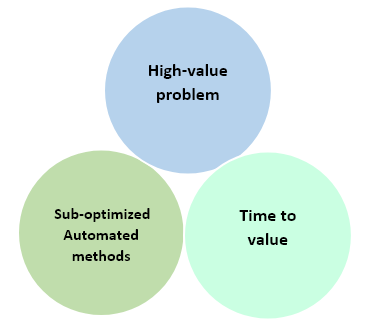
When one or more of these factors are applicable, we'll have a winning use case for Autonomous AI, and Machine Teaching will help you unlock the business value.
Solving a high-value problem
Selecting a high-value problem is key to identifying a good use case for Autonomous AI. The rule of thumb is that a single-digit percentage improvement of a key performance indicator (KPI) per year leads to over $1 million USD in savings or increased revenue per facility.
Examples of a single-digit KPI are: 5% improvement in throughput, 6% reduction in operation costs, or 9% waste reduction.
Financial return on investment is the most obvious way to identify a high-value problem, but it isn't the only way. There are other benefits, including social change, justice, or safety.
We recommend a single-digit percentage improvement of a KPI leading to $1 million USD return of investment because designing and building an AI brain requires resources. Developing the simulator is especially costly and time consuming. Executives and business owners need to see the value for the project to succeed.
Sub-optimized automated methods
The second factor to consider when selecting use cases is the level of sub-optimization of the existing automated methods. Here, we'll consider the limitations of the current methods and how much Autonomous AI can help improve the process.
There are several situations that help us identify when a challenge is a good fit to be solved with Autonomous AI, having a winning use case:
- Dynamic highly variable systems: Traditional systems control a narrow range of scenarios effectively. When you have a large set of possible environmental conditions, it's challenging to find optimal solutions using traditional engineering approaches, especially if those conditions are changing constantly. Engineers and operators often turn to intuition and heuristics in such situations. Autonomous AI can deal with that complexity and learn how to optimize for all conditions. It can learn from historical data or via simulations to analyze competing situations, being able to deliver the best optimization strategy in a short time.
- Competing optimization goals or strategies: Traditional systems can't trade off goals and strategies. For instance, we'll be able to improve throughput but not efficiency, or vice versa. However, Autonomous AI can learn these tradeoff strategies and improve both.
- Unforeseen system conditions: Traditional systems can't respond to unknown inputs or changing system behavior. In these situations, it's very difficult for an operator to decide. However, Autonomous AI can learn to handle unforeseen changes to system conditions and lead the process to the steady state.
- When the process still relies on human decision making: Often there's an automated system that works well most of the time, but people still have to step in when it makes bad decisions. Alternatively, the process might even need constant supervision for each action the automated system suggests. If the existing automation can't perform better than it already does with the existing automated methods, it's a sign that we have a winning use case.
Time to value
The third factor in selecting a winning use case has to do with the time to value. Here, we'll consider how many resources (time and money) it takes to develop the AI brain. The most important risk factor is the difficulty of developing a simulator for your machine or process.
Most large companies have large machines and complex processes. In the best-case scenario, the company will have a simulator to control that part of the process or the machine. However, most commonly these simulations aren't prepared to close the loop of identifying the impact of control actions on the environment required to train the deep-reinforcement learning. The simulation must be updated to include that loop.
When the company doesn't have a simulation for that part of the process or machine, it must be developed to take advantage of Machine Teaching for Autonomous AI. How precise and difficult it is to develop the simulation has a direct impact on the cost of the project and on the balance of cost/time to value to select your use case.
The art of storytelling
Once you've identified use cases where Autonomous AI will likely produce groundbreaking results, you need to be able to communicate the challenge that you want to solve, its business value, and how you're planning on solving it to several stakeholders, including business owners, expert operators, engineers, and AI brain builders.
Storytelling is how humans consume persuasion through stories. Data is important and facts are important, but persuasive arguments aren't delivered as dry facts and data. For this reason, storytelling is an important technique for communicating the value of the AI that you design.
Your story should include the following components:
- What's the challenge you're going to solve?
- What's the business value of the decision?
- What are the limitations of the current methods?
- How will Autonomous AI lead to groundbreaking results?
Here, you can find examples of presentation for Autonomous AI winning use cases: