Differentiate between inventory costing methodologies
Inventory costing methodologies play a critical role in managing and analyzing costs. Functional consultants must understand these methodologies to ensure accurate financial reporting and operational efficiency.
Inventory costing methodologies
Inventory costing methodologies in Dynamics 365 are frameworks used to determine how the value of inventory is calculated and reported. They aren't just technical settings—they're foundational to how a business understands its costs, profitability, and financial health.
The following is what the methodologies are fundamentally about:
Valuing Inventory Accurately: At their core, costing methodologies define how the system calculates the cost of inventory items as they move through the supply chain—from purchase or production to sale. This valuation affects not only inventory balances but also cost of goods sold (COGS), gross margin, and ultimately net profit.
Reflecting Real-World Inventory Flow: Each methodology simulates a different way inventory might flow through a business. For example, FIFO (First In, First Out) assumes older inventory is sold first, while weighted average smooths out cost fluctuations. These models help businesses mirror their operational realities in financial terms.
Supporting Financial Reporting and Compliance: Costing methodologies directly affect how inventory and COGS are reported in financial statements. Dynamics 365 allows organizations to choose a method that aligns with their accounting standards, tax regulations, and audit requirements.
Enabling Strategic Decision-Making: Choosing the right costing methodology, businesses can better understand product profitability, pricing strategies, and cost control. For example, standard costing provides predictability and control, while actual costing offers precision.
Driving System Behavior: In Dynamics 365, the selected costing methodology influences how the system handles inventory close, recalculations, adjustments, and postings to the general ledger. It also affects how variances are tracked and reconciled during production and sales processes.
Why different inventory costing methodologies exist in Dynamics 365
The following list describes why different Inventory Costing Methodologies exist within Dynamics 365:
To Align with Diverse Business Models and Industries: Different organizations operate under varying business models—manufacturing, retail, distribution, or services—and each has unique inventory flow characteristics. Dynamics 365 supports multiple costing methodologies to accommodate these differences. For example, a manufacturer prioritizes cost roll-ups and production variances, while a retailer focuses on real-time margin tracking.
To Comply with Local and International Accounting Standards: Costing methodologies must often align with regulatory requirements. Some jurisdictions mandate specific inventory valuation methods for tax or financial reporting purposes. Dynamics 365 allows organizations to select a costing model that complies with their local laws and accounting frameworks.
To Support Strategic Financial Reporting and Decision-Making: Each costing methodology provides a different lens on inventory value and profitability. For instance, standard costing offers predictability and control, while weighted average or FIFO reflects more accurate real-time costs. Organizations choose based on what best supports their financial strategy and reporting needs.
To Enable Operational Flexibility Across Legal Entities: Dynamics 365 allows different legal entities within the same organization to use different costing models. This flexibility is crucial for multinational companies or companies with varied operational units, each with distinct financial, and logistical needs.
To Reflect Real-World Inventory Behavior: Inventory costing models help simulate how inventory flows through a business. For example, FIFO (First In, First Out) mimics perishable goods handling, while standard costing is often used in stable, repetitive production environments. The choice of model helps mirror real-world inventory behavior in financial systems.
Note
Dynamics 365 allows businesses to configure and track inventory costs at various levels, such as by item or inventory dimension, to align with their operational needs.
Define different methodologies
The following list defines the different methodologies:
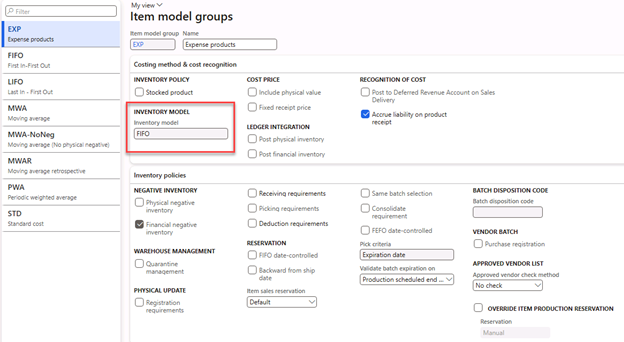
FIFO (First In, First Out): FIFO assumes that the oldest inventory items are sold or used first. This method is ideal for perishable goods or products with expiration dates.
LIFO (Last In, First Out): LIFO assumes that the most recently acquired inventory is sold or used first. LIFO can only be used for nonperishable items. This method is less common and isn't allowed under certain accounting standards. In periods of falling inventory costs, LIFO results in higher gross profit; in rising costs, it leads to lower gross profit.
Weighted Average: The weighted average method calculates the average cost of inventory by considering both the quantity and cost of items, averaging cost across the period (month). It's useful for businesses with homogeneous inventory.
Moving Average: The moving average method recalculates item cost after each purchase receipt transaction. This method expenses the difference between a new purchase cost and the current moving average and records only the average as inventory value.
Standard Cost: Standard cost assigns a cost to the item, which is used in cost calculations regardless of the actual price paid for the item (or for items used in manufacturing a finished good). It removes the cost fluctuation and provides predictability.
Specific identification
This method tracks the cost of each individual inventory item, making it suitable for high-value or unique items, such as custom machinery or luxury goods. This isn't a costing methodology in Dynamics 365 – one of the above methodologies must still be selected for the item. With specific identification, the inventory is serialized and the cost of the serialized item is used as the cost when that specific item is sold.
Advantages and disadvantages of the methodologies
| Methodology | Advantages | Disadvantages |
|---|---|---|
| FIFO | Reflects actual flow of goods; aligns with perishable inventory. | May not match current market costs in inflationary environments. |
| LIFO | Matches current costs with revenue during inflation. | Not accepted under IFRS; can distort inventory valuation. |
| Weighted Average | Simplifies cost calculations; smoothens cost fluctuations. | May not reflect actual inventory flow. |
| Moving Average | Smooths out fluctuations and allows a cost to be assigned immediately as an item is used. Doesn't require an inventory close process. | Doesn't reflect actual inventory flow or changes in market prices. |
| Standard Cost | Provides predictability in cost. Doesn't require an inventory close process. | Can produce large variances and differ significantly from actual cost. |
| Specific Identification | Provides precise cost tracking for unique items. | Impractical for large volumes of similar items. |
Wrong selection performance issues
Choosing an inappropriate costing methodology can lead to significant performance and financial issues, such as:
Inaccurate Financial Reporting: Misaligned costing methodologies can distort profit margins and inventory valuations.
Operational Inefficiencies: Incorrect methods may complicate inventory tracking and decision-making.
Compliance Risks: Some methods, like LIFO, may not comply with international accounting standards.
Functional consultants must carefully evaluate business requirements and regulatory constraints to select the most appropriate methodology.
Choosing the right costing method
To choose the right costing method, consider the following factors:
Nature of Inventory:
- Perishable or time-sensitive goods: Use FIFO.
- Homogeneous items: Use Weighted Average or Moving Average.
- High-value, unique items: Use Specific Identification.
- Manufactured items: Use standard cost if you manufacture with standard quantities.
Regulatory Requirements:
- Ensure compliance with local accounting standards (for example, IFRS or GAAP).
Business Objectives:
- Align the costing method with financial and operational goals.
System Capabilities:
- Use Dynamics 365's flexibility to configure and track costs at the desired level of granularity.
Tip
Use Dynamics 365's processes to simulate the effect of different costing methodologies before finalizing your choice. For more information see, Simulate cost changes by using a costing version for planned costs
You can't change the cost method for items if there's on-hand inventory. There are processes to convert to Moving average or Standard cost from the other cost methods but you should consider your cost method selection as final as many rules exist that block changing the cost method once you start transacting with an item.