Implement multi-job builds
Multi-job builds enable you to distribute work across multiple agents, run tasks in parallel, and create more efficient CI/CD workflows. This approach is particularly useful when different parts of your application have different requirements or when you want to reduce overall build time.
For example, some application components might require incompatible versions of libraries or dependencies, necessitating separate execution environments.
Benefits of multiple jobs
Adding multiple jobs to your pipeline provides several advantages:
- Break your pipeline into sections that need different agent pools or self-hosted agents.
- Publish artifacts in one job and consume them in one or more subsequent jobs.
- Build faster by running multiple jobs in parallel.
- Enable conditional execution of tasks.
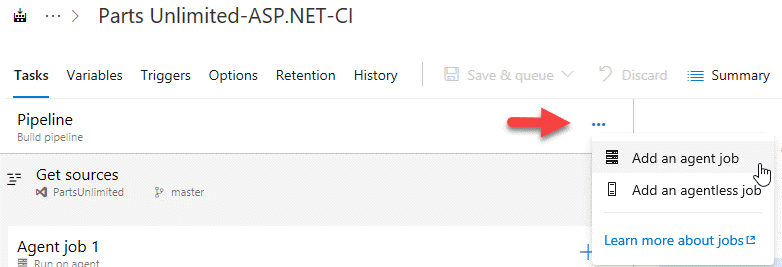
To add another agent job to an existing pipeline, click on the ellipsis and choose as shown in this image:
Parallel jobs
At the organization level, you can configure the number of parallel jobs that are made available.
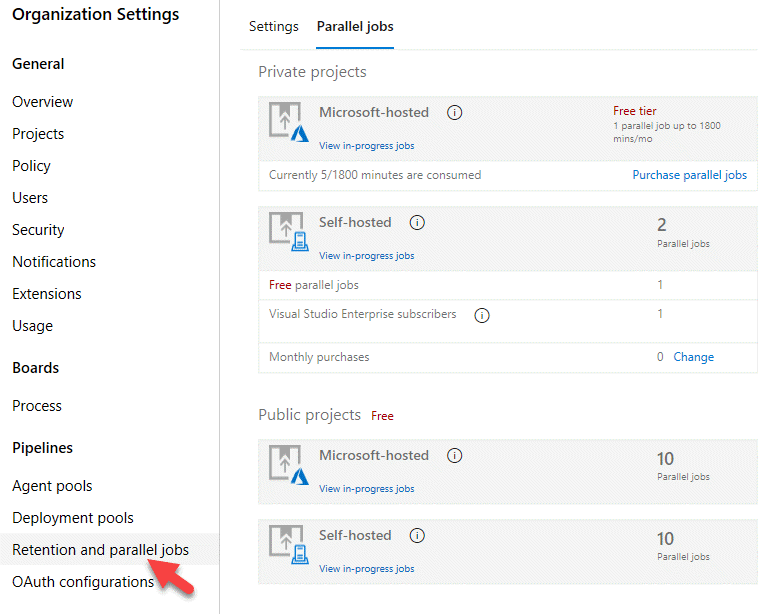
The free tier allows for one parallel job of up to 1800 minutes per month. The self-hosted agents have higher levels.
Note
You can define a build as a collection of jobs rather than as a single job. Each job consumes one of these parallel jobs that run on an agent. If there aren't enough parallel jobs available for your organization, the jobs will be queued and run sequentially.
Build Related Tooling
Azure DevOps can be integrated with a wide range of existing tooling used for builds or associated with builds.
Which build-related tools do you currently use?
What do you like or don't like about the tools?