Operator Nexus systems
Operator Nexus utilizes a curated and certified hardware Bill of Materials (BOM). It’s composed of commercially available off-the-shelf servers, network switches, and storage arrays. The infrastructure is deployed in the operator’s on-premises data center.
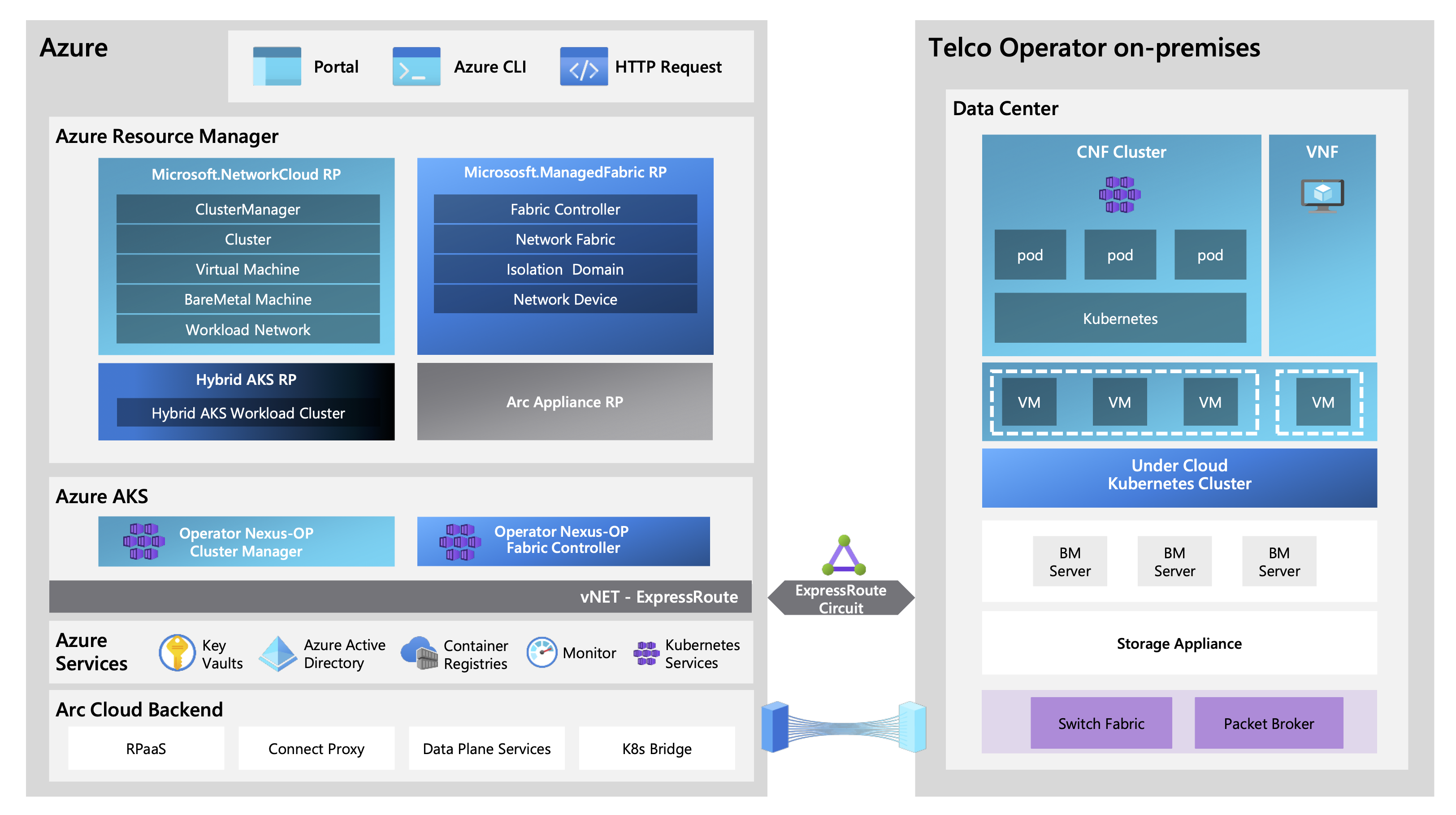
The service that manages the Operator Nexus infrastructure is hosted in Azure. Operators can choose any supported Azure region for each on-premises Operator Nexus instance. The following points outline the Operator Nexus service architecture:
- The management layer of Operator Nexus is built on Azure Resource Manager (ARM), providing a consistent user experience in the Azure portal and Azure APIs.
- Azure Resource Providers provide modeling and lifecycle management of Operator Nexus resources such as bare metal machines, clusters, and network devices.
- The Operator Nexus controllers, Cluster Manager and Network Fabric Controller, are deployed in a managed Virtual Network (VNet) connected to the operator’s on-premises network. The controllers enable functionalities such as infrastructure bootstrapping, configurations, and service upgrades.
- Operator Nexus is integrated with many Azure services such as Azure Monitor, Azure Container Registry, and Azure Kubernetes Service.
- ExpressRoute is a network connectivity service that bridges Azure regions and operators’ locations.
Nexus Network Fabric
Operator Nexus includes Nexus Network Fabric (NNF) which enables operators to build, operate and manage carrier-grade network fabrics. The reliable and distributed cloud services model supports the operators’ telco network functions. Operators can interact with Operator Nexus to provision the network fabric via Zero-Touch Provisioning (ZTP), and perform complex network implementations via a workflow-driven, API model.
Cluster manager
The Cluster Manager (CM) is hosted on Azure and manages the lifecycle of all on-premises clusters. Like NFC, a CM can manage multiple Operator Nexus instances. The CM and the NFC are hosted in the same Azure subscription.
Bare metal and cluster management
Operator Nexus includes capabilities to manage the bare metal hosts in operators’ premises. Operators can provision the bare metal hosts using Operator Nexus and can interact to restart, shutdown, or reimage, for example. One important component of the service is Cluster Manager. Cluster Manager provides the lifecycle management of Kubernetes clusters that are made of bare metal hosts.
Operator Nexus key components
Azure cloud services
Azure Resource Manager (ARM) is the Azure deployment and management service that enables the creation, update, and deletion of resources. When a user sends a request from Azure, the Resource Manager receives, authenticates, and authorizes the request, and then sends it to the Azure service. The Azure service performs the requested action. Because all requests are handled through the same API, users see consistent results and capabilities, no matter which tool they're using.
The Network Cloud Resource Provider (RP) is the primary Operator-facing component of Operator Nexus architecture. It provides the API interface to lifecycle on-premises environments and higher-level resources like Kubernetes clusters, virtual machines, etc. Users can interact via ARM templates, the Portal, and SDKs. The Network Cloud RP API interacts with the Network Cloud operators running within the operator’s on-premises environment to perform the actual lifecycle operation. A minimum set of administrative RPs allows Microsoft to perform basic management of Operator Nexus platform resources and components.
Azure Arc simplifies governance and management by delivering a consistent multicloud and on-premises management platform. Azure Arc is a set of technologies that brings Azure security and cloud-native services to hybrid and multicloud environments. It enables users to secure and govern infrastructure and applications from anywhere. Cloud-native apps can be built faster with familiar tools and services. They can be run on any Kubernetes platform, and modernize the data estate with Azure data and machine-learning services. Azure Arc provides a centralized, unified way to manage the operator's entire environment by projecting your existing non-Azure and/or on-premises resources into Azure Resource Manager. It allows for the management of physical and virtual (VM) servers, Kubernetes clusters, and other resources hosted outside of Azure as if they were running in Azure.
Azure Operator Service Manager is a service that allows Network Equipment Providers (NEP) to publish their NFs in Azure Marketplace. Operators can deploy them using familiar Azure APIs. Operator Service Manager provides a framework for NEPs and Microsoft to test and validate the basic functionality of the NFs. The validation includes lifecycle management of an NF on Operator Nexus.
For observability, Operator Nexus automatically streams metrics and logs from the operator’s premises to Azure Monitor and Log Analytics workspace, including both infrastructure (compute, network, and storage) and tenant infrastructure (for example, VNF VMs).
Log Analytics has a rich analytical tool set that operators can use for troubleshooting or correlating for operational insights. Azure Monitor allows operators to specify alerts.
Host-level software components
Host operating system (OS)
Azure Linux (also known as CBL-Mariner) is a Linux distribution for Microsoft’s cloud infrastructure and edge products and services, used as the BareMetal host Operating System (OS). CBL-Mariner includes a small common core set of packages that address the universal needs of cloud and edge services. Users can add packages on top of the common core to produce images for their workloads. This customization is made possible by a simple build system that enables:
- Package Generation, producing the desired set of RPM packages from SPEC files and source files.
- Image Generation, producing the desired image artifacts like ISOs or VHDs from a given set of packages.
CBL-Mariner can be deployed as a container or a container host. It consumes limited disk and memory resources, achieving an 80% reduction in the base image size. It also provides a 40% reduction in node image upgrade times compared with other widely used Linux distributions. The lightweight characteristics of CBL-Mariner also provide faster boot times and a minimal attack surface.
Azure Kubernetes Services (AKS)
When users deploy an AKS cluster, the Kubernetes control plane and all nodes are deployed and configured for you. Since Azure manages the Kubernetes control plane, users only manage and maintain the agent nodes.
Advanced networking, Microsoft Entra integration, monitoring, and other features can be configured during the deployment process.
Virtual Machines
Operator Nexus Virtual Machine (VM) gives operators the flexibility to run legacy virtualized workloads that aren’t available as containerized network functions.
Nexus Kubernetes cluster
Nexus Kubernetes Service (NKS) Azure-managed Kubernetes services to on-premises environments. It provides users the ability to create Kubernetes clusters and manage them through an API. NKS is optimized to automate the creation of containers to run tenant network function workloads. NKS integrates with Operator Nexus networking that supports SRIOV and DPDK. It also integrates with Operator Nexus storage backends such as Pure.
Like any Kubernetes cluster, the Nexus Kubernetes cluster has two components:
- Control plane: provides core Kubernetes services and orchestration of application workloads.
- Nodes: There are two different node pools in Nexus Kubernetes clusters - System node pools and user node pools. System node pools host critical system pods. User node pools host application pods. However, application pods can be scheduled on system node pools if the user wants only one pool in their cluster. Every Nexus Kubernetes cluster must contain at least one system node pool with at least one node.
Network functions virtualization infrastructure capabilities
As a platform, Operator Nexus is designed for telco network functions and optimized for carrier-grade performance and resiliency. It has many built-in Network Functions Virtualization Infrastructure (NFVI) capabilities:
- Compute: NUMA aligned VMs with dedicated cores (both SMT siblings), backed by huge pages ensures consistent performance. There’s no impact from other workloads running on the same hypervisor host.
- Networking: SR-IOV & DPDK for low latency and high throughput. Highly available VFs to VMs with redundant physical paths provide links to all workloads. APIs are used to control access and trunk port consumption in both VNFs and CNFs.
- Storage: Filesystem storage for CNFs backed by high-performance storage arrays