Implementation methodology
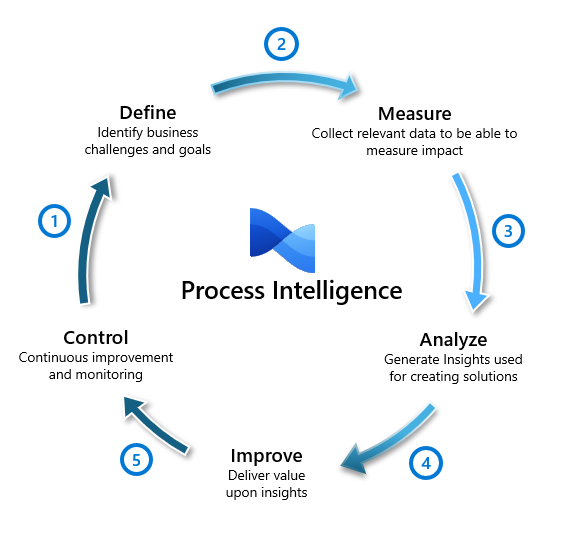
Making data-driven decisions is a primary path to project success with process mining. The define, measure, analyze, improve, and control (DMAIC) methodology is an industry standard methodology to help improve processes that are driven by data quality.
You should complete each phase of the DMAIC methodology in order because each contributes to the overall success of the project. However, DMAIC is iterative and allows for ebbing and flowing between the phases as needed during the project as you discover new information.
Define the problem and goals
Defining the problem and goals is the first, and often most crucial, step in the DMAIC process. In the define stage, you identify a clear purpose, determine goals, and use tools, such as a project charter and root cause analysis. The outputs of this phase confirm that everyone involved has a clear understanding.
A project charter can contain any or all of the following components:
Project title
Project sponsor
Problem statement
Project objectives
Project scope
Project team members and their responsibilities
Timeline and milestones
Budget and resources
Risks and assumptions
Stakeholders
Project approval requirements
Communication plans
Measure current performance
By evaluating and measuring a baseline before the project launch, you can better understand improvements from identified changes. In the measure phase, you define a performance baseline to gain an understanding of the current state of the process and to better define the problem that you're trying to solve. This phase also identifies key performance indicators (KPIs) to use to measure the process.
In the measure phase, the team decides what data is important to measure and then determines which tools to use to complete those measures and validate the system of measure. Often, the plan to collect data includes a trial run, or program pilot, to ensure that the measures are accurate and indicate what you need to identify potential process improvements. Occasionally, it's necessary to request modification of a part of a process to produce other telemetry, which helps ensure that the key steps of the process are measurable.
Determining the full capability of the process helps to confirm that the process meets the stated needs and helps guide you to process improvements.
Analyze data for variations
Analyze is the third phase of DMAIC where you identify outliers and bottlenecks. This phase is where you should begin noticing the results from the define and measure phases.
By using the data that you collect from a root cause analysis, you can identify causes of the problems. Then, you can evaluate further to find the root of the problems, going beyond the surface details.
During the analyze phase, you complete a statistical analysis and a process analysis. You can use techniques, such as hypothesis testing and regression analysis, for statistical analysis. The process map highlights inefficiencies and areas of improvement in the process analysis. Additionally, you can highlight activities that don't add value and could be candidates for removal if it benefits the overall process.
In this phase, you also identify critical factors that the previous phases discover. The key factors that you identify are the ones with the most significant impact on the process that you're evaluating.
Often, you also dedicate time in this phase to verify the accuracy of your findings.
Improve the process
In the improve phase, you determine what you need to act on to better automate and reduce friction in the processes that you're evaluating. During this phase, you determine and implement solutions. Depending on the relative size of the processes that you're improving, this phase might take the longest of all DMAIC phases.
In the improve phase, you set goals. The goals include identifying the possible solutions for root causes, performing cost-benefit analysis, testing the solution, and assessing the effectiveness of the solutions. This phase requires continual measuring of the results and comparing them to the baseline that you already established during a previous phase.
During this improve phase is when you likely ebb and flow between previous phases. Throughout this phase, you make adjustments and major course corrections to the process as you learn more from the gathered results and presented solutions from other phases.
Control the improved process to continue the realized gains
The control phase focuses on establishing and implementing policy and practices to ensure continued success.
Activities during the control phase might include creating or updating documentation and instructions, quantifying the financial savings, and putting monitoring mechanisms in place for continued evaluation of updated processes. Monitoring the process helps ensure that the process continues to meet your needs and retains established gains.
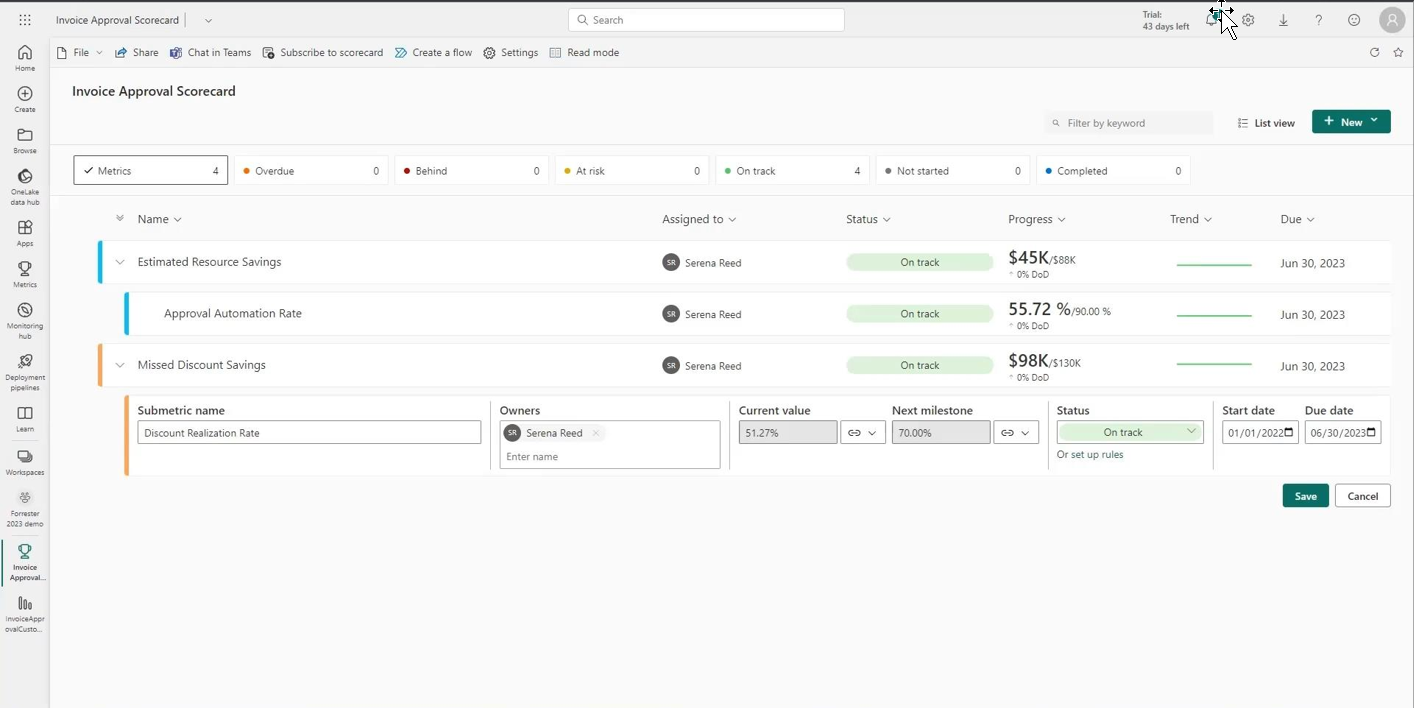
Ideally, this phase includes handoff to the new owner of the process. The realized gains from the previous phases should continue with a successful control phase.
Example deliverables with DMAIC
The following examples describe deliverables that you might find in relation to the stages of DMAIC.
Define phase deliverables
The define stage helps you prepare for success, identify the correct process, and define business rules (effort versus value = priority), scope, team, and stakeholders.
The define phase includes the following deliverables:
Selected process
Signed process canvas
Effort estimation
Allocated team
Measure phase deliverables
During the measure phase, you build the event log, set up the environment, connect the data source, and determine the staging area, data transformation, business translation, and validation.
The measure phase includes the following deliverables:
Environment (PA + PBI)
Data connection
Staging area
Validated event log
Analyze phase deliverables
In the analyze phase, you generate business rule insights, review the process model, analyze the business rules by priority, and identify root causes (CM, RCA, conformance, benchmarking, and so on).
The analyze phase includes the following deliverables:
BR workshop
Crowd onboarding
Insights
Impact analysis
Improve phase deliverables
With the improve phase, you can deliver value by acting on business rule insights. Additionally, you can act on insights with data-backed change (change management, workshops, and training), application development, or automation (API triggers, RPA, or integration).
The improve phase includes the following deliverables:
Workshops
Training
Actions
Control phase deliverables
During the control phase, you work toward continuous improvement of the process. This phase helps you determine if the implemented improvements achieve the desired improvements on a large scale so that you can adjust accordingly.
The control phase includes the following deliverables:
Management trend dashboard
Management Summary
Feedback
The DMAIC methodology stands as a robust and data-driven approach to process improvement, ensuring that you make decisions based on quality data. It's an industry standard that provides a structured framework for identifying, analyzing, and improving processes. The iterative nature of DMAIC allows for flexibility, where you can adapt to new information as projects progress. By defining clear goals, measuring current performance, analyzing data for variations, improving processes, and controlling the improved process, you can realize significant gains and maintain them over time.