Process mining canvas
A process mining canvas is a framework to help organizations better understand and analyze their business processes. The process mining canvas is a structured tool that organizations can use in process mining projects, especially during proofs of concept (POC) or pilot phases. It helps organize and document all essential information, ensuring a clear outline of prerequisites, success criteria, and other critical elements. This canvas helps capture necessary details, helping to prevent information from being overlooked. The following image shows an example of a process mining canvas.
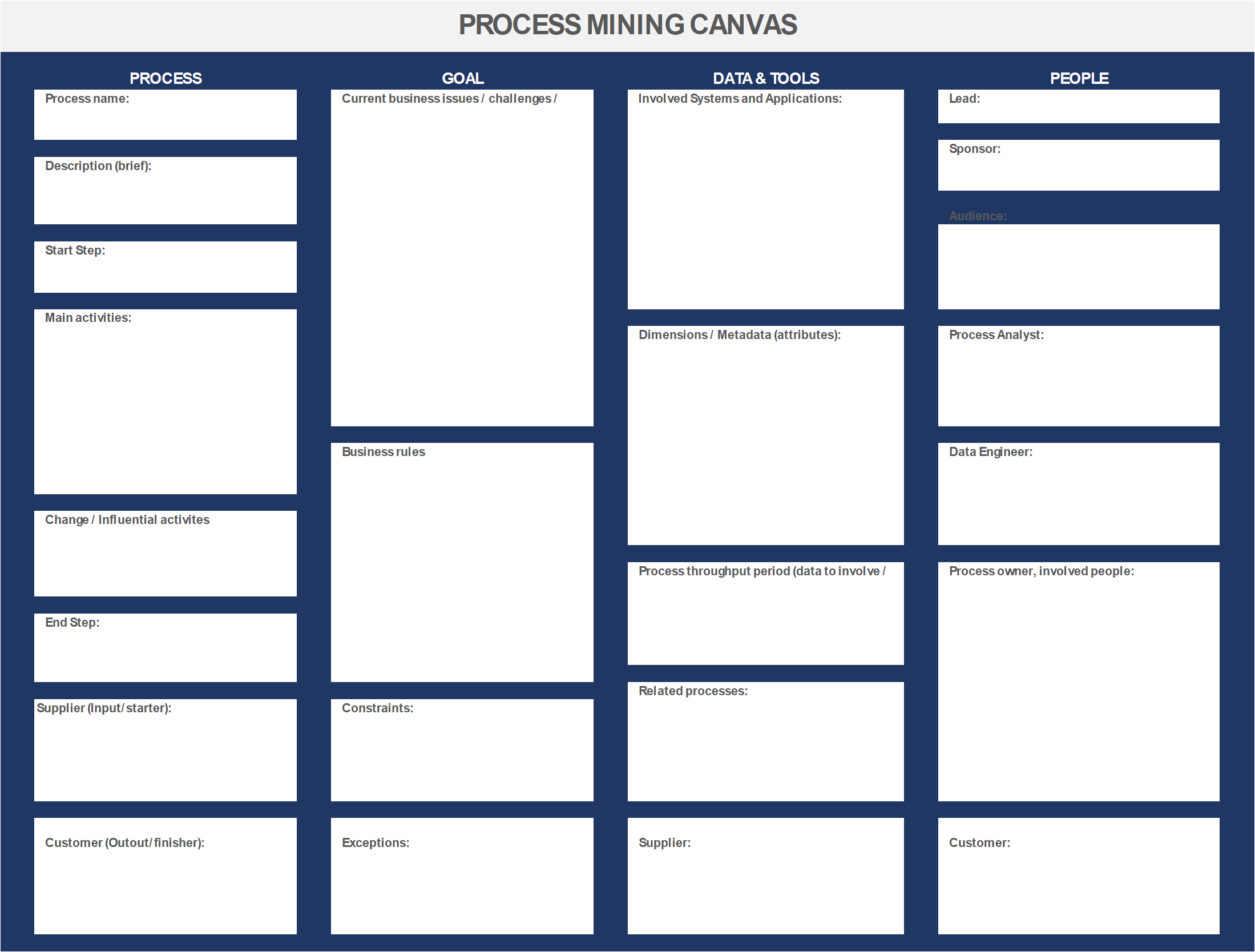
Structure of the process mining canvas
The canvas is divided into several chapters, each serving a specific purpose in the process mining project:
Process - This chapter contains a name and a brief description of the target process. In this chapter, you explain what the process is about, the scope, and the significance to the organization. Additionally, you track activities, some of which are the main activities of the process. Other activities are influential but indirect. In this section, you also establish the beginning of the process and the end of the process.
Goals - This chapter is where you address immediate and future goals. Immediate goals apply to the target of the POC. Future goals are more for establishing long-term plans and strategy. Defining success criteria helps keep the team on track and helps them know when they achieve milestones. Success criteria likely contain at least some of the following components:
Primary objective
Problem to solve
Features to test
Integration points
Benchmarks
Business outcomes
Quantitative targets
Scoping and stakeholders - Clarifying the scope helps define the boundaries of the POC. It specifies what's included and excluded, which helps prevent scope creep and ensures focus on critical aspects. Identifying key stakeholders, such as sponsors, leads, team members, and subject matter experts, ensures that all relevant parties are involved and informed. In this chapter, you clarify roles and responsibilities. Additionally, you plan for feedback collection from stakeholders to ensure that you consider their perspectives, thus enhancing the relevance and acceptance of the POC outcomes.
Business rules - Defining how to measure the process is crucial for evaluating performance. This process includes specifying metrics, such as throughput times, conformance requirements, service level agreements (SLAs), and other constraints or exceptions. For instance, ensuring that Activity B is always followed by Activity C and never by Activity D helps maintain process compliance and efficiency.
Data and tools - In this chapter, you identify and list systems of record and involved applications. Defining attributes and metadata based on goals, success criteria, business challenges, and business rules helps guide the data analysis process. This approach also includes identifying key data elements that you need for effective process mining. Planning the data extraction period ensures that you capture sufficient iterations of the process, which involves considering average process duration and extracting data for a suitable period (such as several months) to cover all scenarios. Assessing required data volume and associated licenses ensures that the POC is adequately supported from a technical and budgetary perspective.
People - Identifying roles, such as the lead, sponsor, process mining analysts, data engineers, and process owners, ensures that everyone involved understands their responsibilities. This approach promotes accountability and smooth project implementation.