Connect credits to value in usage-based AI
A credit report tells you what the work consumed. It doesn't tell you what the work produced. To judge whether usage-based AI is worth its cost, pair every cost measure with a value measure.
Credits are only part of the cost
Credits are the most visible cost of usage-based AI, but they aren't the total cost. The total cost of an AI investment also includes licenses, enablement and training, and support. When you compare cost with value, use the total cost, and don't judge spending on credits alone.
Three value measures
Value appears in stages. Adoption usually shows up first, and work outcomes take longer because they need a baseline to compare against.
| Measure | What it shows | When it appears |
|---|---|---|
| Adoption | Active users, how often they return, and satisfaction | First, often within weeks |
| Assisted hours | Estimated time saved, by task category | After task complete and the data refreshes |
| Work outcomes | Credits consumed per unit of work | After a baseline exists |
Adoption tells you whether people use the service. It doesn't tell you whether the work is worth its cost. Assisted hours estimate time saved, which is useful but still an estimate. Work outcomes connect cost directly to results.
Measure credits per unit of work
A unit of work is a repeatable piece of business output, such as a client status report, a proposal draft, or a completed research summary. To measure work outcomes:
- Define one unit of work for each type of task you delegate to AI.
- Track the credits consumed for each completed unit.
- Compare credits per unit over time and against the effort the same work needed before.
Credits per unit of work turns a consumption figure into a cost per outcome. It also lets you compare teams on the same scale, because a team that completes more work is expected to consume more credits.
Hard returns and soft returns
Not all value is the same kind of value. Describe each kind accurately so that finance can trust the figures you present.
- A hard return changes cash flow or the budget. For example, the organization no longer needs contractor support for work that AI now performs.
- Hours saved are capacity, not cash. Time saved becomes a hard return only when redeployed to work that produces revenue or when the spending it replaces is released.
- Soft benefits are real but hard to price. Examples include more focus time, faster responses to clients, and better-prepared meetings. Report soft benefits in their own units, such as survey scores or turnaround time, next to hard returns. Don't convert them to currency.
Value matures in three states
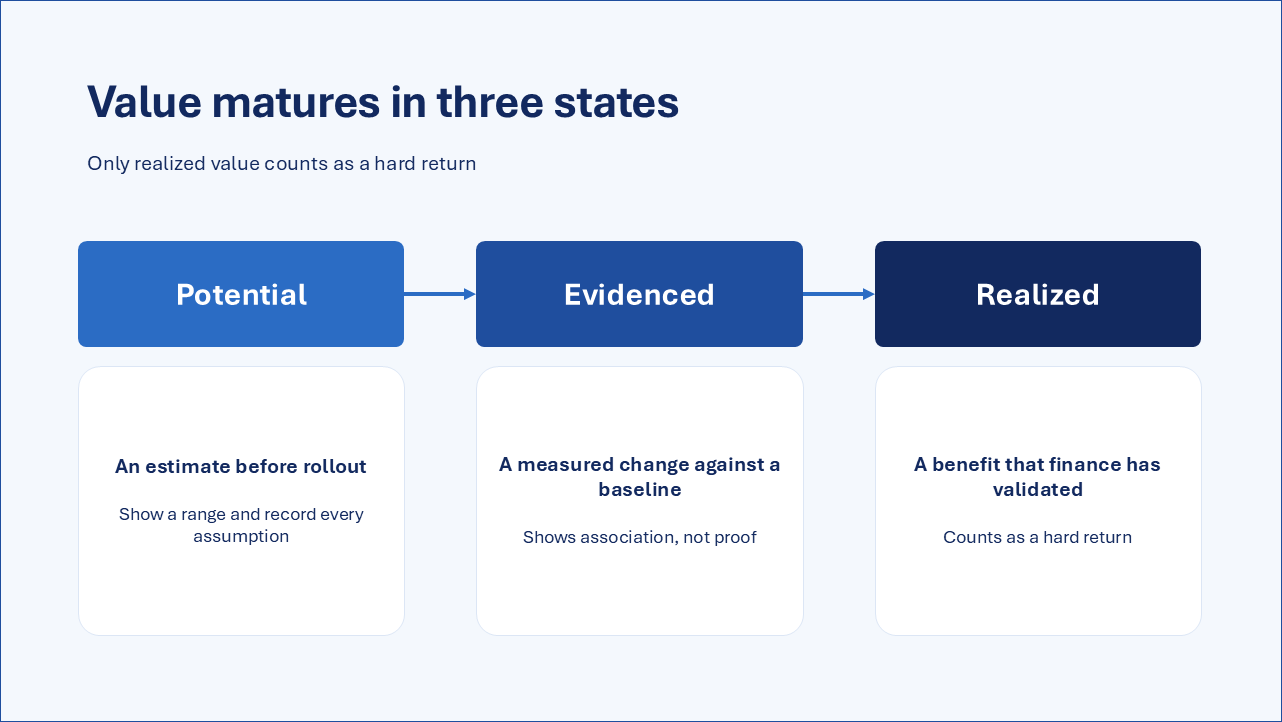
| State | What it means | How to present it |
|---|---|---|
| Potential | An estimate made before or early in rollout | Show a range and record every assumption |
| Evidenced | A measured change against a baseline | Describe it as an association, not proof that AI caused the change |
| Realized | A benefit that finance has validated | Only this state counts as a hard return |
To calculate a hard return, subtract the total AI cost from the realized benefit, and then divide the result by the total AI cost. State every assumption behind the figure so finance can check it.
Important
Presenting potential or evidenced value as realized value damages trust in every figure that follows. Label each figure with its state.
Caldova decision
The department lead turns the tasks the team delegates to Copilot Cowork into units of work, starting with client status reports. Each month, the team tracks credits per completed report. The hours the team saves are reported as capacity. They become a hard return only if the department stops buying outside research support and finance validates the change.