Decide, optimize, continue, or scale AI usage
Data is useful only when it leads to a decision. This unit brings spending, usage, and value together into a recommendation that you can defend, with an owner and a date to review it.
Set a review rhythm
Regular reviews keep decisions small and timely:
- Weekly check: Alerts triggered, top consumers, and unusual spikes. Keep it short.
- Monthly review: Consumption against the planning range, value measures, and cost allocation.
- Value reviews: A deeper review at agreed points, such as 30, 90, and 365 days after launch.
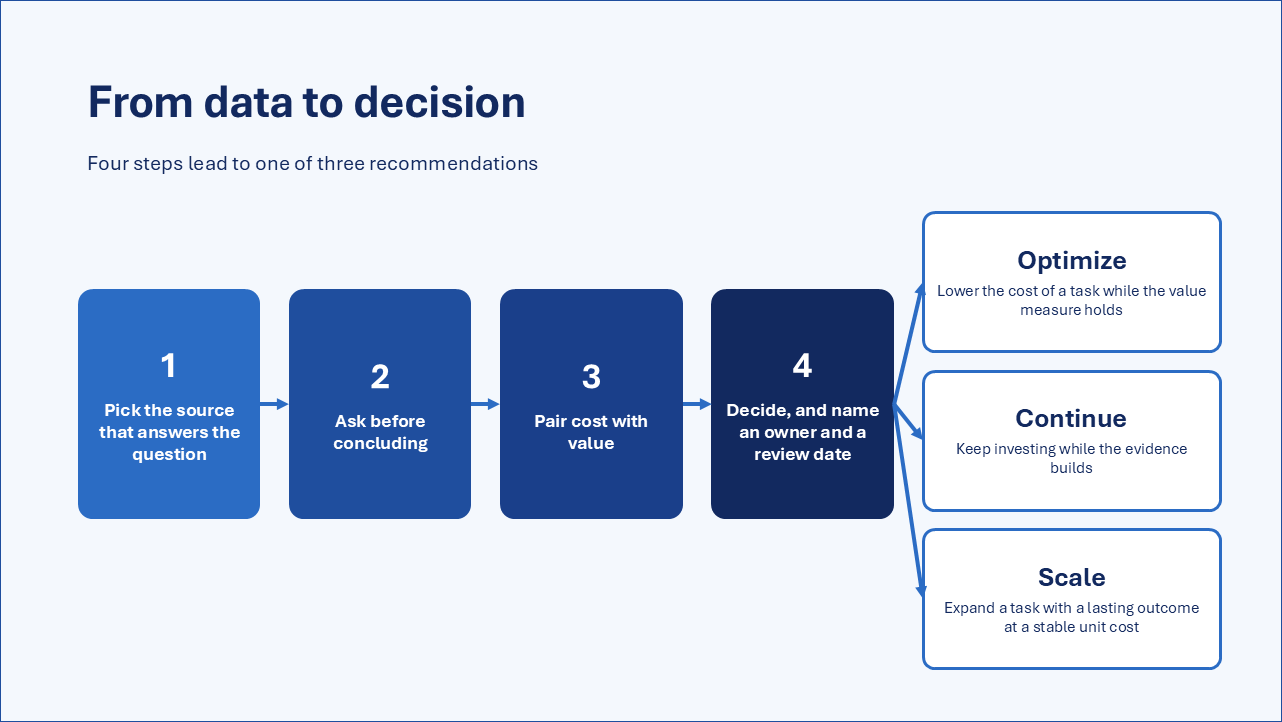
From data to decision in four steps
Use the following four steps to turn spending, usage, and value data into a clear recommendation. Check the context behind the numbers, weigh cost against outcomes, and agree on who will act and when to review the results.
- Pick the source that answers the question. Use the question types from earlier in this module.
- Ask before concluding. The same data can mean different things. A group close to its limit might need more credits, or it might be doing work that isn't worth them. A few heavy users might be a problem, or they might be your strongest use case. Ask the people involved before you act.
- Pair cost with value. Express cost against a unit of work, and count the time people spend reviewing and correcting AI output as part of the cost.
- Decide, and name an owner and a review date. A decision without an owner and a date tends to become no decision.
Reduce cost without reducing value
When a task costs more than its value supports, three levers can lower its cost:
| Lever | What it changes | When to use it |
|---|---|---|
| Model choice | Which models a group can use for its tasks | Routine tasks run on premium models. This is often the largest lever. |
| Agent reuse | Teams build on shared agents instead of creating new ones | Several teams run similar agents |
| Prompt efficiency | How much context a task reads and how many steps it takes | Tasks read more content than the output needs or run again because the request was unclear |
Every lever has the same test: credits go down, and the value measure holds. If the value measure drops, the lever was the wrong choice for that task.
Three recommendations
| Recommendation | When it fits | What to do |
|---|---|---|
| Optimize | A task costs a lot for the value it produces, or the value is close but not yet there | Coach users, share effective prompts, move routine work to lighter models, and retire low-value use |
| Continue | Value is appearing, but the evidence is still building | Keep the investment and measure against the baseline at the agreed review points |
| Scale | A task shows a lasting outcome at a stable cost per unit of work | Expand access based on the evidence |
A recommendation applies to a task or a group, not to AI as a whole. In the same review, you might scale one task, optimize another, and retire a third.
Caldova decision
The 80 percent alert reaches the department lead and the IT admin early in the second month, and the department lead asks for a higher limit. Before approving it, the IT admin reviews Cost Management and finds that three scheduled tasks drive most of the consumption. One builds a daily status digest that the team relies on. The other two produce daily summaries that few people read.
Caldova chooses to optimize. The team keeps the daily digest, moves the other two tasks to a weekly schedule, and holds the current limit until the next monthly review. The department lead owns the decision and reports the result at that review.