Recommend options for listening to Dataverse events
The previous unit closes with a direct handoff. Webhooks, Azure Service Bus, and Azure Event Hubs all register through the same tool and the same underlying table. The real question was never how to register them. It's which one fits a given destination. This unit builds the judgment to answer that question for any listening scenario, including the three destinations already in play at Contoso Facilities.
Ask what the destination actually needs
Before you weigh one option against another, you evaluate the destination itself. A destination's requirements, not a preference for one technology over another, determine the right fit. Three questions get you most of the way there.
- Does the destination need a direct, synchronous response before Dataverse moves on? A webhook step supports that; Azure Service Bus and Azure Event Hubs steps don't, because both are asynchronous only.
- Does the volume involved exceed what a single endpoint can reasonably process inline, one event at a time? That points away from a webhook and toward a durable queue or a streaming pipeline built to absorb bursts without blocking anything upstream.
- Does more than one downstream system need to consume the same stream of events independently, rather than one process draining a queue on its own schedule? That's the question that separates Azure Service Bus from Azure Event Hubs, since a single consumer drains a queue, while many consumers use a stream.
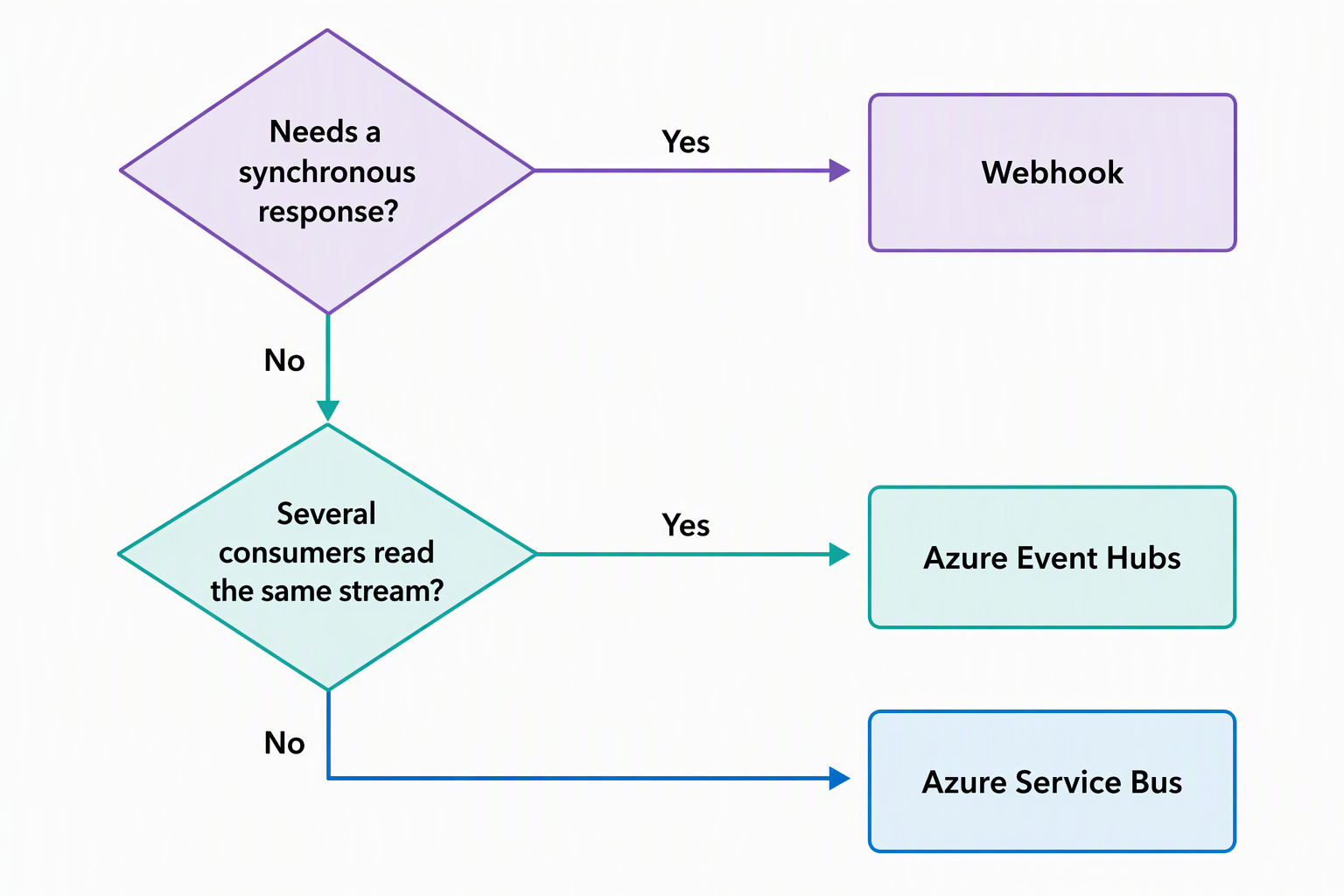
None of these questions ask which technology is more capable in the abstract. Each one asks something specific about the destination's behavior, and each answer rules options in or out.
Weigh the three options against each other
The comparison in the previous unit focused on what you register for each option. Reframed around when you'd choose each one, the same facts turn into a decision tool instead of a registration checklist.
| Decision factor | Choose a webhook when... | Choose Azure Service Bus when... | Choose Azure Event Hubs when... |
|---|---|---|---|
| Response timing | The destination needs a synchronous response path, or doesn't mind either way | Asynchronous delivery is acceptable, and durable retry matters more than speed | Asynchronous delivery is acceptable, as part of a continuous stream |
| Volume and consumers | One destination handles the request directly, point-to-point | One backend process drains a durable queue on its own schedule | Multiple downstream consumers read the same high-volume stream independently |
| Authentication | The destination owner dictates HttpHeader, WebhookKey, or HttpQueryString |
A namespace already has SAS authorization configured in Azure | A namespace already has SAS authorization configured in Azure |
| Payload considerations | JSON over HTTP POST is sufficient for the destination | XML, JSON, or .NET binary all work, but payloads over 192 KB lose certain context properties | Same format flexibility as Azure Service Bus, built for high-throughput ingestion |
Notice how little of this table is about raw technical superiority. A webhook isn't a lesser option than Azure Event Hubs; it's built for a different shape of destination. The same is true in reverse: pointing a low-volume, synchronous-capable destination at Azure Event Hubs adds a streaming layer that destination never needed.
Guiding question: Look back at the three questions in the previous section. Which one, on its own, would eliminate two of the three options fastest for a destination you're familiar with?
Apply the framework to Contoso Facilities' three destinations
With the decision factors in hand, the three endpoints this module already walked through stop looking like three unrelated registrations. They start looking like three answers to the same set of questions.
The availability service fits a webhook because the integration is a simple, point-to-point need: one destination, a direct HTTP POST, and the option, even if not always exercised, for a synchronous response the moment stock gets confirmed. Nothing about that destination needs a queue or a stream sitting in between.
The decoupled fulfillment pipeline fits Azure Service Bus because it's exactly the opposite shape of need: no synchronous response required, a single backend process that drains the queue whenever it's ready, and durability that matters more than immediacy if that backend process is temporarily offline.
Asking the three questions against this destination rules out a webhook immediately, since there's no direct HTTP call to make. It also rules out Azure Event Hubs equally fast, since only one consumer ever reads from this pipeline.
The future analytics stream fits Azure Event Hubs for the reason the other two options don't: multiple downstream consumers, not a single backend process, need to read the same flow of every request, approval, and status change independently of one another. A queue drained by one process can't serve that need the way a continuous stream can.
Three destinations, three different answers, and a recommendation you could now defend to anyone who asked why each endpoint exists.
External endpoints aren't the only way to listen
Everything in this module focuses on three external service endpoint types, but a complete recommendation acknowledges that Dataverse itself offers other ways to listen to events. Plug-ins and custom workflow activities run inside Dataverse and react to the same messages this module's endpoints react to, without ever leaving the platform. Power Automate cloud flows offer a low-code alternative, triggered directly by a Dataverse connector event rather than a registered service endpoint.
Neither option replaces the three this module covers; they solve a different problem, reacting inside Dataverse rather than publishing out to an external system. Knowing they exist rounds out your judgment, even though choosing between them is a decision for a different conversation.
Synthesis prompt: Picture two new destinations. The first is a background-check vendor's intake system that needs to know the moment a new-hire record becomes approved. The second is a security team that wants every create, update, and delete across a table flowing into a pipeline that several independent compliance tools each read on their own. Using the three questions from this unit, which option fits each destination, and why?
Carry the recommendation forward
Across this module, you moved from publishing an event in plug-in code, to publishing one through configuration. From there, you moved to registering the destinations those publishing mechanisms reach, and weighing those destinations against each other. That progression is the real skill: not memorizing three technologies, but recognizing which questions to ask when a new destination shows up. The knowledge check that follows gives you a chance to apply that same judgment to scenarios beyond Contoso Facilities.