Understand how DLP policy decisions fit together
Effective data loss prevention (DLP) policies start with clarity about what each policy is meant to accomplish. A policy isn't a catch-all control for every data risk. It's a targeted decision tool that responds to specific actions that increase the likelihood of data loss.
Before defining conditions or actions, it's important to be clear about the role a policy plays in reducing risk. Some policies are meant to prevent clear, high-risk scenarios. Others are designed to provide visibility, guide user behavior, or validate assumptions before enforcement. Being explicit about this role helps prevent policies from becoming overly broad or disruptive.
Understand the DLP policy lifecycle
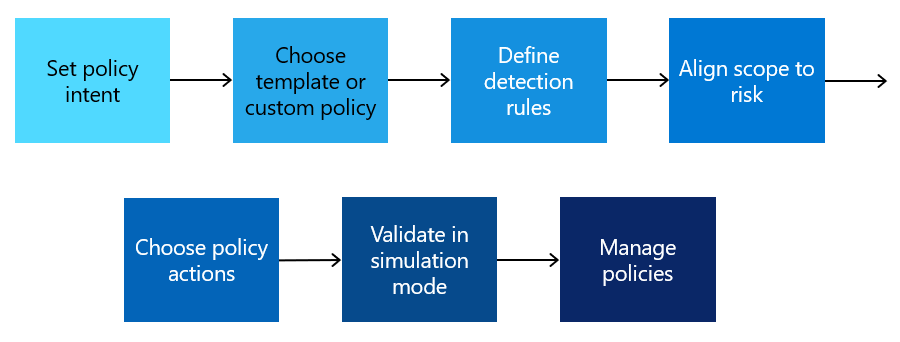
Creating a DLP policy isn't a single configuration step. It's a sequence of related decisions that shape how protection behaves over time. Those decisions begin with intent, then move through how risk is detected, where the policy applies, how it responds, and how it's validated and adjusted as conditions change.
Clear intent at the start makes later decisions more precise. Detection can focus on meaningful risk, scope can reflect real workflows, and enforcement can be introduced deliberately rather than reactively. Approaching policy creation as a lifecycle helps ensure protection remains effective as data usage and business needs change.
Avoid assumptions that lead to over-enforcement
A common mistake during policy creation is assuming that stronger enforcement always leads to better protection. In practice, over-enforcement often creates the opposite effect.
Examples of assumptions that cause problems include:
- Applying broad scope without understanding how data is used
- Blocking actions that are part of normal business workflows
- Layering multiple restrictive rules to compensate for uncertainty
When policies interrupt legitimate work too often, users look for ways around them. That increases risk rather than reducing it.
Understand why identical data can justify different outcomes
The same data doesn't always represent the same level of risk. Identical content can be appropriate in one situation and problematic in another, depending on how it's used and who is involved.
Effective policies account for:
- Differences in how data is shared
- Variations in audience or destination
- The intent implied by the action being taken
Treating all uses of sensitive data the same leads to unnecessary blocking and missed context.
Align policy behavior with real workflows
Most data loss happens during everyday work, not through malicious intent. Policies that acknowledge how people actually work are more accurate and easier to adopt.
When policy behavior aligns with real workflows:
- False positives are reduced
- Users are more likely to understand enforcement decisions
- Policies act as guardrails instead of obstacles
Once intent is clear, the next constraint becomes how much control the policy needs from the start.