Evaluate advanced DLP controls for your environment
For many organizations, well-planned data loss prevention (DLP) policies are enough to manage risk. Clear classification, thoughtful scope, and careful rollout often address most data loss scenarios.
In more complex environments, however, data risk can be influenced by factors beyond content and location alone.
When basic DLP is sufficient
Basic DLP is often enough when:
- Sensitive data is well classified and consistently labeled
- Risk scenarios are predictable and largely accidental
- Enforcement decisions can be made based on data type and action alone
- User behavior is relatively stable across roles and teams
In these cases, adding more layers of control can increase complexity without meaningfully improving outcomes.
Signals that suggest more context might be helpful
Some environments present patterns that are harder to address with content-based controls alone. Examples include:
- Risk that changes over time based on user behavior
- Scenarios where the same action might be acceptable for one user and risky for another
- Situations where enforcement decisions depend on recent activity, not just the current action
Applying judgment to common DLP scenarios
Use the tabs to review each scenario and consider whether basic DLP is sufficient or whether added context would improve enforcement decisions.
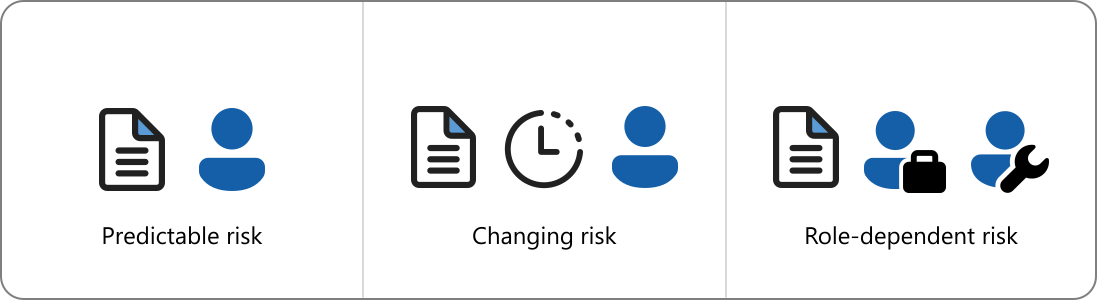
Scenario: Predictable data sharing
A finance team regularly shares labeled payroll files with a small group of internal reviewers. The data is consistently classified, and the sharing pattern is stable and well understood.
Why basic DLP is often sufficient
In this scenario, risk is predictable and largely accidental. Classification and scope provide enough signal to guide enforcement decisions, such as warning or blocking external sharing. Adding behavior-based context is unlikely to improve accuracy and might introduce unnecessary complexity without changing outcomes.
How DLP can work with other signals
In these situations, content and location alone might not provide enough context to make consistent enforcement decisions.
Capabilities like Adaptive Protection illustrate this model by allowing enforcement to respond dynamically when risk increases, rather than applying the same controls to all users at all times.
This approach is available in specific DLP locations, and is intended for scenarios where added context clearly improves enforcement decisions.
Why advanced controls are optional
Advanced DLP controls aren't a maturity requirement. Many organizations never need them.
Introducing signal-based enforcement makes sense only when:
- The added context clearly improves decision quality
- Teams can manage the operational complexity
- There's confidence in the underlying DLP foundation
Without those conditions, advanced controls can create confusion rather than clarity.
Keep the focus on outcomes
Effective data protection isn't measured by how many controls are enabled. It's measured by whether sensitive data is protected without disrupting legitimate work.
Understanding when to stop is as important as knowing when to extend protection.