Understand the role of data loss prevention (DLP)
Sensitive data moves constantly across email, collaboration tools, endpoints, browsers, and AI experiences. Most data loss doesn't come from malicious intent. It happens during everyday work, when people share files, copy content, or use tools to make collaboration easier.
Traditional security controls struggle with this problem. Network boundaries matter less, data lives in many locations, and sensitive information is often shared with valid business context. Preventing data loss requires understanding what the data is, where it moves, and which actions create risk.
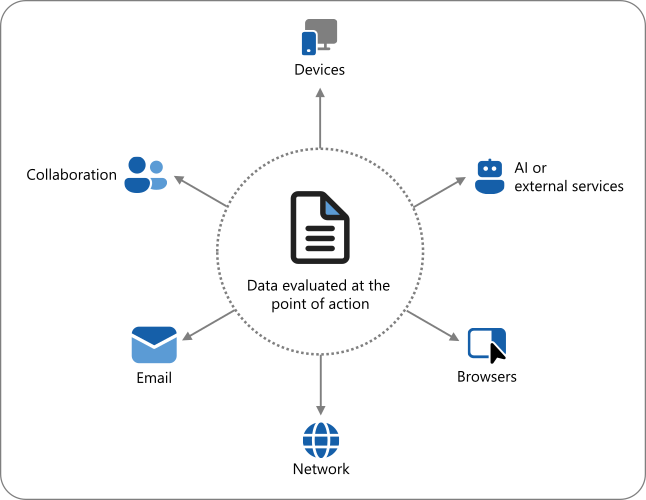
Data loss prevention (DLP) addresses this challenge by evaluating content and context as data is created, shared, or moved. Instead of focusing only on access, DLP focuses on the data itself and the action being taken, which allows organizations to reduce risk without blocking normal work. At a high level, DLP helps organizations detect and respond to risky actions. Decisions are based on what the data is and how it's used.
What data loss looks like in modern organizations
Common data loss scenarios include:
- Sharing sensitive files through email or collaboration tools
- Copying protected content to unmanaged devices or browsers
- Uploading sensitive information to external services or AI tools
- Reusing confidential data in ways that exceed its intended purpose
These actions are often accidental, which makes blanket blocking ineffective and disruptive, and often leads users to find workarounds that increase risk.
Where DLP fits in a data security strategy
Data loss prevention works alongside other data security capabilities:
- Information protection classifies and labels sensitive data
- Data loss prevention uses those signals to apply protective actions at the moment risk occurs
- Insider Risk Management adds behavioral context when elevated risk requires deeper analysis
Together, these capabilities help protect sensitive data while still allowing people to collaborate and work efficiently.
What DLP can and can't do
DLP is designed to reduce risk, not eliminate it entirely.
DLP can:
- Detect sensitive content based on classification and context
- Apply actions like blocking, warning, or auditing risky behavior
- Help organizations validate policies before enforcing them broadly
DLP can't:
- Determine user intent on its own
- Replace data classification or labeling strategies
- Prevent every possible form of misuse
Understanding these boundaries helps set realistic expectations before planning and deploying policies.
With the problem space defined, the next step is to understand how DLP evaluates data and where protection can be applied.