Explore the agentic DevOps concept
Tip
The video for this section is also available in text-based form below.
Agentic DevOps is the practice of using AI agents to automate and orchestrate operational workflows that traditionally required manual coordination. Rather than using AI as a reactive tool that responds to individual prompts, you define a system of specialized agents. These agents proactively execute multi-step pipelines, maintain context across stages, and produce versioned artifacts.
In an agentic DevOps model, the AI isn't just a coding assistant. It's an active participant in the workflow. Each agent has a defined role, access to specific tools, and domain knowledge that shapes its outputs. A coordinating agent manages the sequence, delegates tasks, and ensures that outputs from one stage are available to the next.
Single-agent vs. multi-agent patterns
When you use an AI assistant to help with a single task, such as generating a Bicep template or writing a deployment script, you're working with a single-agent pattern. The agent has one job, one context, and one output. This works well for isolated tasks but breaks down when the workflow has several interconnected steps.
A multi-agent pattern distributes the workflow across several specialized agents, each focused on a specific domain:
| Agent role | Responsibility | Example output |
|---|---|---|
| Requirements agent | Parse a natural-language scenario into structured requirements | A requirements document with resource types, SKUs, and constraints |
| Architecture agent | Assess the requirements and recommend services, trade-offs, and design decisions | An architecture assessment with service recommendations |
| IaC generation agent | Generate infrastructure-as-code templates based on the architecture | Bicep or Terraform templates |
| Deployment agent | Execute the deployment and validate the results | A deployment summary with resource URIs and status |
| Documentation agent | Produce operational documentation from the deployment artifacts | A runbook or demo guide |
Each agent operates independently within its domain but contributes to a shared pipeline. The output of one agent becomes the input for the next.
The conductor pattern
In a multi-agent system, someone (or something) needs to coordinate the workflow. The conductor pattern uses a top-level agent that:
- Receives the user's initial request
- Delegates each step to the appropriate specialized agent
- Verifies that each step completed successfully before moving to the next
- Handles errors and retries when a step fails
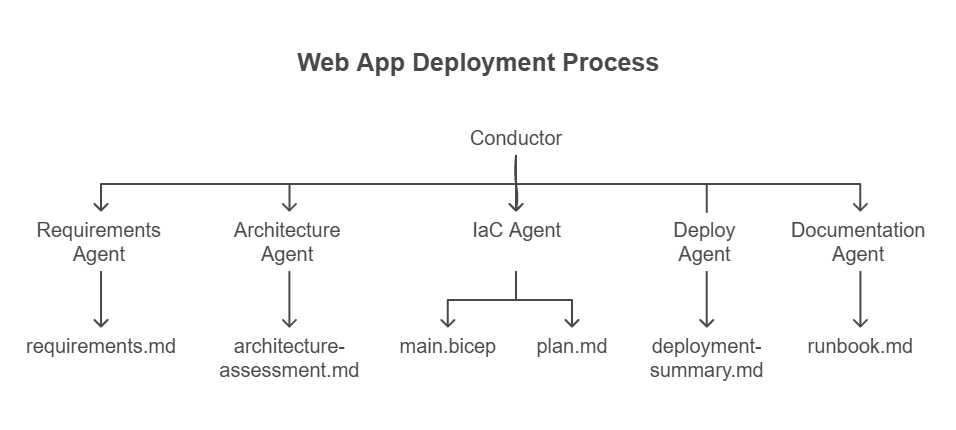
The conductor doesn't perform the actual work. It orchestrates. Think of it as the difference between a project manager and the individual engineers on a team. The conductor knows the workflow sequence and the dependencies between steps. The domain expertise lives in the specialized agents.
Here's how a conductor orchestrates an infrastructure deployment workflow:
Artifact-based communication
Agents in a multi-agent system don't communicate directly through messages. Instead, they communicate through artifacts: files written to a shared location. Each agent reads the artifacts from previous stages and writes its own outputs for downstream agents to consume.
This approach has several advantages:
- Transparency: Every intermediate result is a readable file that you can inspect, modify, or override.
- Reproducibility: If a step fails, you can fix the artifact and rerun only the downstream agents.
- Version control: Artifacts are regular files that work with Git, giving you full change history.
- Isolation: Each agent runs in its own context window. It doesn't inherit accumulated errors or context drift from previous agents.
A typical artifact folder for an infrastructure deployment might look like this:
project/
├── requirements.md
├── architecture-assessment.md
├── architecture-diagram.png
├── implementation-plan.md
├── infra/
│   ├── main.bicep
│   └── main.bicepparam
├── deployment-summary.md
└── docs/
    └── runbook.md
Real-world ops scenarios for agentic DevOps
The multi-agent pattern applies to many operational workflows beyond environment provisioning:
- Compliance auditing: A scanning agent discovers resource configurations. A policy agent evaluates them against organizational standards. A reporting agent generates remediation recommendations.
- Incident response: A monitoring agent detects anomalies. A diagnostic agent gathers logs and metrics. A remediation agent proposes or applies fixes.
- Environment lifecycle management: A provisioning agent creates environments. A monitoring agent tracks usage. A cleanup agent identifies and decommissions unused resources.
- Configuration drift detection: A baseline agent defines the expected state. A scanning agent compares actual state. A correction agent generates the changes needed to bring resources back into compliance.
In each scenario, the pattern is the same: specialized agents handle their domain, a conductor coordinates the sequence, and artifacts provide the shared state between steps.
The next unit examines the specific building blocks you use to create these workflows: agent definitions, skills, instructions, and prompts.