Interpret object classes
The classSchema object tells you what an object of that type must contain, may contain, where it can live, and how it inherits from more general classes.
Core classSchema properties
| Property | Description |
|---|---|
cn |
Relative distinguished name (RDN) of the class definition object |
lDAPDisplayName |
Name used by LDAP clients and filters (for example, user) |
governsID |
Object identifier (OID) that uniquely identifies the class |
schemaIDGUID |
Stable GUID used in object-specific access control |
objectClassCategory |
Integer marking the class structural, abstract, or auxiliary |
subClassOf |
The immediate parent class it inherits from |
mustContain / systemMustContain |
Mandatory attributes (system-prefixed variants are protected) |
mayContain / systemMayContain |
Optional attributes |
auxiliaryClass / systemAuxiliaryClass |
Auxiliary classes that add attributes |
possSuperiors / systemPossSuperiors |
Which parent objects can contain this object |
defaultObjectCategory |
The objectCategory value stamped on new instances |
defaultSecurityDescriptor |
Initial security descriptor for new instances |
systemFlags |
Bit field marking system characteristics |
isDefunct |
Whether the class is deactivated |
Note
rDNAttID, defaultHidingValue, and systemOnly also appear on class definitions.
Structural, abstract, and auxiliary classes
objectClassCategory sorts every class into one of three kinds:
| Category | Purpose | Can be instantiated? |
|---|---|---|
| Structural | Defines objects that can actually exist (user, group) |
Yes |
| Abstract | Provides a common definition base for other classes (top, person) |
No |
| Auxiliary | A reusable attribute bundle attached to other classes | No |
Only structural classes can be instantiated as real directory objects. Abstract classes contribute definitions through inheritance; auxiliary classes contribute a named set of attributes to whatever class includes them.
Inheritance and effective attributes
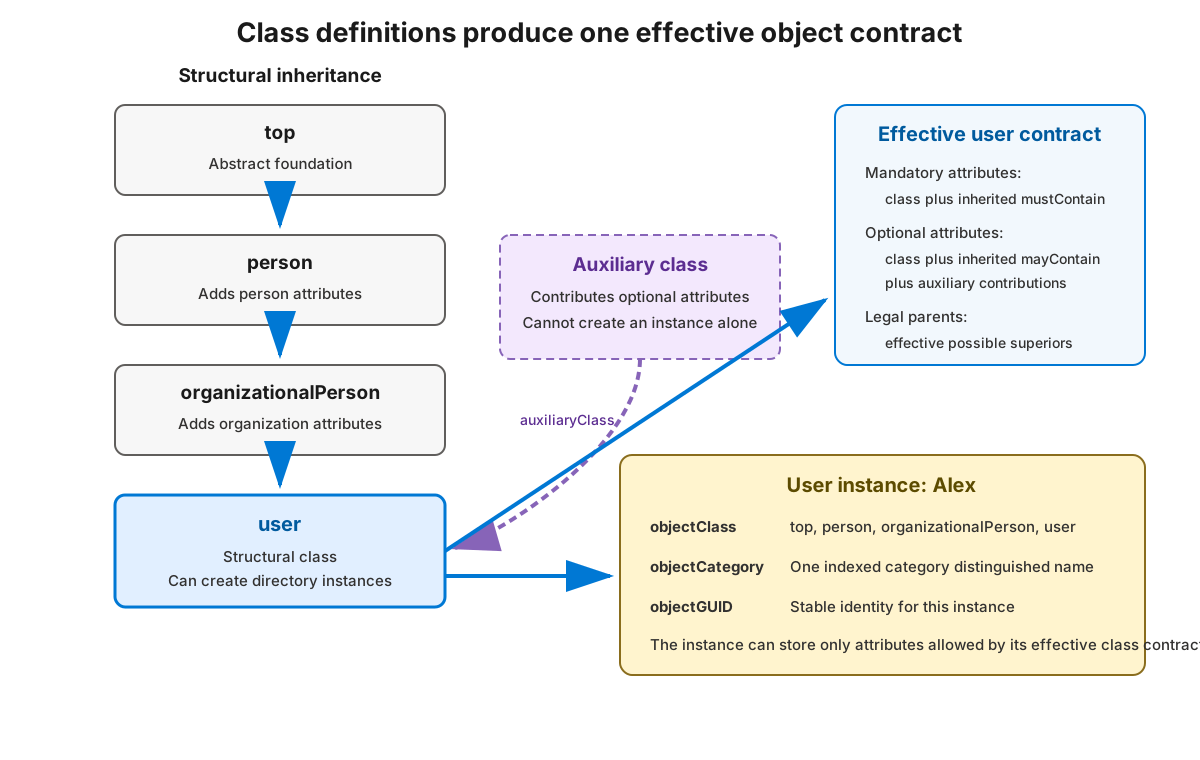
Classes form an inheritance chain through subClassOf. A common example:
top -> person -> organizationalPerson -> user
The effective mandatory and optional attributes of an object are the union of:
- The attributes defined on the class itself,
- The attributes inherited from every superclass up to
top, and - The attributes contributed by any applicable auxiliary classes.
This is why the lists stored directly on the user class aren't the complete picture. To know what a user object can hold, you must combine user with organizationalPerson, person, top, and any auxiliary classes.
possSuperiors constrains hierarchy: it lists the class types that are legal parents, so it governs where in the directory tree an instance may appear.
Inspect a class definition (read-only)
# READ: read the stored definition of the user class
$classProperties = @(
    'lDAPDisplayName','governsID','schemaIDGUID','objectClassCategory',
    'subClassOf','mustContain','systemMustContain','mayContain',
    'systemMayContain','auxiliaryClass','systemAuxiliaryClass',
    'possSuperiors','systemPossSuperiors','defaultObjectCategory',
    'defaultSecurityDescriptor','systemFlags','isDefunct'
)

Get-ADObject `
    -Server $schemaMaster `
    -SearchBase $schemaNC `
    -LDAPFilter '(&(objectClass=classSchema)(lDAPDisplayName=user))' `
    -Properties $classProperties
The mustContain and mayContain values returned here are only the attributes stored directly on user. The full effective set also includes everything inherited and everything added by auxiliary classes.
objectClass, objectCategory, and objectClassCategory
These three similarly named terms are distinct:
| Term | Where it lives | Meaning |
|---|---|---|
objectClass |
On an object instance | Multivalued list of the full inheritance chain (top, person, organizationalPerson, user) |
objectCategory |
On an object instance | Single-valued DN of a class category, used for efficient searches |
objectClassCategory |
On a classSchema definition |
Integer marking the class structural, abstract, or auxiliary |
Searches typically filter on objectCategory because it's single-valued and indexed, making (objectCategory=person) faster and more precise than filtering the multivalued objectClass.
Default category and security behavior
- Property
defaultObjectCategorysets theobjectCategoryvalue stamped onto each new instance of the class. - Property
defaultSecurityDescriptorprovides the initial security descriptor applied to new instances only. Changing it doesn't retroactively resecure objects that already exist.