Interpret schema attributes
An attribute is defined by an attributeSchema object. Its definition controls the attribute's type, size, cardinality, indexing, replication reach, and security exposure everywhere the attribute is used.
Core attributeSchema properties
| Property | Why it matters |
|---|---|
cn |
RDN of the attribute definition object |
lDAPDisplayName |
Name used by LDAP clients and filters |
attributeID |
OID that uniquely identifies the attribute |
schemaIDGUID |
Stable GUID used in object-specific access control |
attributeSyntax |
Data type portion of the syntax triplet |
oMSyntax |
Integer that refines the syntax |
oMObjectClass |
Object type for object-reference syntaxes |
rangeLower / rangeUpper |
Minimum and maximum length or value |
isSingleValued |
Whether the attribute holds one value or many |
searchFlags |
Bit field controlling indexing, ANR, confidentiality, and more |
isMemberOfPartialAttributeSet |
Whether the attribute replicates to the global catalog |
linkID |
Pairs a forward link with its back link |
attributeSecurityGUID |
Associates the attribute with a property set |
schemaFlagsEx |
Marks an attribute critical, blocking RODC filtering |
systemFlags |
Bit field marking system characteristics |
systemOnly |
Whether only the system can write the value |
isDefunct |
Whether the attribute is deactivated |
Syntax, range, and cardinality
The syntax triplet (attributeSyntax, oMSyntax, and where relevant oMObjectClass) determines how AD DS stores and validates values. For example, one triplet defines a Unicode string, another a large integer, another a distinguished-name reference. AD DS enforces the syntax on write; an LDAP client can still present the resulting value in a different textual form.
- Properties
rangeLowerandrangeUpperbound the length of a string or the magnitude of a number. They're validation limits, not storage guarantees. - Property
isSingleValuedchooses cardinality. Multivalued attributes are unordered, so you can't rely on the order values are returned.
Links between objects
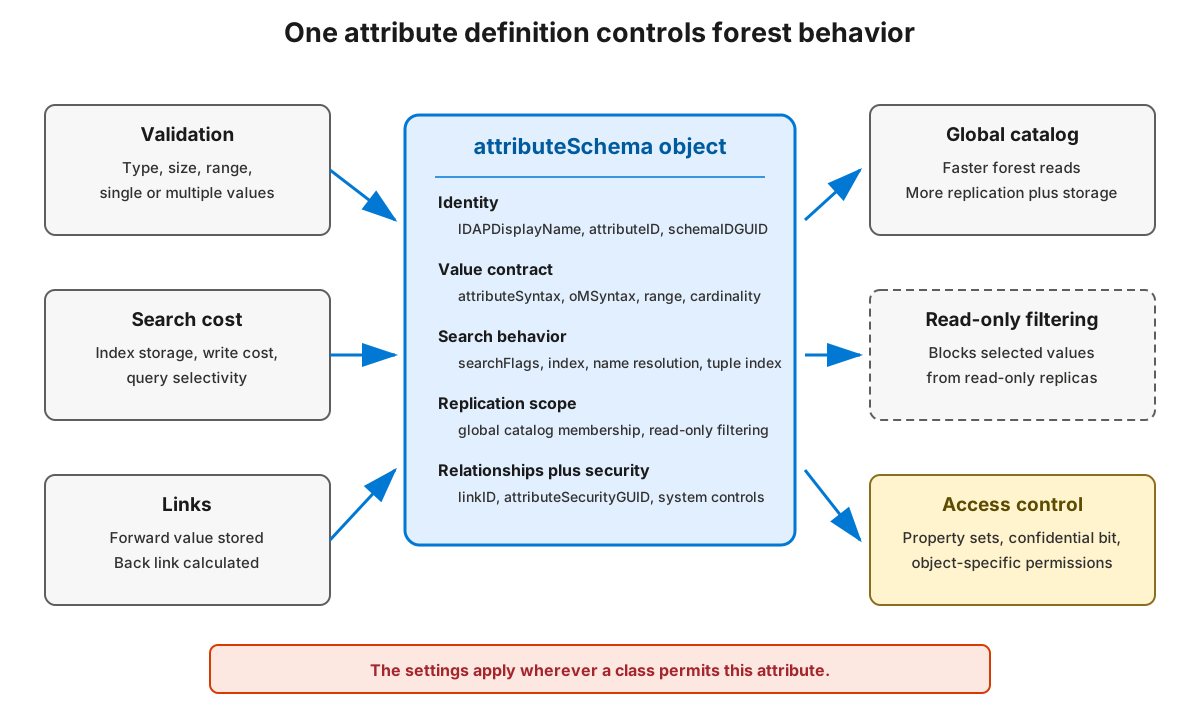
A linked attribute models a managed relationship between objects using a matched pair:
- The forward link stores the reference (for example,
memberon a group). - The back link is calculated from the forward links (for example,
memberOfon a user); you don't write it directly. - The pair is joined by
linkID: the forward link has an even value and the back link the next odd value. - Only forward links replicate; back links are computed locally. Forward-link changes use linked-value replication, which replicates individual values rather than the whole attribute.
Distinguish these from constructed or system-maintained values (such as memberOf or canonicalName) that AD DS calculates rather than stores as ordinary replicated data.
Indexing and search behavior
Indexing is a property of the attribute, so it applies everywhere the attribute is used, not to a single class. The operationally important searchFlags bits are:
| Bit | Meaning |
|---|---|
0x01 |
Create an index |
0x04 |
Include in Ambiguous Name Resolution (ANR) |
0x08 |
Preserve value on logical deletion |
0x20 |
Create a tuple index (for medial searches) |
0x80 |
Mark as confidential |
0x200 |
Include in the RODC filtered attribute set |
Note
searchFlags contains additional bits beyond these. They're rarely administered directly and their numeric values aren't assessed here; see the reference links for the complete field.
Decode the flags on any attribute you retrieved:
# READ: decode the searchFlags bit field for one attribute
$flags = [int]$attribute.searchFlags

[pscustomobject]@{
    Indexed          = [bool]($flags -band 0x01)
    ANR              = [bool]($flags -band 0x04)
    PreserveOnDelete = [bool]($flags -band 0x08)
    TupleIndex       = [bool]($flags -band 0x20)
    Confidential     = [bool]($flags -band 0x80)
    RODCFiltered     = [bool]($flags -band 0x200)
}
Global catalog, read-only domain controllers, and confidentiality
- Partial attribute set (PAS): When
isMemberOfPartialAttributeSetis true, the attribute replicates to every global catalog in the forest. That speeds forest-wide reads but adds replication and storage cost across all GC servers. Add attributes to the GC only when forest-wide reads justify it. - RODC filtered attribute set: The
0x200bit stops an attribute from replicating to read-only domain controllers. It's a replication control, not encryption, and not a substitute for access control lists (ACLs). An attribute marked critical throughschemaFlagsExcan't be added to the filtered attribute set. - Confidential bit (
0x80): Marking an attribute confidential adds an extra control-access authorization check before it can be read. It's not encryption and doesn't replace careful ACL design.
Inspect an attribute definition (read-only)
# READ: read the stored definition of the employeeID attribute
$attributeProperties = @(
    'lDAPDisplayName','attributeID','schemaIDGUID','attributeSyntax',
    'oMSyntax','oMObjectClass','rangeLower','rangeUpper','isSingleValued',
    'searchFlags','isMemberOfPartialAttributeSet','linkID',
    'attributeSecurityGUID','schemaFlagsEx','systemFlags','systemOnly','isDefunct'
)

$attribute = Get-ADObject `
    -Server $schemaMaster `
    -SearchBase $schemaNC `
    -LDAPFilter '(&(objectClass=attributeSchema)(lDAPDisplayName=employeeID))' `
    -Properties $attributeProperties

$attribute

# Convert the byte-array schemaIDGUID to standard GUID notation
[Guid]::new([byte[]]$attribute.schemaIDGUID)
PowerShell commonly returns schemaIDGUID as a raw byte array. Converting it with [Guid]::new(...) produces the GUID notation used in object-specific access-control documentation.
Names and identifiers
An attribute (and a class) carries several identifiers with different purposes and uniqueness scopes:
| Identifier | Purpose | Uniqueness |
|---|---|---|
cn |
RDN of the definition object | Within the schema partition |
lDAPDisplayName |
Name used by LDAP clients and filters | Across all class and attribute definitions |
attributeID |
OID for an attribute | Shared OID space with classes |
governsID |
OID for a class | Shared OID space with attributes |
objectGUID |
Identity of the definition object itself | Forest-wide, per object |
schemaIDGUID |
Stable GUID used in object-specific ACLs | Per definition, reused across installs |
attributeSecurityGUID |
Associates the attribute with a property set | Per property set |
Class and attribute OIDs share one uniqueness space, and lDAPDisplayName values must be unique across both class and attribute definitions.