Govern schema changes
A schema change is forest-wide and effectively permanent. This unit covers when to extend, how to decide safely, and the ownership and controls a change requires.
Permanence sets the stakes
Warning
Adding a class or attribute isn't a reversible operation. Schema objects can't be deleted through a normal rollback, and restoring one domain controller isn't a safe or supported schema-only rollback strategy.
The most you can do to retire a definition is deactivate it by setting isDefunct to true. Even then:
- The definition object remains in the schema.
- Existing data in that attribute isn't automatically removed.
- The identifiers it consumed aren't freed for arbitrary reuse.
Because you can't cleanly undo an extension, the decision to make a schema extension requires careful planning.
Decide: Extend, reuse, or store elsewhere
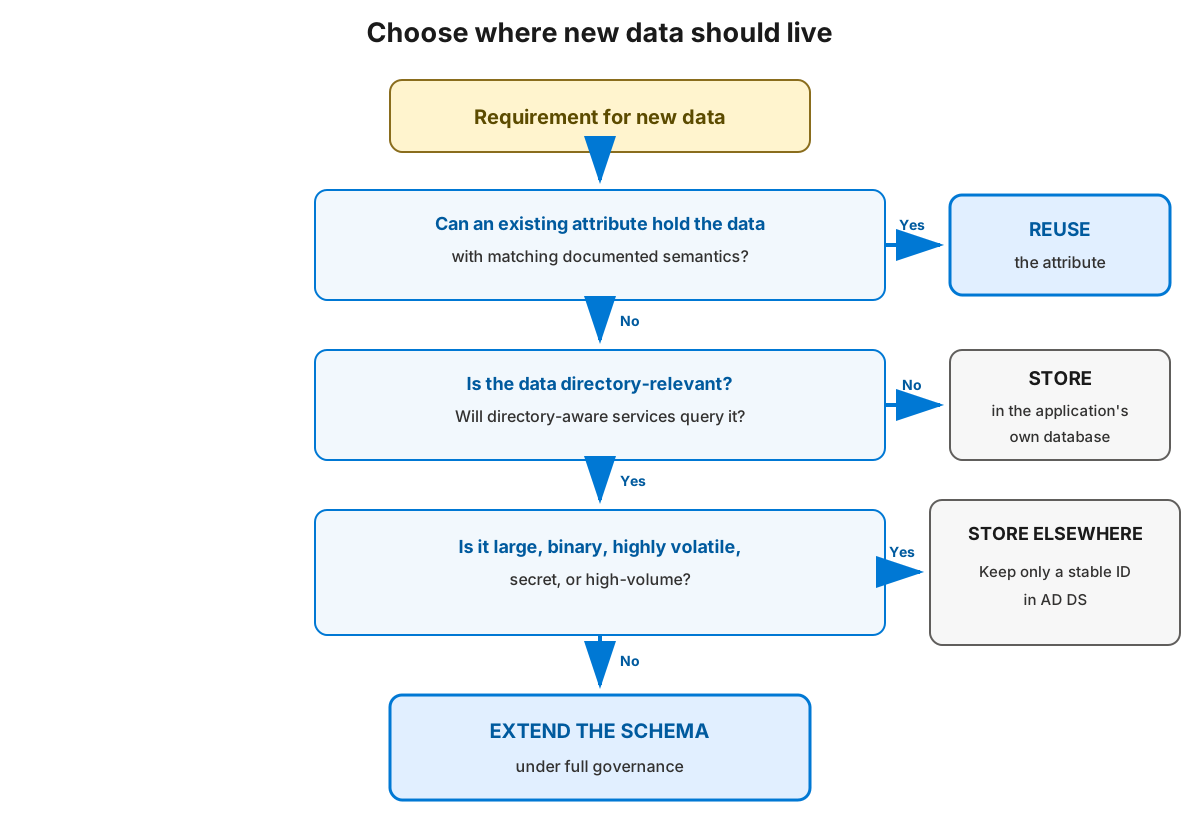
When not to extend
Don't extend the schema simply because AD DS is convenient. Prefer an alternative store when data is:
- Application-private and never used by directory-aware services.
- Large, binary, highly volatile, or unbounded.
- Secret material needing application-layer encryption or specialized controls.
- High-volume telemetry, history, or transactional data.
- Governed by a lifecycle different from the directory object's lifecycle.
- Better kept in an application database with only a stable identifier in AD DS.
Attribute design decisions
- Reuse an existing attribute only when its documented semantics match the new use; never overload an attribute in a way that breaks interoperability.
- Choose the narrowest correct syntax and reasonable
rangeLower/rangeUpperlimits. - Decide single-valued versus multivalued deliberately.
- Plan linked attributes only when a true managed relationship exists.
- Estimate value and object size from current product guidance and representative testing, not from advisory numbers treated as universal hard limits.
- Estimate total storage and replication impact across all instances.
- Avoid indexing attributes with poor selectivity or rare queries; an index consumes storage, adds write cost, and builds in the background on DCs.
- Add an attribute to the global catalog only when forest-wide reads justify the replication and storage cost.
Identifier and naming governance
| Rule | Reason |
|---|---|
| Obtain a registered enterprise OID arc | Guarantees your OIDs never collide with others |
| Keep a central allocation record | Prevents internal reuse of OIDs, names, and GUIDs |
| Use an organization-specific naming prefix | Distinguishes custom classes and attributes from built-ins |
Generate schemaIDGUID values once and reuse them |
Keeps ACLs consistent across every installation |
Important
Never invent OIDs, reuse another organization's OID arc, or reuse identifiers without a collision check. Class and attribute OIDs share one uniqueness space, and lDAPDisplayName must be unique across all class and attribute definitions.
Security design decisions
- Grant temporary, audited Schema Admins membership or narrowly delegated schema rights. The Schema Admins group lives in the forest-root domain; remove membership immediately after the approved change.
- Preflight rights against the schema-container ACLs and effective access.
- Distinguish the four GUID-bearing identifiers: an object's
objectGUID, a definition'sschemaIDGUID, an attribute'sattributeSecurityGUID, and a control access right'srightsGuid. - Understand
controlAccessRightobjects inCN=Extended-Rights,CN=Configuration,...at a conceptual level: they back extended rights, property sets, and validated writes. Defining an attribute doesn't by itself create a custom validated-write implementation. - Remember that
defaultSecurityDescriptorsecures new instances only, the confidential bit is an extra access check (not encryption), and the RODC filtered attribute set is a replication control (not encryption or a permissions substitute). - Never store passwords, private keys, tokens, or equivalent secrets in custom attributes.
Governance controls before any change
- Confirm business and technical ownership, data classification, retention, query patterns, expected object count, and application lifecycle.
- Produce an extension manifest (see the next unit) as the change record.
- Run compatibility analysis against ranges, cardinality, inheritance, legal parents, indexing, GC/RODC behavior, security, storage, and replication cost.
- Check for collisions across
cn,lDAPDisplayName, OID,schemaIDGUID, and where applicablerightsGuidandlinkID. - Confirm recovery readiness: current backups, a validated forest-recovery plan, and acceptance that no simple schema-only rollback exists.
- Validate the exact signed or checksummed package in an isolated test forest representative of production.
- Obtain change approval, and for vendor packages perform a full extension review.
Worked scenario: Application metadata request
A team asks to add an employeeShoeSize attribute to every user so their internal app can read it.
- Directory-relevant? No directory-aware service consumes it.
- Lifecycle? It changes independently of the user object and is app-private.
- Decision: Don't extend. Store it in the application's database keyed by the user's
objectGUID. Extending the forest schema permanently for a single private app is disproportionate to the need.
Worked scenario: Vendor package review
A vendor ships an LDIF package that extends the schema. Before approving it, review:
- Identifiers: registered OID arc, unique
lDAPDisplayNames, stableschemaIDGUIDs, no collisions. - Dependencies and apply order between attributes and the classes that reference them.
- Required permissions and whether they can be time-boxed.
- Test evidence in a representative forest.
- Indexing, ANR, global catalog membership, and RODC handling of each attribute.
- Uninstall behavior. Confirm the vendor doesn't claim uninstall removes schema definitions, because it can't.
Only after that review, and successful test-forest validation, does the package proceed to a change window.