Introduction
For many years, organizations planned software costs around a simple rule: buy the licenses, pay a known amount, and plan for the year. Microsoft 365 Copilot still works this way for everyday AI. Every licensed employee can find information, summarize content, and create drafts for a fixed price per user, per month.
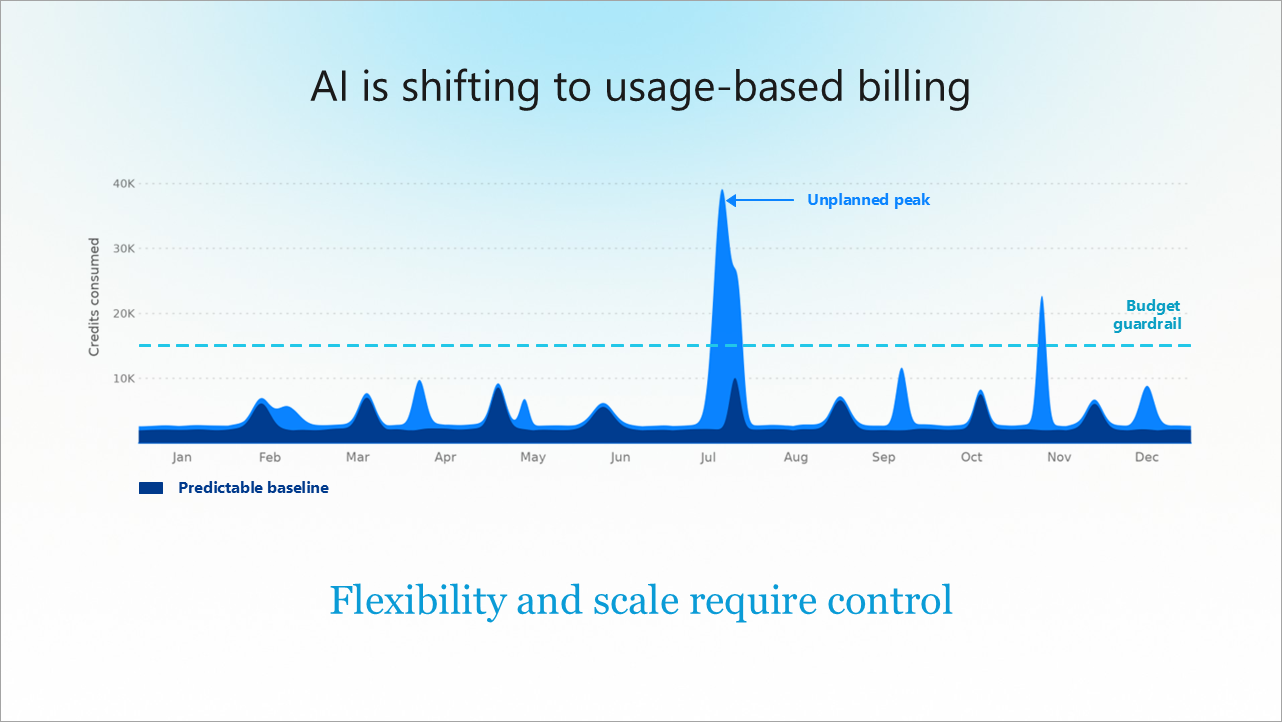
Advanced AI works differently. When an employee hands a long-running, multi-step task to Copilot Cowork, or when an eligible agent runs a business process, the cost depends on the work performed. This is called usage-based billing. The amount consumed rises and falls with how much people use these capabilities and how complex the work is.
Note
Everyday Copilot helps you do a task. Agentic capabilities can take on work for you. When AI takes on work, not just assists with it, the cost model shifts from fixed licensing to usage-based billing.
This change doesn't mean that costs are out of control. It means that spending becomes an ongoing management decision instead of a one-time purchase. Organizations that understand how usage-based AI is billed can turn it on with confidence, start small, and expand as they gather evidence of value.
Tip
Seats refer to the number of licensed users, which determines the fixed cost for everyday Copilot. Credits are consumed when agentic capabilities perform work, and the amount used depends on the complexity and volume of tasks.
Scenario
In this module, you follow Caldova, a mid-size professional services company. Caldova's leadership wants to give one department access to Copilot Cowork.
Before anyone turns it on, the finance team needs to know what the pilot costs, how to pay for it and who owns each decision.
The team also needs to understand why spending should be tied to business outcomes, how usage and value inform decisions, and when evidence supports expanding, adjusting, or stopping a pilot.
In each unit, you help Caldova make one of these decisions. By the end of the module, Caldova has a cost estimate for its pilot, a funding approach, and named owners.