Understand how the Copilot commercial model works
Copilot combines a predictable licensing baseline with usage-based costs for eligible work, so organizations need to plan, control, measure, and optimize consumption against the value it creates.
Everyday AI and Advanced AI
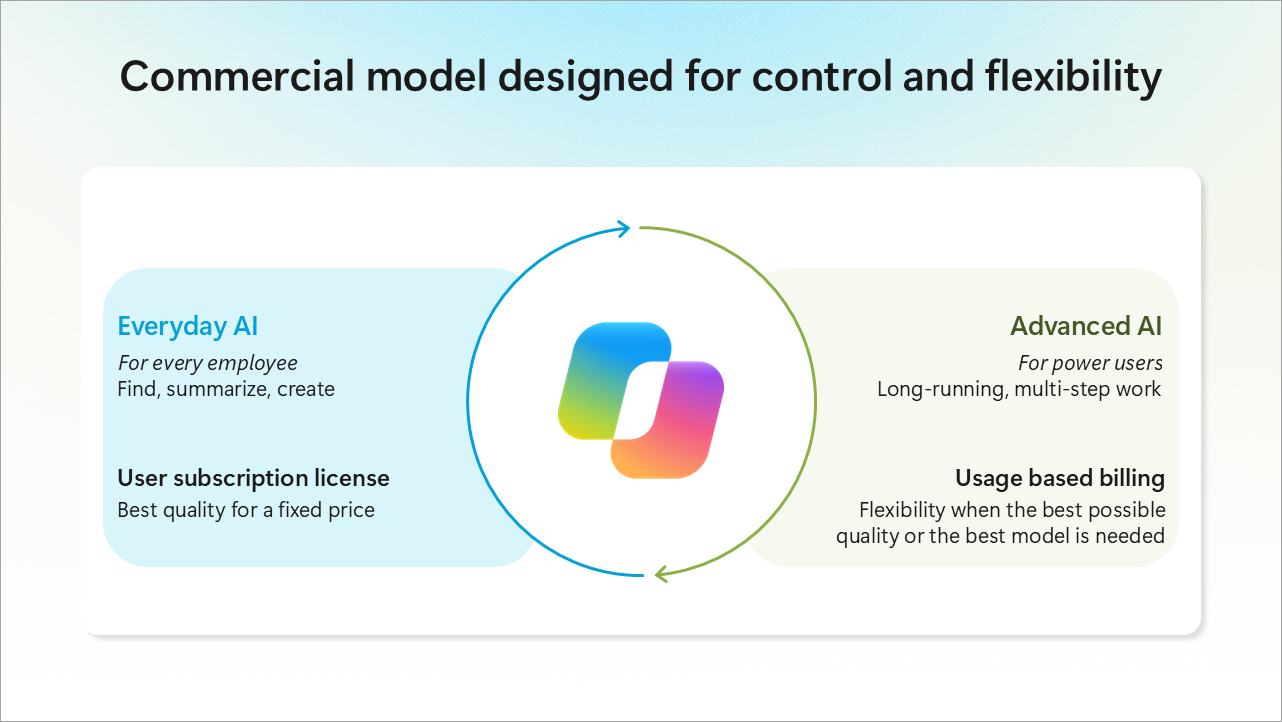
The Copilot commercial model has two parts. Each part matches a different type of AI work. The following table compares the parts:
| Aspect | Everyday AI | Advanced AI |
|---|---|---|
| Typical work | Summarizing, drafting, creating, and analyzing | Delegate complex or long-running work |
| How access works | Included with the applicable user license | Requires the applicable license, plus organizational enablement and funding |
| How it's paid for | Fixed per-user subscription | Eligible usage consumes Copilot Credits, funded through a supported billing option |
| Examples | Copilot Chat and Copilot in Word, Excel, PowerPoint, Outlook, and Teams | Copilot Cowork and eligible usage-based agent experiences |
Everyday AI is included in the Microsoft 365 Copilot license. Quick answers, drafts, summaries, and analysis stay in the subscription at a predictable cost.
Advanced AI is work you delegate. Copilot Cowork can gather information from many sources, reason over it and produce several deliverables, sometimes over a long period. This type of agentic work can require more time and compute, so eligible usage is measured in Copilot Credits.
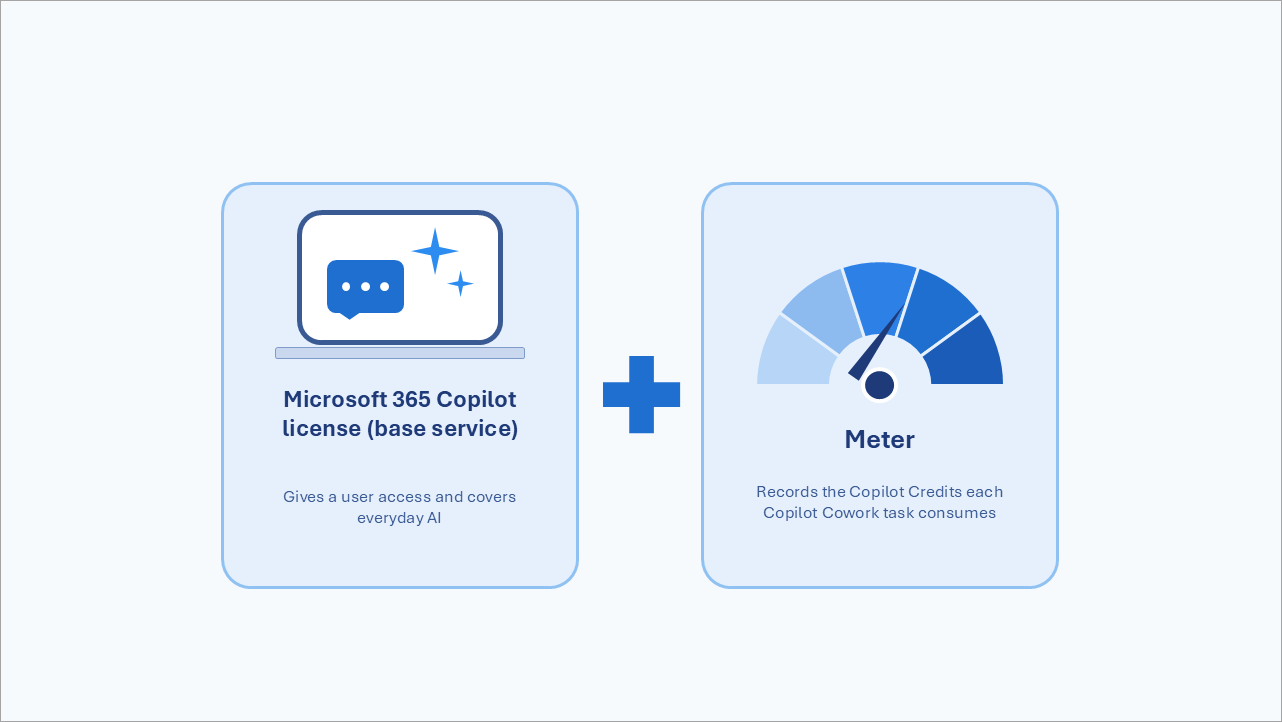
Think of the commercial model as a base service with a meter for additional work. The Microsoft 365 Copilot license is the base: it gives a user access and covers everyday AI. When that same user runs an eligible Copilot Cowork task, the meter records the credits consumed by that task. The meter doesn't replace the base service; Copilot Cowork still requires the user to have a Microsoft 365 Copilot license.
That means a budget needs to account for both costs separately: the fixed cost of licenses and an estimate of Copilot Credit consumption.
Why not every task requires advanced AI
Many everyday tasks, such as turning a meeting transcript into a short list of action items, can be handled by the AI included in the license, and extra capability doesn't meaningfully improve the result.
Long-running, multi-step work, such as research across many sources that produces several deliverables, benefits from more advanced capability.
The commercial model reflects this difference: predictable pricing for everyday work, and usage-based billing for demanding work that needs more.
Caldova decision
Caldova confirms that every employee in the pilot department already has a Microsoft 365 Copilot license.
The new cost to plan for is the Copilot Credit consumption.
This doesn't make AI spending unpredictable. It means organizations need to actively manage the variable part of the model.
Note
If your department started using Copilot Cowork next month, which costs are already covered by licenses and which would need a separate budget? What would you confirm before approving the pilot?