Note
Access to this page requires authorization. You can try signing in or changing directories.
Access to this page requires authorization. You can try changing directories.
Devices have two main behaviors that are addressed by the WPD architecture:
- Accessing and storing content. For example, applications must be able to add music files to a portable music player.
- Programming the device. This includes simple operations such as changing settings and preparing the device for data capture, or more complex operations such as uploading firmware. For example, a Take Picture command might be issued to a digital still camera.
In WPD, these behaviors are described by representing the device as a hierarchy of objects. The following picture shows a WPD object representation for a multifunction device, in this case, a mobile phone.
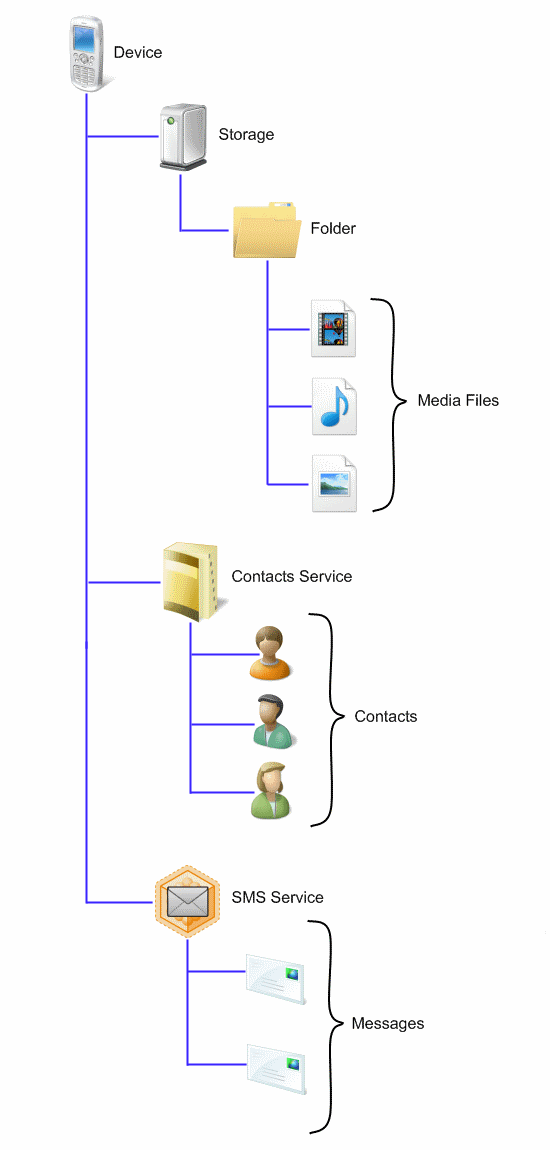
This hierarchy illustrates the following functionality and contents.
Functionality
- Storage object. This device has data storage.
- Contacts Service. This service is a functional object that can be used to synchronize and store contacts on the phone.
- SMS Service. This service is a functional object that can be used to send, receive, and store SMS messages.
Contents
- Media objects. This device stores images, music, and video files in folders on the Storage object. While the files shown above are stored under one folder, a device can subdivide content into folders organized by the type of media stored (such as an image folder, a music folder, or a video folder).
- Contact objects. This device stores contact information (such as name, phone number, address, and so on) as children of the Contacts Service.
- Message objects. This device stores SMS (Short Message Service) messages as children of the SMS Service.