Nota:
El acceso a esta página requiere autorización. Puede intentar iniciar sesión o cambiar directorios.
El acceso a esta página requiere autorización. Puede intentar cambiar los directorios.
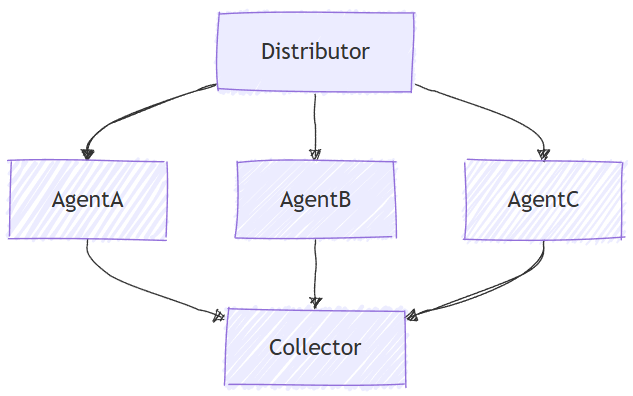
La orquestación simultánea permite que varios agentes funcionen en la misma tarea en paralelo. Cada agente procesa la entrada de forma independiente y sus resultados se recopilan y agregan. Este enfoque es adecuado para escenarios en los que diversas perspectivas o soluciones son valiosas, como lluvia de ideas, razonamiento de conjuntos o sistemas de votación.
Temas que se abordarán
- Cómo definir varios agentes con diferentes conocimientos
- Cómo organizar estos agentes para que funcionen simultáneamente en una sola tarea
- Recopilación y procesamiento de los resultados
En la orquestación concurrente, varios agentes trabajan en la misma tarea simultáneamente e independientemente, proporcionando diversas perspectivas sobre la misma entrada.
Configuración del cliente de Azure OpenAI
using System;
using System.Collections.Generic;
using System.Linq;
using System.Threading.Tasks;
using Azure.AI.OpenAI;
using Azure.Identity;
using Microsoft.Agents.AI.Workflows;
using Microsoft.Extensions.AI;
using Microsoft.Agents.AI;

// 1) Set up the Azure OpenAI client
var endpoint = Environment.GetEnvironmentVariable("AZURE_OPENAI_ENDPOINT") ??
    throw new InvalidOperationException("AZURE_OPENAI_ENDPOINT is not set.");
var deploymentName = Environment.GetEnvironmentVariable("AZURE_OPENAI_DEPLOYMENT_NAME") ?? "gpt-4o-mini";
var client = new AzureOpenAIClient(new Uri(endpoint), new AzureCliCredential())
    .GetChatClient(deploymentName)
    .AsIChatClient();
Definir los agentes
Cree varios agentes especializados que funcionarán en la misma tarea simultáneamente:
// 2) Helper method to create translation agents
static ChatClientAgent GetTranslationAgent(string targetLanguage, IChatClient chatClient) =>
    new(chatClient,
        $"You are a translation assistant who only responds in {targetLanguage}. Respond to any " +
        $"input by outputting the name of the input language and then translating the input to {targetLanguage}.");

// Create translation agents for concurrent processing
var translationAgents = (from lang in (string[])["French", "Spanish", "English"]
                         select GetTranslationAgent(lang, client));
Configurar la orquestación simultánea
Compile el flujo de trabajo mediante AgentWorkflowBuilder para ejecutar agentes en paralelo:
// 3) Build concurrent workflow
var workflow = AgentWorkflowBuilder.BuildConcurrent(translationAgents);
Ejecutar el flujo de trabajo simultáneo y recopilar resultados
Ejecute el flujo de trabajo y procese eventos de todos los agentes que se ejecutan simultáneamente:
// 4) Run the workflow
var messages = new List<ChatMessage> { new(ChatRole.User, "Hello, world!") };

StreamingRun run = await InProcessExecution.StreamAsync(workflow, messages);
await run.TrySendMessageAsync(new TurnToken(emitEvents: true));

List<ChatMessage> result = new();
await foreach (WorkflowEvent evt in run.WatchStreamAsync().ConfigureAwait(false))
{
    if (evt is AgentRunUpdateEvent e)
    {
        Console.WriteLine($"{e.ExecutorId}: {e.Data}");
    }
    else if (evt is WorkflowOutputEvent outputEvt)
    {
        result = (List<ChatMessage>)outputEvt.Data!;
        break;
    }
}

// Display aggregated results from all agents
Console.WriteLine("===== Final Aggregated Results =====");
foreach (var message in result)
{
    Console.WriteLine($"{message.Role}: {message.Content}");
}
Salida de ejemplo
French_Agent: English detected. Bonjour, le monde !
Spanish_Agent: English detected. ¡Hola, mundo!
English_Agent: English detected. Hello, world!

===== Final Aggregated Results =====
User: Hello, world!
Assistant: English detected. Bonjour, le monde !
Assistant: English detected. ¡Hola, mundo!
Assistant: English detected. Hello, world!
Conceptos clave
- Ejecución paralela: todos los agentes procesan la entrada simultánea e independiente
- AgentWorkflowBuilder.BuildConcurrent(): crea un flujo de trabajo simultáneo a partir de una colección de agentes.
- Agregación automática: los resultados de todos los agentes se recopilan automáticamente en el resultado final.
-
Streaming de eventos: monitoreo en tiempo real del avance del agente
AgentRunUpdateEvent - Diversas perspectivas: cada agente aporta su experiencia única al mismo problema
Los agentes son entidades especializadas que pueden procesar tareas. Aquí definimos tres agentes: un experto en investigación, un experto en marketing y un experto legal.
from agent_framework.azure import AzureChatClient

# 1) Create three domain agents using AzureChatClient
chat_client = AzureChatClient(credential=AzureCliCredential())

researcher = chat_client.create_agent(
    instructions=(
        "You're an expert market and product researcher. Given a prompt, provide concise, factual insights,"
        " opportunities, and risks."
    ),
    name="researcher",
)

marketer = chat_client.create_agent(
    instructions=(
        "You're a creative marketing strategist. Craft compelling value propositions and target messaging"
        " aligned to the prompt."
    ),
    name="marketer",
)

legal = chat_client.create_agent(
    instructions=(
        "You're a cautious legal/compliance reviewer. Highlight constraints, disclaimers, and policy concerns"
        " based on the prompt."
    ),
    name="legal",
)
Configurar la orquestación simultánea
La ConcurrentBuilder clase permite construir un flujo de trabajo para ejecutar varios agentes en paralelo. Se pasa la lista de agentes como participantes.
from agent_framework import ConcurrentBuilder

# 2) Build a concurrent workflow
# Participants are either Agents (type of AgentProtocol) or Executors
workflow = ConcurrentBuilder().participants([researcher, marketer, legal]).build()
Ejecutar el flujo de trabajo simultáneo y recopilar los resultados
from agent_framework import ChatMessage, WorkflowOutputEvent

# 3) Run with a single prompt, stream progress, and pretty-print the final combined messages
output_evt: WorkflowOutputEvent  | None = None
async for event in workflow.run_stream("We are launching a new budget-friendly electric bike for urban commuters."):
    if isinstance(event, WorkflowOutputEvent):
        output_evt = event

if output_evt:
    print("===== Final Aggregated Conversation (messages) =====")
    messages: list[ChatMessage] | Any = output_evt.data
    for i, msg in enumerate(messages, start=1):
        name = msg.author_name if msg.author_name else "user"
        print(f"{'-' * 60}\n\n{i:02d} [{name}]:\n{msg.text}")
Salida de ejemplo
Sample Output:

    ===== Final Aggregated Conversation (messages) =====
    ------------------------------------------------------------

    01 [user]:
    We are launching a new budget-friendly electric bike for urban commuters.
    ------------------------------------------------------------

    02 [researcher]:
    **Insights:**

    - **Target Demographic:** Urban commuters seeking affordable, eco-friendly transport;
        likely to include students, young professionals, and price-sensitive urban residents.
    - **Market Trends:** E-bike sales are growing globally, with increasing urbanization,
        higher fuel costs, and sustainability concerns driving adoption.
    - **Competitive Landscape:** Key competitors include brands like Rad Power Bikes, Aventon,
        Lectric, and domestic budget-focused manufacturers in North America, Europe, and Asia.
    - **Feature Expectations:** Customers expect reliability, ease-of-use, theft protection,
        lightweight design, sufficient battery range for daily city commutes (typically 25-40 miles),
        and low-maintenance components.

    **Opportunities:**

    - **First-time Buyers:** Capture newcomers to e-biking by emphasizing affordability, ease of
        operation, and cost savings vs. public transit/car ownership.
    ...
    ------------------------------------------------------------

    03 [marketer]:
    **Value Proposition:**
    "Empowering your city commute: Our new electric bike combines affordability, reliability, and
        sustainable design—helping you conquer urban journeys without breaking the bank."

    **Target Messaging:**

    *For Young Professionals:*
    ...
    ------------------------------------------------------------

    04 [legal]:
    **Constraints, Disclaimers, & Policy Concerns for Launching a Budget-Friendly Electric Bike for Urban Commuters:**

    **1. Regulatory Compliance**
    - Verify that the electric bike meets all applicable federal, state, and local regulations
        regarding e-bike classification, speed limits, power output, and safety features.
    - Ensure necessary certifications (e.g., UL certification for batteries, CE markings if sold internationally) are obtained.

    **2. Product Safety**
    - Include consumer safety warnings regarding use, battery handling, charging protocols, and age restrictions.
Avanzado: Ejecutores de agente personalizados
La orquestación simultánea admite ejecutores personalizados que encapsulan agentes con lógica adicional. Esto resulta útil cuando necesita más control sobre cómo se inicializan los agentes y cómo procesan las solicitudes:
Definir ejecutores de agente personalizados
from agent_framework import (
    AgentExecutorRequest,
    AgentExecutorResponse,
    ChatAgent,
    Executor,
    WorkflowContext,
    handler,
)

class ResearcherExec(Executor):
    agent: ChatAgent

    def __init__(self, chat_client: AzureChatClient, id: str = "researcher"):
        agent = chat_client.create_agent(
            instructions=(
                "You're an expert market and product researcher. Given a prompt, provide concise, factual insights,"
                " opportunities, and risks."
            ),
            name=id,
        )
        super().__init__(agent=agent, id=id)

    @handler
    async def run(self, request: AgentExecutorRequest, ctx: WorkflowContext[AgentExecutorResponse]) -> None:
        response = await self.agent.run(request.messages)
        full_conversation = list(request.messages) + list(response.messages)
        await ctx.send_message(AgentExecutorResponse(self.id, response, full_conversation=full_conversation))

class MarketerExec(Executor):
    agent: ChatAgent

    def __init__(self, chat_client: AzureChatClient, id: str = "marketer"):
        agent = chat_client.create_agent(
            instructions=(
                "You're a creative marketing strategist. Craft compelling value propositions and target messaging"
                " aligned to the prompt."
            ),
            name=id,
        )
        super().__init__(agent=agent, id=id)

    @handler
    async def run(self, request: AgentExecutorRequest, ctx: WorkflowContext[AgentExecutorResponse]) -> None:
        response = await self.agent.run(request.messages)
        full_conversation = list(request.messages) + list(response.messages)
        await ctx.send_message(AgentExecutorResponse(self.id, response, full_conversation=full_conversation))
Creación de un flujo de trabajo con ejecutores personalizados
chat_client = AzureChatClient(credential=AzureCliCredential())

researcher = ResearcherExec(chat_client)
marketer = MarketerExec(chat_client)
legal = LegalExec(chat_client)

workflow = ConcurrentBuilder().participants([researcher, marketer, legal]).build()
Avanzado: Agregador personalizado
De forma predeterminada, la orquestación simultánea agrega todas las respuestas del agente en una lista de mensajes. Puede invalidar este comportamiento con un agregador personalizado que procese los resultados de una manera específica:
Definir un agregador personalizado
# Define a custom aggregator callback that uses the chat client to summarize
async def summarize_results(results: list[Any]) -> str:
    # Extract one final assistant message per agent
    expert_sections: list[str] = []
    for r in results:
        try:
            messages = getattr(r.agent_run_response, "messages", [])
            final_text = messages[-1].text if messages and hasattr(messages[-1], "text") else "(no content)"
            expert_sections.append(f"{getattr(r, 'executor_id', 'expert')}:\n{final_text}")
        except Exception as e:
            expert_sections.append(f"{getattr(r, 'executor_id', 'expert')}: (error: {type(e).__name__}: {e})")

    # Ask the model to synthesize a concise summary of the experts' outputs
    system_msg = ChatMessage(
        Role.SYSTEM,
        text=(
            "You are a helpful assistant that consolidates multiple domain expert outputs "
            "into one cohesive, concise summary with clear takeaways. Keep it under 200 words."
        ),
    )
    user_msg = ChatMessage(Role.USER, text="\n\n".join(expert_sections))

    response = await chat_client.get_response([system_msg, user_msg])
    # Return the model's final assistant text as the completion result
    return response.messages[-1].text if response.messages else ""
Creación de un flujo de trabajo con agregador personalizado
workflow = (
    ConcurrentBuilder()
    .participants([researcher, marketer, legal])
    .with_aggregator(summarize_results)
    .build()
)

output_evt: WorkflowOutputEvent | None = None
async for event in workflow.run_stream("We are launching a new budget-friendly electric bike for urban commuters."):
    if isinstance(event, WorkflowOutputEvent):
        output_evt = event

if output_evt:
    print("===== Final Consolidated Output =====")
    print(output_evt.data)
Salida de ejemplo con agregador personalizado
===== Final Consolidated Output =====
Urban e-bike demand is rising rapidly due to eco-awareness, urban congestion, and high fuel costs,
with market growth projected at a ~10% CAGR through 2030. Key customer concerns are affordability,
easy maintenance, convenient charging, compact design, and theft protection. Differentiation opportunities
include integrating smart features (GPS, app connectivity), offering subscription or leasing options, and
developing portable, space-saving designs. Partnering with local governments and bike shops can boost visibility.

Risks include price wars eroding margins, regulatory hurdles, battery quality concerns, and heightened expectations
for after-sales support. Accurate, substantiated product claims and transparent marketing (with range disclaimers)
are essential. All e-bikes must comply with local and federal regulations on speed, wattage, safety certification,
and labeling. Clear warranty, safety instructions (especially regarding batteries), and inclusive, accessible
marketing are required. For connected features, data privacy policies and user consents are mandatory.

Effective messaging should target young professionals, students, eco-conscious commuters, and first-time buyers,
emphasizing affordability, convenience, and sustainability. Slogan suggestion: "Charge Ahead—City Commutes Made
Affordable." Legal review in each target market, compliance vetting, and robust customer support policies are
critical before launch.
Conceptos clave
- Ejecución paralela: todos los agentes trabajan en la tarea de forma simultánea e independiente
- Agregación de resultados: los resultados se recopilan y se pueden procesar mediante el agregador predeterminado o personalizado.
- Diversas perspectivas: cada agente aporta su experiencia única al mismo problema
- Participantes flexibles: puede usar agentes directamente o encapsularlos en ejecutores personalizados.
- Procesamiento personalizado: invalide el agregador predeterminado para sintetizar los resultados de maneras específicas del dominio