Nota:
El acceso a esta página requiere autorización. Puede intentar iniciar sesión o cambiar directorios.
El acceso a esta página requiere autorización. Puede intentar cambiar los directorios.
Este tutorial muestra cómo evaluar un sistema de generación aumentada por recuperación (RAG) en Microsoft Fabric. El ejemplo mide dos cosas: si el recuperador encuentra el documento fuente correcto en Búsqueda de Azure AI y si la respuesta generada permanece fundamentada en el contexto recuperado. Al final del tutorial, dispondrás de un flujo de trabajo reproducible de pruebas comparativas para comparar las configuraciones de los prompts y de recuperación, detectar regresiones y evaluar la calidad de las respuestas antes de su uso en producción.
Este tutorial se centra en:
- Configuración de los servicios azure OpenAI y Búsqueda de Azure AI
- Carga los datos de benchmark del conjunto de datos de QA de CMU para crear un conjunto de evaluación pequeño
- Haz una prueba de humo con una consulta para confirmar que el flujo RAG funciona de extremo a extremo
- Definir métricas deterministas y asistidas por IA
- Comprobación 1: evaluar el rendimiento del recuperador mediante la precisión en el top-N
- Comprobación 2: evalúa la generación de respuestas mediante métricas de fundamentación, relevancia y similitud
- Guarda y compara los resultados de las evaluaciones en OneLake
Prerrequisitos
Antes de empezar, asegúrate de contar con estos recursos y permisos:
- Un espacio de trabajo y casa lacustre de Microsoft Fabric
- Un proyecto de Fundición de IA de Azure con un recurso Azure OpenAI y modelos de chat y de inserción implementados
- Un servicio de Búsqueda de Azure AI con un índice vectorial que contiene el contenido incrustado creado en el tutorial anterior
- Valores del punto de conexión, claves de API y nombres de despliegue para ambos servicios
- Permiso para leer el lakehouse, acceder al recurso de Azure OpenAI y consultar el servicio Búsqueda de Azure AI
Si aún no tienes estos recursos, completa primero el inicio rápido de RAG . Ese inicio rápido crea el lakehouse y el índice vectorial que se usan en esta evaluación comparativa.

Configuración del acceso a Azure OpenAI y Búsqueda de Azure AI
Defina puntos de conexión y claves necesarias. Importe las bibliotecas y funciones necesarias. Cree instancias de clientes para Azure OpenAI y Búsqueda de Azure AI. Defina un envoltorio de funciones con una solicitud para realizar consultas al sistema RAG.
# Enter your Azure OpenAI service values.
# Use the deployment names you created in Azure OpenAI, not the base model name.
aoai_endpoint = "https://<your-resource-name>.openai.azure.com"
aoai_key = "<your-azure-openai-key>"
aoai_deployment_name_embeddings = "<your-embedding-deployment-name>"
aoai_deployment_name_query = "<your-chat-deployment-name>"
aoai_deployment_name_metrics = "<your-chat-deployment-name>"
aoai_api_version = "2025-04-01-preview"

# Set up Azure AI Search.
aisearch_index_name = "<your-index-name>"
aisearch_api_key = "<your-search-key>"
aisearch_endpoint = "https://<your-resource-name>.search.windows.net"
import warnings
warnings.filterwarnings("ignore", category=DeprecationWarning)

import os, requests, json

from datetime import datetime, timedelta
from azure.core.credentials import AzureKeyCredential
from azure.search.documents import SearchClient

from pyspark.sql import functions as F
from pyspark.sql.functions import to_timestamp, current_timestamp, concat, col, split, explode, udf, monotonically_increasing_id, when, rand, coalesce, lit, input_file_name, regexp_extract, concat_ws, length, ceil
from pyspark.sql.types import StructType, StructField, StringType, IntegerType, TimestampType, ArrayType, FloatType
from pyspark.sql import Row
import pandas as pd
from azure.search.documents.indexes import SearchIndexClient
from azure.search.documents.models import (
    VectorizedQuery,
)
from azure.search.documents.indexes.models import (
    SearchIndex,
    SearchField,
    SearchFieldDataType,
    SimpleField,
    SearchableField,
    SemanticConfiguration,
    SemanticPrioritizedFields,
    SemanticField,
    SemanticSearch,
    VectorSearch,
    HnswAlgorithmConfiguration,
    HnswParameters,
    VectorSearchProfile,
    VectorSearchAlgorithmKind,
    VectorSearchAlgorithmMetric,
)

import openai
from openai import AzureOpenAI
from synapse.ml.fabric.credentials import get_openai_httpx_sync_client
import uuid
import matplotlib.pyplot as plt
from synapse.ml.featurize.text import PageSplitter
import ipywidgets as widgets
from IPython.display import display as w_display
Salida de celda:StatementMeta(, 21cb8cd3-7742-4c1f-8339-265e2846df1d, 6, Finished, Available, Finished)
# Configure access to the Azure OpenAI endpoint.
# In Fabric, use the built-in HTTP client helper so authentication is handled correctly.
embed_client = AzureOpenAI(
    api_version=aoai_api_version,
    azure_endpoint=aoai_endpoint,
    api_key=aoai_key,
    http_client=get_openai_httpx_sync_client(),
)

chat_client = AzureOpenAI(
    azure_endpoint=aoai_endpoint,
    api_key=aoai_key,
    api_version=aoai_api_version,
    http_client=get_openai_httpx_sync_client(),
)

# Configure access to Azure AI Search.
search_client = SearchClient(
    aisearch_endpoint,
    aisearch_index_name,
    credential=AzureKeyCredential(aisearch_api_key)
)
Una vez completada la configuración, confirma lo siguiente antes de continuar:
- Los clientes de OpenAI de Azure se crean sin errores.
- El nombre del índice de Búsqueda de Azure AI coincide con el índice que creaste.
- Una consulta de ejemplo devuelve contexto no vacío de
get_context_source.
Si alguna comprobación falla, revisa los valores de los endpoints, las claves API y los nombres de los despliegues antes de pasar al benchmark.
Salida de celda:StatementMeta(, 21cb8cd3-7742-4c1f-8339-265e2846df1d, 7, Finished, Available, Finished)
Las siguientes funciones implementan los dos componentes principales de RAG: recuperador (get_context_source) y generador de respuestas (get_answer). El código es similar al tutorial anterior. El topN parámetro permite establecer el número de recursos pertinentes que se van a recuperar (en este tutorial se usa 3, pero el valor óptimo puede variar según el conjunto de datos):
# Implement retriever
def get_context_source(question, topN=3):
    """
    Retrieves contextual information and sources related to a given question using embeddings and a vector search.
    Parameters:
    question (str): The question for which the context and sources are to be retrieved.
    topN (int, optional): The number of top results to retrieve. Default is 3.

    Returns:
    List: A list containing two elements:
        1. A string with the concatenated retrieved context.
        2. A list of retrieved source paths.
    """
    query_embedding = embed_client.embeddings.create(
        input=question,
        model=aoai_deployment_name_embeddings,
    ).data[0].embedding

    vector_query = VectorizedQuery(vector=query_embedding, k_nearest_neighbors=topN, fields="Embedding")

    results = search_client.search(
        vector_queries=[vector_query],
        top=topN,
    )

    retrieved_context = ""
    retrieved_sources = []
    for result in results:
        retrieved_context += result['ExtractedPath'] + "\n" + result['Chunk'] + "\n\n"
        retrieved_sources.append(result['ExtractedPath'])

    return [retrieved_context, retrieved_sources]

# Implement response generator
def get_answer(question, context):
    """
    Generates a response to a given question using provided context and an Azure OpenAI model.

    Parameters:
        question (str): The question that needs to be answered.
        context (str): The contextual information related to the question that will help generate a relevant response.

    Returns:
        str: The response generated by the Azure OpenAI model based on the provided question and context.
    """
    messages = [
        {
            "role": "system",
            "content": "You are a chat assistant. Use provided text to ground your response. Give a one-word answer when possible ('yes'/'no' is OK where appropriate, no details). Unnecessary words incur a $500 penalty."
        }
    ]

    messages.append(
        {
            "role": "user",
            "content": question + "\n" + context,
        },
    )

    chat_completion = chat_client.chat.completions.create(
        model=aoai_deployment_name_query,
        messages=messages,
    )

    return chat_completion.choices[0].message.content
Salida de celda:StatementMeta(, 21cb8cd3-7742-4c1f-8339-265e2846df1d, 8, Finished, Available, Finished)
Dataset
La versión 1.2 del conjunto de datos Question-Answer de la Universidad Carnegie Mellon es un corpus de artículos de Wikipedia con preguntas fácticas y respuestas escritas manualmente. Está alojado en Azure Blob Storage bajo la GFDL. El conjunto de datos usa una tabla con estos campos:
-
ArticleTitle: nombre del artículo de Wikipedia del cual proceden las preguntas y respuestas -
Question: pregunta escrita manualmente sobre el artículo -
Answer: respuesta escrita manualmente basada en el artículo -
DifficultyFromQuestioner: calificación de dificultad asignada por el autor de la pregunta -
DifficultyFromAnswerer: Calificación de dificultad que asigna el evaluador; puede diferir deDifficultyFromQuestioner -
ExtractedPath: ruta de acceso al artículo original (un artículo puede tener varios pares de preguntas y respuestas) -
text: Texto del artículo de Wikipedia limpiado
Descargue los archivos LICENSE-S08 y LICENSE-S09 de la misma ubicación para obtener más información sobre la licencia.
Historial y cita
Use esta cita para el conjunto de datos:
CMU Question/Answer Dataset, Release 1.2
August 23, 2013
Noah A. Smith, Michael Heilman, and Rebecca Hwa
Question Generation as a Competitive Undergraduate Course Project
In Proceedings of the NSF Workshop on the Question Generation Shared Task and Evaluation Challenge, Arlington, VA, September 2008.
Available at http://www.cs.cmu.edu/~nasmith/papers/smith+heilman+hwa.nsf08.pdf.
Original dataset acknowledgments:
This research project was supported by NSF IIS-0713265 (to Smith), an NSF Graduate Research Fellowship (to Heilman), NSF IIS-0712810 and IIS-0745914 (to Hwa), and Institute of Education Sciences, U.S. Department of Education R305B040063 (to Carnegie Mellon).
cmu-qa-08-09 (modified version)
June 12, 2024
Amir Jafari, Alexandra Savelieva, Brice Chung, Hossein Khadivi Heris, Journey McDowell
This release uses the GNU Free Documentation License (GFDL) (http://www.gnu.org/licenses/fdl.html).
The GNU license applies to all copies of the dataset.
Creación de pruebas comparativas
Importe el punto de referencia. Para esta demostración, use un subconjunto de preguntas de los S08/set1 y S08/set2 conjuntos. Para mantener una sola pregunta por artículo, aplique df.dropDuplicates(["ExtractedPath"]). Quitar preguntas duplicadas. El proceso de curación agrega etiquetas de dificultad; este ejemplo los limita a medium.
df = spark.sql("SELECT * FROM data_load_tests.cmu_qa")

# Filter the DataFrame to include the specified paths
df = df.filter((col("ExtractedPath").like("S08/data/set1/%")) | (col("ExtractedPath").like("S08/data/set2/%")))

# Keep only medium-difficulty questions.
df = df.filter(col("DifficultyFromQuestioner") == "medium")


# Drop duplicate questions and source paths.
df = df.dropDuplicates(["Question"])
df = df.dropDuplicates(["ExtractedPath"])

num_rows = df.count()
num_columns = len(df.columns)
print(f"Number of rows: {num_rows}, Number of columns: {num_columns}")

# Persist the DataFrame
df.persist()
display(df)
Salida de celda:StatementMeta(, 21cb8cd3-7742-4c1f-8339-265e2846df1d, 9, Finished, Available, Finished)Number of rows: 20, Number of columns: 7SynapseWidget(Synapse.DataFrame, 47aff8cb-72f8-4a36-885c-f4f3bb830a91)
El resultado es un DataFrame con 20 filas: la prueba comparativa de demostración. Los campos clave son Question, Answer (respuesta verdadera curada por humanos) y ExtractedPath (el documento de origen). Ajuste los filtros para incluir otras preguntas y variar la dificultad de un ejemplo más realista. Pruébelo.
Ejecución de una prueba de un extremo a otro simple
Comience con una prueba preliminar de principio a fin de la generación aumentada mediante recuperación (RAG).
question = "How many suborders are turtles divided into?"
retrieved_context, retrieved_sources = get_context_source(question)
answer = get_answer(question, retrieved_context)
print(answer)
Salida de celda:StatementMeta(, 21cb8cd3-7742-4c1f-8339-265e2846df1d, 10, Finished, Available, Finished)Three
Esta prueba de humo le ayuda a encontrar problemas en la implementación de RAG, como credenciales incorrectas, un índice de vector vacío o faltante, o interfaces de función incompatibles. Si se produce un error en la prueba, compruebe si hay problemas. Salida esperada: Three. Si se supera la prueba de humo, vaya a la sección siguiente para evaluar RAG más adelante.
Establecimiento de métricas
Defina una métrica determinística para evaluar el sistema de recuperación. Está inspirado en motores de búsqueda. Comprueba si la lista de fuentes recuperadas incluye la fuente de referencia. Esta métrica es una puntuación de precisión top-N porque el parámetro topN establece el número de orígenes recuperados.
def get_retrieval_score(target_source, retrieved_sources):
    if target_source in retrieved_sources:
        return 1
    else:
        return 0
Salida de celda:StatementMeta(, 21cb8cd3-7742-4c1f-8339-265e2846df1d, 11, Finished, Available, Finished)
Según la prueba comparativa, la respuesta se encuentra en el origen con el identificador "S08/data/set1/a9". La prueba de la función en el ejemplo que se ejecutó anteriormente devuelve 1, como se esperaba, porque estaba en los tres fragmentos de texto pertinentes principales.
print("Retrieved sources:", retrieved_sources)
get_retrieval_score("S08/data/set1/a9", retrieved_sources)
Salida de celda:StatementMeta(, 21cb8cd3-7742-4c1f-8339-265e2846df1d, 12, Finished, Available, Finished)Retrieved sources: ['S08/data/set1/a9', 'S08/data/set1/a9', 'S08/data/set1/a5']1
En esta sección se definen las métricas asistidas por IA. La plantilla de instrucción incluye algunos ejemplos de entrada (CONTEXTO y RESPUESTA) y una salida sugerida, también conocido como modelo de pocos ejemplos. Este patrón es un enfoque habitual de usar un LLM como juez para evaluar la calidad de la respuesta. Esta demostración utiliza groundedness y relevance, que se emplean ampliamente para comprobar si una respuesta está soportada por el contexto recuperado y responde adecuadamente a la pregunta. Otras métricas pueden ser útiles, pero pueden proporcionar señales menos intuitivas. Por ejemplo, las respuestas no tienen que ser similares para ser correctas, por lo que similarity las puntuaciones pueden ser engañosas. La escala de todas las métricas es de 1 a 5. Más alto es mejor. La precisión solo toma dos entradas (contexto y respuesta generada), mientras las otras dos métricas usan también la verdad de referencia en la evaluación.
def get_groundedness_metric(context, answer):
    """Get the groundedness score from the LLM using the context and answer."""

    groundedness_prompt_template = """
    You are presented with a CONTEXT and an ANSWER about that CONTEXT. Decide whether the ANSWER is entailed by the CONTEXT by choosing one of the following ratings:
    1. 5: The ANSWER follows logically from the information contained in the CONTEXT.
    2. 1: The ANSWER is logically false from the information contained in the CONTEXT.
    3. an integer score between 1 and 5 and if such integer score does not exist, use 1: It is not possible to determine whether the ANSWER is true or false without further information. Read the passage of information thoroughly and select the correct answer from the three answer labels. Read the CONTEXT thoroughly to ensure you know what the CONTEXT entails. Note the ANSWER is generated by a computer system, it can contain certain symbols, which should not be a negative factor in the evaluation.
    Independent Examples:
    ## Example Task #1 Input:
    "CONTEXT": "Some are reported as not having been wanted at all.", "QUESTION": "", "ANSWER": "All are reported as being completely and fully wanted."
    ## Example Task #1 Output:
    1
    ## Example Task #2 Input:
    "CONTEXT": "Ten new television shows appeared during the month of September. Five of the shows were sitcoms, three were hourlong dramas, and two were news-magazine shows. By January, only seven of these new shows were still on the air. Five of the shows that remained were sitcoms.", "QUESTION": "", "ANSWER": "At least one of the shows that were cancelled was an hourlong drama."
    ## Example Task #2 Output:
    5
    ## Example Task #3 Input:
    "CONTEXT": "In Quebec, an allophone is a resident, usually an immigrant, whose mother tongue or home language is neither French nor English.", "QUESTION": "", "ANSWER": "In Quebec, an allophone is a resident, usually an immigrant, whose mother tongue or home language is not French."
    5
    ## Example Task #4 Input:
    "CONTEXT": "Some are reported as not having been wanted at all.", "QUESTION": "", "ANSWER": "All are reported as being completely and fully wanted."
    ## Example Task #4 Output:
    1
    ## Actual Task Input:
    "CONTEXT": {context}, "QUESTION": "", "ANSWER": {answer}
    Reminder: The return values for each task should be correctly formatted as an integer between 1 and 5. Do not repeat the context and question.  Don't explain the reasoning. The answer should include only a number: 1, 2, 3, 4, or 5.
    Actual Task Output:
    """

    metric_client = AzureOpenAI(
        api_version=aoai_api_version,
        azure_endpoint=aoai_endpoint,
        api_key=aoai_key,
        http_client=get_openai_httpx_sync_client(),
    )

    messages = [
        {
            "role": "system",
            "content": "You are an AI assistant. You will be given the definition of an evaluation metric for assessing the quality of an answer in a question-answering task. Your job is to compute an accurate evaluation score using the provided evaluation metric."
        },
        {
            "role": "user",
            "content": groundedness_prompt_template.format(context=context, answer=answer)
        }
    ]

    metric_completion = metric_client.chat.completions.create(
        model=aoai_deployment_name_metrics,
        messages=messages,
        temperature=0,
    )

    return metric_completion.choices[0].message.content
Salida de celda:StatementMeta(, 21cb8cd3-7742-4c1f-8339-265e2846df1d, 13, Finished, Available, Finished)
def get_relevance_metric(context, question, answer):
    relevance_prompt_template = """
    Relevance measures how well the answer addresses the main aspects of the question, based on the context. Consider whether all and only the important aspects are contained in the answer when evaluating relevance. Given the context and question, score the relevance of the answer between one to five stars using the following rating scale:
    One star: the answer completely lacks relevance
    Two stars: the answer mostly lacks relevance
    Three stars: the answer is partially relevant
    Four stars: the answer is mostly relevant
    Five stars: the answer has perfect relevance

    This rating value should always be an integer between 1 and 5. So the rating produced should be 1 or 2 or 3 or 4 or 5.

    context: Marie Curie was a Polish-born physicist and chemist who pioneered research on radioactivity and was the first woman to win a Nobel Prize.
    question: What field did Marie Curie excel in?
    answer: Marie Curie was a renowned painter who focused mainly on impressionist styles and techniques.
    stars: 1

    context: The Beatles were an English rock band formed in Liverpool in 1960, and they are widely regarded as the most influential music band in history.
    question: Where were The Beatles formed?
    answer: The band The Beatles began their journey in London, England, and they changed the history of music.
    stars: 2

    context: The recent Mars rover, Perseverance, was launched in 2020 with the main goal of searching for signs of ancient life on Mars. The rover also carries an experiment called MOXIE, which aims to generate oxygen from the Martian atmosphere.
    question: What are the main goals of Perseverance Mars rover mission?
    answer: The Perseverance Mars rover mission focuses on searching for signs of ancient life on Mars.
    stars: 3

    context: The Mediterranean diet is a commonly recommended dietary plan that emphasizes fruits, vegetables, whole grains, legumes, lean proteins, and healthy fats. Studies have shown that it offers numerous health benefits, including a reduced risk of heart disease and improved cognitive health.
    question: What are the main components of the Mediterranean diet?
    answer: The Mediterranean diet primarily consists of fruits, vegetables, whole grains, and legumes.
    stars: 4

    context: The Queen's Royal Castle is a well-known tourist attraction in the United Kingdom. It spans over 500 acres and contains extensive gardens and parks. The castle was built in the 15th century and has been home to generations of royalty.
    question: What are the main attractions of the Queen's Royal Castle?
    answer: The main attractions of the Queen's Royal Castle are its expansive 500-acre grounds, extensive gardens, parks, and the historical castle itself, which dates back to the 15th century and has housed generations of royalty.
    stars: 5

    Don't explain the reasoning. The answer should include only a number: 1, 2, 3, 4, or 5.

    context: {context}
    question: {question}
    answer: {answer}
    stars:
    """

    metric_client = AzureOpenAI(
        api_version=aoai_api_version,
        azure_endpoint=aoai_endpoint,
        api_key=aoai_key,
        http_client=get_openai_httpx_sync_client(),
    )

    messages = [
        {
            "role": "system",
            "content": "You are an AI assistant. You are given the definition of an evaluation metric for assessing the quality of an answer in a question-answering task. Compute an accurate evaluation score using the provided evaluation metric."
        },
        {
            "role": "user",
            "content": relevance_prompt_template.format(context=context, question=question, answer=answer)
        }
    ]

    metric_completion = metric_client.chat.completions.create(
        model=aoai_deployment_name_metrics,
        messages=messages,
        temperature=0,
    )

    return metric_completion.choices[0].message.content
Salida de celda:StatementMeta(, 21cb8cd3-7742-4c1f-8339-265e2846df1d, 14, Finished, Available, Finished)
def get_similarity_metric(question, ground_truth, answer):
    similarity_prompt_template = """
    Equivalence, as a metric, measures the similarity between the predicted answer and the correct answer. If the information and content in the predicted answer is similar or equivalent to the correct answer, then the value of the Equivalence metric should be high, else it should be low. Given the question, correct answer, and predicted answer, determine the value of Equivalence metric using the following rating scale:
    One star: the predicted answer is not at all similar to the correct answer
    Two stars: the predicted answer is mostly not similar to the correct answer
    Three stars: the predicted answer is somewhat similar to the correct answer
    Four stars: the predicted answer is mostly similar to the correct answer
    Five stars: the predicted answer is completely similar to the correct answer

    This rating value should always be an integer between 1 and 5. So the rating produced should be 1 or 2 or 3 or 4 or 5.

    The examples below show the Equivalence score for a question, a correct answer, and a predicted answer.

    question: What is the role of ribosomes?
    correct answer: Ribosomes are cellular structures responsible for protein synthesis. They interpret the genetic information carried by messenger RNA (mRNA) and use it to assemble amino acids into proteins.
    predicted answer: Ribosomes participate in carbohydrate breakdown by removing nutrients from complex sugar molecules.
    stars: 1

    question: Why did the Titanic sink?
    correct answer: The Titanic sank after it struck an iceberg during its maiden voyage in 1912. The impact caused the ship's hull to breach, allowing water to flood into the vessel. The ship's design, lifeboat shortage, and lack of timely rescue efforts contributed to the tragic loss of life.
    predicted answer: The sinking of the Titanic was a result of a large iceberg collision. This caused the ship to take on water and eventually sink, leading to the death of many passengers due to a shortage of lifeboats and insufficient rescue attempts.
    stars: 2

    question: What causes seasons on Earth?
    correct answer: Seasons on Earth are caused by the tilt of the Earth's axis and its revolution around the Sun. As the Earth orbits the Sun, the tilt causes different parts of the planet to receive varying amounts of sunlight, resulting in changes in temperature and weather patterns.
    predicted answer: Seasons occur because of the Earth's rotation and its elliptical orbit around the Sun. The tilt of the Earth's axis causes regions to be subjected to different sunlight intensities, which leads to temperature fluctuations and alternating weather conditions.
    stars: 3

    question: How does photosynthesis work?
    correct answer: Photosynthesis is a process by which green plants and some other organisms convert light energy into chemical energy. This occurs as light is absorbed by chlorophyll molecules, and then carbon dioxide and water are converted into glucose and oxygen through a series of reactions.
    predicted answer: In photosynthesis, sunlight is transformed into nutrients by plants and certain microorganisms. Light is captured by chlorophyll molecules, followed by the conversion of carbon dioxide and water into sugar and oxygen through multiple reactions.
    stars: 4

    question: What are the health benefits of regular exercise?
    correct answer: Regular exercise can help maintain a healthy weight, increase muscle and bone strength, and reduce the risk of chronic diseases. It also promotes mental well-being by reducing stress and improving overall mood.
    predicted answer: Routine physical activity can contribute to maintaining ideal body weight, enhancing muscle and bone strength, and preventing chronic illnesses. In addition, it supports mental health by alleviating stress and augmenting general mood.
    stars: 5

    Don't explain the reasoning. The answer should include only a number: 1, 2, 3, 4, or 5.

    question: {question}
    correct answer:{ground_truth}
    predicted answer: {answer}
    stars:
    """

    metric_client = AzureOpenAI(
        api_version=aoai_api_version,
        azure_endpoint=aoai_endpoint,
        api_key=aoai_key,
        http_client=get_openai_httpx_sync_client(),
    )

    messages = [
        {
            "role": "system",
            "content": "You are an AI assistant. You will be given the definition of an evaluation metric for assessing the quality of an answer in a question-answering task. Your job is to compute an accurate evaluation score using the provided evaluation metric."
        },
        {
            "role": "user",
            "content": similarity_prompt_template.format(question=question, ground_truth=ground_truth, answer=answer)
        }
    ]

    metric_completion = metric_client.chat.completions.create(
        model=aoai_deployment_name_metrics,
        messages=messages,
        temperature=0,
    )

    return metric_completion.choices[0].message.content
Salida de celda:StatementMeta(, 21cb8cd3-7742-4c1f-8339-265e2846df1d, 15, Finished, Available, Finished)
Pruebe la métrica de relevancia:
get_relevance_metric(retrieved_context, question, answer)
Salida de celda:StatementMeta(, 21cb8cd3-7742-4c1f-8339-265e2846df1d, 16, Finished, Available, Finished)'2'
Una puntuación de 5 significa que la respuesta es relevante. El código siguiente obtiene la métrica de similitud:
get_similarity_metric(question, 'three', answer)
Salida de celda:StatementMeta(, 21cb8cd3-7742-4c1f-8339-265e2846df1d, 17, Finished, Available, Finished)'5'
Una puntuación de 5 significa que la respuesta coincide con la respuesta correcta elaborada por un experto humano. Las puntuaciones de métricas asistidas por IA pueden fluctuar con la misma entrada. Son más rápidos que usar jueces humanos.
Evaluación del rendimiento de RAG en preguntas y respuestas comparativas
Cree contenedores de función para que se ejecuten a escala. Encapsula cada función que termina con _udf (breve para user-defined function) para que se ajuste a los requisitos de Spark (@udf(returnType=StructType([ ... ]))) y ejecute cálculos en datos de gran tamaño más rápido en el clúster.
# UDF wrappers for RAG components
@udf(returnType=StructType([
    StructField("retrieved_context", StringType(), True),
    StructField("retrieved_sources", ArrayType(StringType()), True)
]))
def get_context_source_udf(question, topN=3):
    return get_context_source(question, topN)

@udf(returnType=StringType())
def get_answer_udf(question, context):
    return get_answer(question, context)


# UDF wrapper for retrieval score
@udf(returnType=StringType())
def get_retrieval_score_udf(target_source, retrieved_sources):
    return get_retrieval_score(target_source, retrieved_sources)


# UDF wrappers for AI-assisted metrics
@udf(returnType=StringType())
def get_groundedness_metric_udf(context, answer):
    return get_groundedness_metric(context, answer)

@udf(returnType=StringType())
def get_relevance_metric_udf(context, question, answer):
    return get_relevance_metric(context, question, answer)

@udf(returnType=StringType())
def get_similarity_metric_udf(question, ground_truth, answer):
    return get_similarity_metric(question, ground_truth, answer)
Salida de celda:StatementMeta(, 21cb8cd3-7742-4c1f-8339-265e2846df1d, 18, Finished, Available, Finished)
Comprobación n.º 1: rendimiento del sistema de recuperación
El código siguiente crea las columnas result y retrieval_score en el DataFrame de referencia. Estas columnas incluyen la respuesta generada por RAG y un indicador de si el contexto proporcionado al LLM incluye el artículo en el que se basa la pregunta.
df = df.withColumn("result", get_context_source_udf(df.Question)).select(df.columns+["result.*"])
df = df.withColumn('retrieval_score', get_retrieval_score_udf(df.ExtractedPath, df.retrieved_sources))
print("Aggregate Retrieval score: {:.2f}%".format((df.where(df["retrieval_score"] == 1).count() / df.count()) * 100))
display(df.select(["question", "retrieval_score",  "ExtractedPath", "retrieved_sources"]))
Salida de celda:StatementMeta(, 21cb8cd3-7742-4c1f-8339-265e2846df1d, 19, Finished, Available, Finished)Aggregate Retrieval score: 100.00%SynapseWidget(Synapse.DataFrame, 14efe386-836a-4765-bd88-b121f32c7cfc)
Para todas las preguntas, el recuperador captura el contexto correcto y, en la mayoría de los casos, es la primera entrada. Búsqueda de Azure AI funciona bien. Es posible que se pregunte por qué, en algunos casos, el contexto tiene dos o tres valores idénticos. No es un error: significa que el obtenedor captura porciones del mismo artículo que no caben en un fragmento durante la división.
Comprobación 2: rendimiento del generador de respuestas
Pase la pregunta y el contexto al LLM para generar una respuesta. Almacénelo en la generated_answer columna de DataFrame:
df = df.withColumn('generated_answer', get_answer_udf(df.Question, df.retrieved_context))
Salida de celda:StatementMeta(, 21cb8cd3-7742-4c1f-8339-265e2846df1d, 20, Finished, Available, Finished)
Use la respuesta generada, la respuesta de verdad básica, la pregunta y el contexto para calcular las métricas. Mostrar los resultados de evaluación para cada par de preguntas y respuestas:
df = df.withColumn('gpt_groundedness', get_groundedness_metric_udf(df.retrieved_context, df.generated_answer))
df = df.withColumn('gpt_relevance', get_relevance_metric_udf(df.retrieved_context, df.Question, df.generated_answer))
df = df.withColumn('gpt_similarity', get_similarity_metric_udf(df.Question, df.Answer, df.generated_answer))
display(df.select(["question", "answer", "generated_answer", "retrieval_score", "gpt_groundedness","gpt_relevance", "gpt_similarity"]))
Salida de celda:StatementMeta(, 21cb8cd3-7742-4c1f-8339-265e2846df1d, 21, Finished, Available, Finished)SynapseWidget(Synapse.DataFrame, 22b97d27-91e1-40f3-b888-3a3399de9d6b)
¿Qué muestran estos valores? Para que sean más fáciles de interpretar, trazar histogramas de solidez, relevancia y similitud. El LLM es más detallado que las respuestas de verdad fundamental humanas, lo que reduce la métrica de similitud: aproximadamente la mitad de las respuestas son semánticamente correctas, pero reciben cuatro estrellas por ser mayormente similares. La mayoría de los valores de las tres métricas son 4 o 5, lo que sugiere que el rendimiento de RAG es bueno. Hay algunos valores atípicos: por ejemplo, para la pregunta How many species of otter are there?, el modelo generó There are 13 species of otter, que es correcto con alta relevancia y similitud (5). Por alguna razón, GPT considera que está mal fundamentado en el contexto proporcionado y le dio una estrella. En los otros tres casos con al menos una métrica asistida por IA de una estrella, la puntuación baja apunta a una respuesta incorrecta. El LLM ocasionalmente presenta errores de puntuación, pero generalmente puntúa con precisión.
# Convert Spark DataFrame to Pandas DataFrame
pandas_df = df.toPandas()

selected_columns = ['gpt_groundedness', 'gpt_relevance', 'gpt_similarity']
trimmed_df = pandas_df[selected_columns].astype(int)

# Define a function to plot histograms for the specified columns
def plot_histograms(dataframe, columns):
    # Set up the figure size and subplots
    plt.figure(figsize=(15, 5))
    for i, column in enumerate(columns, 1):
        plt.subplot(1, len(columns), i)
        # Filter the dataframe to only include rows with values 1, 2, 3, 4, 5
        filtered_df = dataframe[dataframe[column].isin([1, 2, 3, 4, 5])]
        filtered_df[column].hist(bins=range(1, 7), align='left', rwidth=0.8)
        plt.title(f'Histogram of {column}')
        plt.xlabel('Values')
        plt.ylabel('Frequency')
        plt.xticks(range(1, 6))
        plt.yticks(range(0, 20, 2))


# Call the function to plot histograms for the specified columns
plot_histograms(trimmed_df, selected_columns)

# Show the plots
plt.tight_layout()
plt.show()
Salida de celda:StatementMeta(, 21cb8cd3-7742-4c1f-8339-265e2846df1d, 24, Finished, Available, Finished)
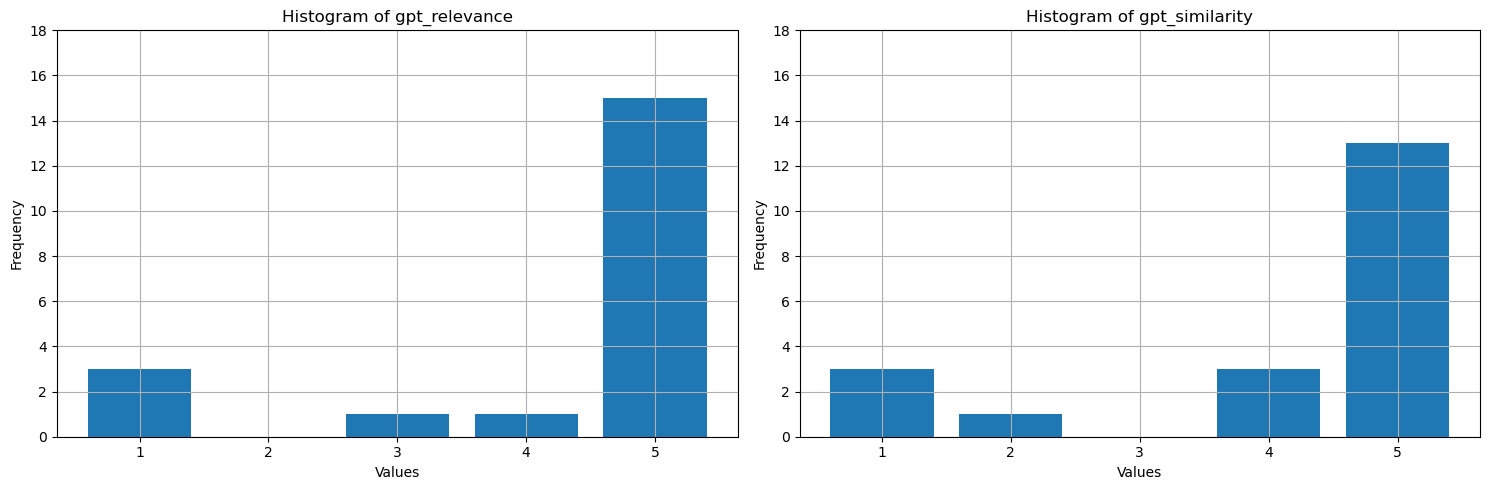
Como último paso, guarde los resultados de la prueba comparativa en una tabla del lakehouse. Este paso es opcional, pero muy recomendado: hace que sus hallazgos resulten más útiles. Al cambiar algo en el RAG (por ejemplo, modificar el mensaje, actualizar el índice o usar un modelo GPT diferente en el generador de respuestas), mida el impacto, cuantifique las mejoras y detecte regresiones.
# create name of experiment that is easy to refer to
friendly_name_of_experiment = "rag_tutorial_experiment_1"

# Note the current date and time
time_of_experiment = current_timestamp()

# Generate a unique GUID for all rows
experiment_id = str(uuid.uuid4())

# Add two new columns to the Spark DataFrame
updated_df = df.withColumn("execution_time", time_of_experiment) \
                        .withColumn("experiment_id", lit(experiment_id)) \
                        .withColumn("experiment_friendly_name", lit(friendly_name_of_experiment))

# Store the updated DataFrame in the default lakehouse as a table named 'rag_experiment_runs'
table_name = "rag_experiment_run_demo1"
updated_df.write.format("parquet").mode("append").saveAsTable(table_name)
Salida de celda:StatementMeta(, 21cb8cd3-7742-4c1f-8339-265e2846df1d, 28, Finished, Available, Finished)
Vuelva a los resultados del experimento en cualquier momento para revisarlos, compararlos con nuevos experimentos y elegir la configuración que mejor funciona para producción.
Troubleshooting
Si el cuaderno falla, comprueba los siguientes elementos:
- Credenciales o punto de conexión de Azure OpenAI no válidos: confirma el nombre del recurso, la clave de API y los nombres de implementación.
- Resultados vacíos o ausentes de Búsqueda de Azure AI: verifica el nombre del índice, el esquema del índice vectorial y que los datos se cargan.
- Nombres de modelos incorrectos: asegúrate de que las implementaciones de embeddings y de chat existen y coinciden con los valores especificados en el código.
- Puntuaciones bajas o valores inesperados de métrica: confirmar que el contexto recuperado contiene la fuente esperada y que la pregunta de referencia coincide con los documentos indexados.
- Resultados duplicados en la recuperación: confirme que los fragmentos se han creado correctamente y que el índice contiene los metadatos esperados de los fragmentos.
Si falla un paso, detente y valida la celda anterior antes de pasar a la siguiente sección.
Resumen
Use las métricas asistidas por IA y la tasa de recuperación superior N para crear la solución de generación aumentada de recuperación (RAG).