Nota:
El acceso a esta página requiere autorización. Puede intentar iniciar sesión o cambiar directorios.
El acceso a esta página requiere autorización. Puede intentar cambiar los directorios.
Cuando una aplicación llama a SQLFetch, SQLFetchScrollo SQLGetData, el controlador recupera los datos del origen de datos. If necessary, it converts the data from the data type in which the driver retrieved it to the data type specified by the TargetType argument in SQLBindCol or SQLGetData. Finally, it stores the data in the location pointed to by the TargetValuePtr argument in SQLBindCol or SQLGetData (and the SQL_DESC_DATA_PTR field of the ARD).
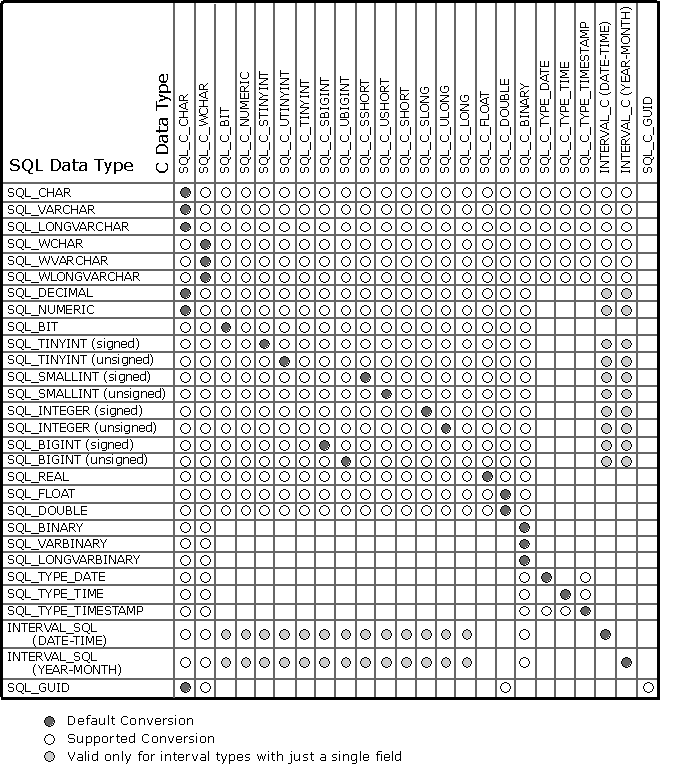
En la tabla siguiente se muestran las conversiones admitidas de tipos de datos DE ODBC SQL a tipos de datos ODBC C. A filled circle indicates the default conversion for a SQL data type (the C data type to which the data will be converted when the value of TargetType is SQL_C_DEFAULT). Un círculo hueco indica una conversión admitida.
For an ODBC 3.x application working with an ODBC 2.x driver, conversion from driver-specific data types might not be supported.
El formato de los datos convertidos no se ve afectado por la configuración de país o región de Windows.
En las tablas de las secciones siguientes se describe cómo el controlador o el origen de datos convierte los datos recuperados del origen de datos; Los controladores son necesarios para admitir conversiones a todos los tipos de datos ODBC C de los tipos de datos ODBC SQL que admiten. For a given ODBC SQL data type, the first column of the table lists the legal input values of the TargetType argument in SQLBindCol and SQLGetData. The second column lists the outcomes of a test, often using the BufferLength argument specified in SQLBindCol or SQLGetData, which the driver performs to determine whether it can convert the data. For each outcome, the third and fourth columns list the values placed in the buffers specified by the TargetValuePtr and StrLen_or_IndPtr arguments specified in SQLBindCol or SQLGetData after the driver has attempted to convert the data. (The StrLen_or_IndPtr argument corresponds to the SQL_DESC_OCTET_LENGTH_PTR field of the ARD.) The last column lists the SQLSTATE returned for each outcome by SQLFetch, SQLFetchScroll, or SQLGetData.
If the TargetType argument in SQLBindCol or SQLGetData contains an identifier for an ODBC C data type not shown in the table for a given ODBC SQL data type, SQLFetch, SQLFetchScroll, or SQLGetData returns SQLSTATE 07006 (Restricted data type attribute violation). If the TargetType argument contains an identifier that specifies a conversion from a driver-specific SQL data type to an ODBC C data type and this conversion isn't supported by the driver, SQLFetch, SQLFetchScroll, or SQLGetData returns SQLSTATE HYC00 (Optional feature not implemented).
Although it's not shown in the tables, the driver returns SQL_NULL_DATA in the buffer specified by the StrLen_or_IndPtr argument when the SQL data value is NULL. For an explanation of the use of StrLen_or_IndPtr when multiple calls are made to retrieve data, see the SQLGetData Function function description. When SQL data is converted to character C data, the character count returned in StrLen_or_IndPtr doesn't include the null-termination byte. If TargetValuePtr is a null pointer, SQLGetData returns SQLSTATE HY009 (Invalid use of null pointer); in SQLBindCol, this unbinds the column.
En las tablas se usan los términos y convenciones siguientes:
La longitud de bytes de los datos es el número de bytes de datos de C disponibles para devolver en TargetValuePtr, independientemente de si los datos se truncan o no antes de que se devuelvan a la aplicación. En el caso de los datos de cadena, esto no incluye el espacio para el carácter de terminación null.
La longitud del byte de caracteres es el número total de bytes necesarios para mostrar los datos en formato de caracteres. This is as defined for each C data type in the section Display Size, except that character byte length is in bytes while the display size is in characters.
Words in italics represent function arguments or elements of the SQL grammar. Para obtener la sintaxis de los elementos de gramática, vea Apéndice C: Gramática SQL.
Esta sección contiene los siguientes artículos.