Notiz
Zougrëff op dës Säit erfuerdert Autorisatioun. Dir kënnt probéieren, Iech unzemellen oder Verzeechnesser ze änneren.
Zougrëff op dës Säit erfuerdert Autorisatioun. Dir kënnt probéieren, Verzeechnesser ze änneren.
APPLIES TO: All API Management tiers
By providing a ProxyError object, Azure API Management allows publishers to respond to error conditions, which can occur during processing of requests. The ProxyError object is accessed through the context.LastError property. Policies in the on-error policy section can use the ProxyError object. This article provides a reference for the error handling capabilities in Azure API Management.
Error handling in API Management
Policies in Azure API Management are divided into inbound, backend, outbound, and on-error sections as shown in the following example.
<policies>
    <inbound>
        <!-- statements to be applied to the request go here -->
    </inbound>
    <backend>
        <!-- statements to be applied before the request is
             forwarded to the backend service go here -->
    </backend>
    <outbound>
        <!-- statements to be applied to the response go here -->
    </outbound>
    <on-error>
        <!-- statements to be applied if there is an error
             condition go here -->
    </on-error>
</policies>
During the processing of a request, built-in steps run along with any policies that are in scope for the request. If an error occurs, processing immediately jumps to the on-error policy section.
The on-error policy section can be used at any scope. API publishers can configure custom behavior, such as logging the error to Azure Event Hubs or creating a new response to return to the caller.
Note
The on-error section isn't present in policies by default. To add the on-error section to a policy, browse to the desired policy in the policy editor and add it. For more information about configuring policies, see Policies in API Management.
If there's no on-error section, callers receive 400 or 500 HTTP response messages if an error condition occurs.
Policies allowed in on-error
The following policies can be used in the on-error policy section.
- choose
- set-variable
- find-and-replace
- return-response
- set-header
- set-method
- set-status
- send-request
- send-one-way-request
- log-to-eventhub
- json-to-xml
- xml-to-json
- limit-concurrency
- mock-response
- retry
- trace
LastError
When an error occurs and control jumps to the on-error policy section, the error is stored in the context.LastError property. Policies in the on-error section can access context.LastError. LastError has the following properties.
| Name | Type | Description | Required |
|---|---|---|---|
Source |
string | Name of the element where the error occurred. Could be either policy or a built-in pipeline step name. | Yes |
Reason |
string | Machine-friendly error code, which could be used in error handling. | No |
Message |
string | Human-readable error description. | Yes |
Scope |
string | Name of the scope where the error occurred. | No |
Section |
string | Section name where error occurred. Possible values: inbound, backend, outbound, or on-error. |
No |
Path |
string | Specifies nested policy hierarchy, for example choose[3]\\when[2]. Multiple instances of a nested policy are indexed from 1. |
No |
PolicyId |
string | Value of the id attribute, if specified by the customer, on the policy where error occurred |
No |
Tip
You can access the status code through context.Response.StatusCode.
Note
All policies have an optional id attribute that can be added to the root element of the policy. If this attribute is present in a policy when an error condition occurs, you can retrieve the value of the attribute by using the context.LastError.PolicyId property.
Predefined errors for built-in steps
The following errors are predefined for error conditions that can occur during the evaluation of built-in processing steps.
| Source | Condition | Reason | Message |
|---|---|---|---|
| configuration | URI doesn't match to any API or Operation | OperationNotFound | Unable to match incoming request to an operation. |
| authorization | Subscription key not supplied | SubscriptionKeyNotFound | Access denied due to missing subscription key. Make sure to include subscription key when making requests to this API. |
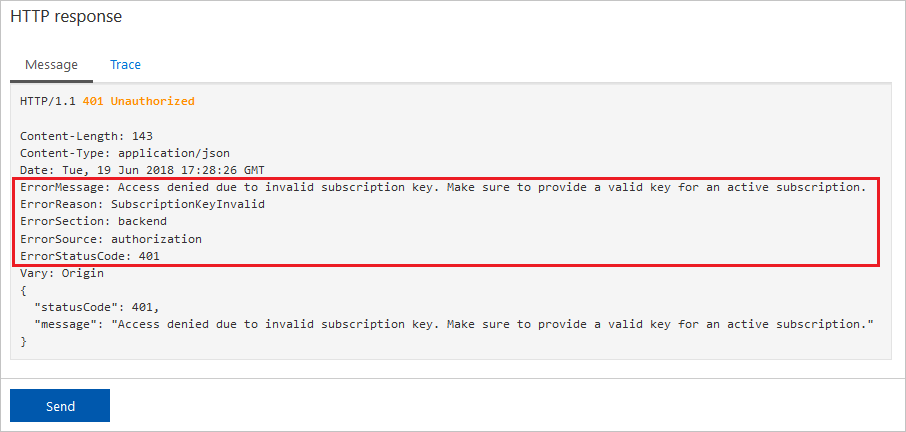
| authorization | Subscription key value is invalid | SubscriptionKeyInvalid | Access denied due to invalid subscription key. Make sure to provide a valid key for an active subscription. |
| multiple | The client aborted a downstream connection (from a client to an API Management gateway) while request was pending | ClientConnectionFailure | multiple |
| multiple | The back end aborted or wasn't able to establish an upstream connection (from an API Management gateway to a back-end service) | BackendConnectionFailure | multiple |
| multiple | Runtime exception occurred during evaluation of a particular expression | ExpressionValueEvaluationFailure | multiple |
Predefined errors for policies
The following errors are predefined for error conditions that can occur during policy evaluation.
| Source | Condition | Reason | Message |
|---|---|---|---|
| rate-limit | Rate limit exceeded | RateLimitExceeded | Rate limit is exceeded |
| quota | Quota exceeded | QuotaExceeded | Out of call volume quota. Quota will be replenished in xx:xx:xx. -or- Out of bandwidth quota. Quota will be replenished in xx:xx:xx. |
| jsonp | Callback parameter value is invalid (contains wrong characters) | CallbackParameterInvalid | Value of callback parameter {callback-parameter-name} is not a valid JavaScript identifier. |
| ip-filter | Failed to parse caller IP from request | FailedToParseCallerIP | Failed to establish IP address for the caller. Access denied. |
| ip-filter | Caller IP isn't in allowed list | CallerIpNotAllowed | Caller IP address {ip-address} is not allowed. Access denied. |
| ip-filter | Caller IP is in blocked list | CallerIpBlocked | Caller IP address is blocked. Access denied. |
| check-header | Required header not presented or value is missing | HeaderNotFound | Header {header-name} was not found in the request. Access denied. |
| check-header | Required header not presented or value is missing | HeaderValueNotAllowed | Header {header-name} value of {header-value} is not allowed. Access denied. |
| validate-jwt | JSON Web Token (JWT) is missing in request | TokenNotPresent | JWT not present. |
| validate-jwt | Signature validation failed | TokenSignatureInvalid | <message from jwt library>. Access denied. |
| validate-jwt | Invalid audience | TokenAudienceNotAllowed | <message from jwt library>. Access denied. |
| validate-jwt | Invalid issuer | TokenIssuerNotAllowed | <message from jwt library>. Access denied. |
| validate-jwt | Token expired | TokenExpired | <message from jwt library>. Access denied. |
| validate-jwt | Signature key wasn't resolved by ID | TokenSignatureKeyNotFound | <message from jwt library>. Access denied. |
| validate-jwt | Required claims are missing from token | TokenClaimNotFound | JWT is missing the following claims: <c1>, <c2>, … Access denied. |
| validate-jwt | Claim values mismatch | TokenClaimValueNotAllowed | Claim {claim-name} value of {claim-value} is not allowed. Access denied. |
| validate-jwt | Other validation failures | JwtInvalid | <message from jwt library> |
| forward-request or send-request | HTTP response status code and headers weren't received from the back end within the configured timeout | Timeout | multiple |
Example
Set an API policy to the following value:
<policies>
    <inbound>
        <base />
    </inbound>
    <backend>
        <base />
    </backend>
    <outbound>
        <base />
    </outbound>
    <on-error>
        <set-header name="ErrorSource" exists-action="override">
            <value>@(context.LastError.Source)</value>
        </set-header>
        <set-header name="ErrorReason" exists-action="override">
            <value>@(context.LastError.Reason)</value>
        </set-header>
        <set-header name="ErrorMessage" exists-action="override">
            <value>@(context.LastError.Message)</value>
        </set-header>
        <set-header name="ErrorScope" exists-action="override">
            <value>@(context.LastError.Scope)</value>
        </set-header>
        <set-header name="ErrorSection" exists-action="override">
            <value>@(context.LastError.Section)</value>
        </set-header>
        <set-header name="ErrorPath" exists-action="override">
            <value>@(context.LastError.Path)</value>
        </set-header>
        <set-header name="ErrorPolicyId" exists-action="override">
            <value>@(context.LastError.PolicyId)</value>
        </set-header>
        <set-header name="ErrorStatusCode" exists-action="override">
            <value>@(context.Response.StatusCode.ToString())</value>
        </set-header>
        <base />
    </on-error>
</policies>
Sending an unauthorized request results in the following response:
Related content
For more information about working with policies, see:
- Tutorial: Transform and protect your API
- Policy reference for a full list of policy statements and their settings
- Policy expressions
- Set or edit policies
- Reuse policy configurations
- Policy snippets repo
- Policy samples repo
- Azure API Management policy toolkit
- Get Copilot assistance to create, explain, and troubleshoot policies