Notiz
Zougrëff op dës Säit erfuerdert Autorisatioun. Dir kënnt probéieren, Iech unzemellen oder Verzeechnesser ze änneren.
Zougrëff op dës Säit erfuerdert Autorisatioun. Dir kënnt probéieren, Verzeechnesser ze änneren.
This refactoring applies to:
- C#
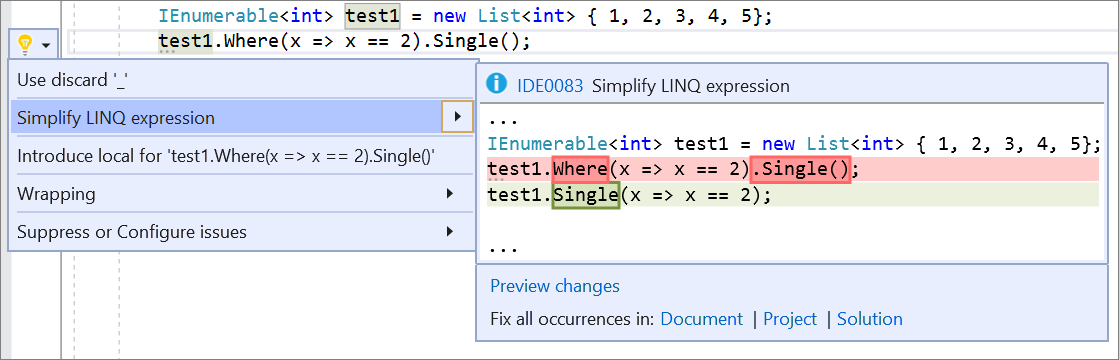
What: Refactors instances of SomeEnumerableType.Where(<LambdaExpression>).Single() to SomeEnumerable.Single(<LambdaExpression>) for Enumerable.Single() as well as the following Enumerable methods: SingleOrDefault(), Last(), LastOrDefault(), Any(), Count(), First(), and FirstOrDefault().
When: All instances where the method calls Single(), SingleOrDefault(), and so on, doesn't have any arguments and is preceded by a Where() expression. The input to the Where() expression cannot be constructed as an expression tree.
Why: Removing the unnecessary call to the Enumerable for the .Where() method improves readability and in some cases performance, see remarks.
How-to
Place your cursor within the
SomeEnumerableType.Where(<LambdaExpression>).Single()instance in visual studio.Press Ctrl+. to trigger the Quick Actions and Refactorings menu.
Select Simplify LINQ expression
Remarks
In some cases this refactoring may reduce performance. LINQ operations on List<T> and T[] are not optimized in this case and result in worse performance.