Nota
L-aċċess għal din il-paġna jeħtieġ l-awtorizzazzjoni. Tista’ tipprova tidħol jew tibdel id-direttorji.
L-aċċess għal din il-paġna jeħtieġ l-awtorizzazzjoni. Tista’ tipprova tibdel id-direttorji.
Azure Private Link service helps you privately expose your own applications, such as applications that run on virtual machines (VMs), within an Azure virtual network. Private Link service helps other Azure customers or clients on your networks connect securely without public IP addresses, which ensures that traffic remains within the Azure network.
When you use Azure, reliability is a shared responsibility. Microsoft provides a range of capabilities to support resiliency and recovery. You're responsible for understanding how those capabilities work within all of the services you use, and selecting the capabilities you need to meet your business objectives and uptime goals.
This article focuses on Private Link service and the associated private endpoints as a connectivity mechanism. It describes platform-level and control-plane behavior during transient faults, availability zone outages, and region-wide outages.
Note
This article focuses on Private Link service, which facilitates private connectivity to applications that you run on your own VMs. If you use private endpoints with other Azure services, for example Azure Storage or Azure SQL Database, you should instead review the reliability guides for those services for reliability information about their private endpoints.
Important
The reliability of your overall solution depends on the configuration of the backend servers that Private Link service connects to. These backend servers might be Azure VMs, Azure virtual machine scale sets, or external endpoints. The reliability of your solution also depends on the configuration of load balancers and other network components.
Your backend servers aren't in scope for this article, but their availability configurations directly affect your application's resilience. To understand how each service supports your reliability requirements, review the reliability guides for all Azure services in your solution. You can achieve end-to-end reliability for your application by ensuring that your backend servers are also configured for high availability and zone redundancy.
Reliability architecture overview
Private Link service helps your customers connect privately to your workloads in Azure. As the service provider, you deploy a Private Link service resource. Service consumers create private endpoints in their own Azure virtual networks. These endpoints connect securely and privately to your applications through Azure Private Link. This setup doesn't expose public IP addresses, even when a consumer uses the private endpoint from an on-premises environment through Azure ExpressRoute or another private connectivity method.
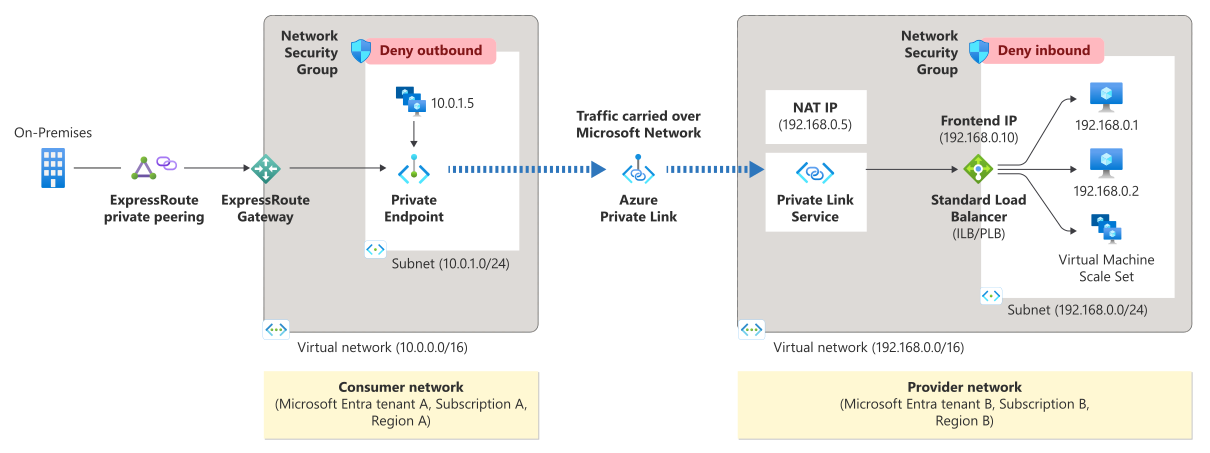
A Private Link service is typically attached to an Azure load balancer that fronts backend resources, like VMs or virtual machine scale sets. You can also use Private Link service Direct Connect (preview), which facilitates connectivity to any privately routable IP address within your virtual network. If you use Private Link service Direct Connect, review the documentation carefully to understand requirements, region availability, and limitations.
Important
Private Link service Direct Connect is currently in preview.
See the Supplemental Terms of Use for Microsoft Azure Previews for legal terms that apply to Azure features that are in beta, preview, or are otherwise not generally available.
Resilience to transient faults
Transient faults are short, intermittent failures in components. They occur frequently in a distributed environment like the cloud, and they're a normal part of operations. Transient faults correct themselves after a short period of time. It's important that your applications can handle transient faults, usually by retrying affected requests.
All cloud-hosted applications should follow the Azure transient fault handling guidance when they communicate with any cloud-hosted APIs, databases, and other components. For more information, see Recommendations for handling transient faults.
When you deploy a Private Link service with Standard Load Balancer, review the transient fault handling recommendations for Azure Load Balancer and ensure that your load balancer is configured to handle transient faults.
Resilience to availability zone failures
Private Link service is automatically resilient to availability zone failures when deployed in a region that supports availability zones. Service providers don't need to configure anything to enable this behavior.
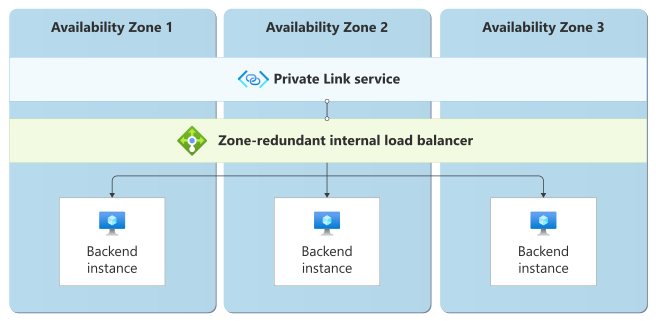
Diagram that shows three vertical sections arranged side by side that represent three separate availability zones. A zone-redundant internal load balancer and Private Link service span all three zones. Each zone has a backend instance. Private Link service connects to the load balancer, which connects to all backend instances.
Private endpoints are automatically distributed across availability zones in the region. Service consumers don't need to create separate private endpoints in different zones.
Requirements
Region support: You can deploy zone-redundant Private Link services in any region that supports availability zones.
Load balancer dependency: If you use Private Link service with a backend load balancer, also configure the load balancer as zone redundant to ensure end-to-end zone resiliency. For more information, see Reliability in Load Balancer.
Cost
There's no extra cost associated with availability zone support for Private Link service.
Configure availability zone support
Availability zone support is automatically enabled when you deploy Private Link service in a region that supports availability zones.
Behavior when all zones are healthy
This section describes what to expect when Private Link services and private endpoints support availability zones, and all zones are operational.
Cross-zone operation: Traffic through a private endpoint and Private Link service might be routed through any availability zone.
Cross-zone data replication: Private Link doesn't perform data replication between zones because it's a stateless service for connectivity.
Behavior during a zone failure
This section describes what to expect when your Private Link services and private endpoints support availability zones, and there's an outage in one of the zones.
- Detection and response: Microsoft is responsible for detecting availability zone failures and managing the service response.
- Notification: Microsoft doesn't automatically notify you when a zone is down. However, you can use Azure Service Health to understand the overall health of the service, including any zone failures, and you can set up Service Health alerts to notify you of problems.
Active requests: Active requests might be terminated during an availability zone failure. Service consumers should retry failed requests after transient interruptions, similar to other transient faults.
Expected data loss: No data loss occurs because Private Link is a stateless service for connectivity.
Expected downtime: Existing connections that connect through the failed zone might fail. If backend components such as the load balancer and application servers remain available, service consumers can immediately retry the connection, and requests are routed through infrastructure in another zone.
Redistribution: When a single availability zone fails, the service routes new traffic through healthy zones, which continues operation.
VMs in the affected availability zone are unlikely to remain operational during a zone outage. However, if a partial zone failure makes Private Link unavailable in the affected zone while VMs in that zone continue to operate, outbound connections to VMs in the affected zone are routed through Private Link infrastructure in another zone.
Application downtime can also occur if dependent components, such as load balancers or backend VMs, aren't zone resilient.
Zone recovery
When the affected availability zone recovers, Microsoft automatically manages the failback process. No customer action is required.
Test for zone failures
The Private Link platform manages traffic routing, failover, and failback for Private Link services and private endpoints across availability zones. Because this feature is fully managed, you don't need to validate availability zone failure processes.
Resilience to region-wide failures
Private Link service is a single-region service. The service doesn't provide native multi-region capabilities or automatic failover between regions. If an Azure region becomes unavailable, Private Link services in that region are also unavailable.
Custom multi-region solutions for resiliency
If you design a networking approach that spans multiple regions, you should deploy independent Private Link services into each region. You're responsible for Private Link service deployment and management. Service consumers are responsible for private endpoint configuration on each region's Private Link services. Service consumers are also responsible for routing traffic to the appropriate Private Link service.
Backup and restore
Private Link service doesn't store customer data and doesn't require backup or restore. To recreate configurations, consider maintaining infrastructure as code (IaC) templates for networking resources. Private Link services are configuration-only and store no customer data, so backup efforts should focus on IaC templates for rapid redeployment.
Service-level agreement
The service-level agreement (SLA) for Azure services describes the expected availability of each service and the conditions that your solution must meet to achieve that availability expectation. For more information, see SLAs for online services.