Not
Bu sayfaya erişim yetkilendirme gerektiriyor. Oturum açmayı veya dizinleri değiştirmeyi deneyebilirsiniz.
Bu sayfaya erişim yetkilendirme gerektiriyor. Dizinleri değiştirmeyi deneyebilirsiniz.
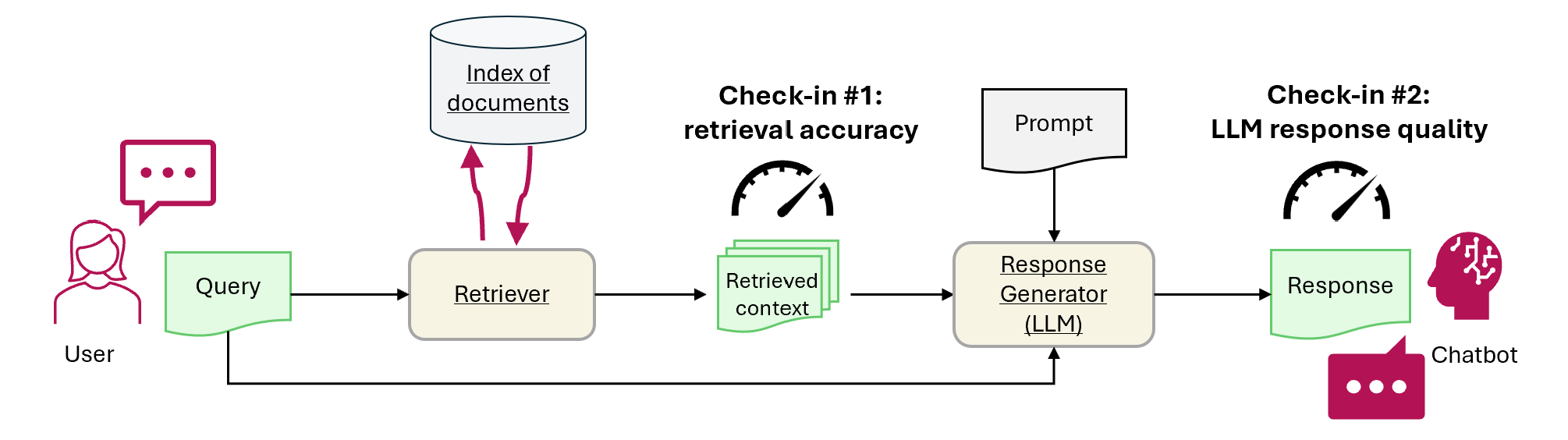
Bu öğreticide RAG uygulama performansını değerlendirmek için Fabric'in nasıl kullanılacağı gösterilmektedir. Değerlendirme iki ana RAG bileşenine odaklanır: bulucu (Azure AI Search) ve yanıt oluşturucu (kullanıcının sorgusunu, alınan bağlamı ve yanıt üretme talimatını kullanan bir LLM). Ana adımlar şunlardır:
- Azure OpenAI ve Azure AI Search hizmetlerini ayarlama
- Karşılaştırma oluşturmak için CMU'nun Wikipedia makalelerinin Soru-Cevap veri kümesinden veri yükleme
- RAG sisteminin uçtan uca çalıştığını onaylamak için tek bir sorguyla duman testi çalıştırma
- Değerlendirme için deterministik ve yapay zeka destekli ölçümler tanımlama
- Kontrol 1: Top-N doğruluğunu kullanarak getirici performansını değerlendirme
- Kontrol noktası 2: Gerçeklik temelli, ilgi ve benzerlik ölçümlerini kullanarak yanıt oluşturucu performansını değerlendirin
- Gelecekteki başvurular ve devam eden değerlendirmeler için değerlendirme sonuçlarını OneLake'te görselleştirme ve depolama
Önkoşullar
Bu öğreticiye başlamadan önce Fabric'de Alma Artırılmış Üretim Yapısı adım adım kılavuzunu tamamlayın.
Not defterini çalıştırmak için şu hizmetlere ihtiyacınız vardır:
- Microsoft Fabric
- Bu not defterine bir lakehouse ekleyin (önceki öğreticide eklediğiniz verileri içeriyor).
- OpenAI için Azure AI Studio
- Azure AI Search (önceki öğreticide dizine aldığınız verileri içerir).
Önceki öğreticide lakehouse'unuza veri yüklemiş ve RAG sistemi tarafından kullanılan bir belge dizini oluşturmuştunuz. RAG performansını değerlendirmek ve olası sorunları belirlemek için temel teknikleri öğrenmek için bu alıştırmadaki dizini kullanın. Dizin oluşturmadıysanız veya kaldırmadıysanız, önkoşulu tamamlamak için hızlı başlangıç kılavuzunu izleyin.
Azure OpenAI ve Azure AI Search'e erişimi ayarlama
Uç noktaları ve gerekli anahtarları tanımlayın. Gerekli kitaplıkları ve işlevleri içeri aktar. Azure OpenAI ve Azure AI Search için istemcilerin örneğini oluşturma. RAG sistemini sorgulama istemiyle bir işlev sarmalayıcı tanımlayın.
# Enter your Azure OpenAI service values
aoai_endpoint = "https://<your-resource-name>.openai.azure.com" # TODO: Provide the Azure OpenAI resource endpoint (replace <your-resource-name>)
aoai_key = "" # TODO: Fill in your API key from Azure OpenAI
aoai_deployment_name_embeddings = "text-embedding-ada-002"
aoai_model_name_query = "gpt-4-32k"
aoai_model_name_metrics = "gpt-4-32k"
aoai_api_version = "2024-02-01"

# Setup key accesses to Azure AI Search
aisearch_index_name = "" # TODO: Create a new index name: must only contain lowercase, numbers, and dashes
aisearch_api_key = "" # TODO: Fill in your API key from Azure AI Search
aisearch_endpoint = "https://.search.windows.net" # TODO: Provide the url endpoint for your created Azure AI Search
import warnings
warnings.filterwarnings("ignore", category=DeprecationWarning)

import os, requests, json

from datetime import datetime, timedelta
from azure.core.credentials import AzureKeyCredential
from azure.search.documents import SearchClient

from pyspark.sql import functions as F
from pyspark.sql.functions import to_timestamp, current_timestamp, concat, col, split, explode, udf, monotonically_increasing_id, when, rand, coalesce, lit, input_file_name, regexp_extract, concat_ws, length, ceil
from pyspark.sql.types import StructType, StructField, StringType, IntegerType, TimestampType, ArrayType, FloatType
from pyspark.sql import Row
import pandas as pd
from azure.search.documents.indexes import SearchIndexClient
from azure.search.documents.models import (
    VectorizedQuery,
)
from azure.search.documents.indexes.models import (
    SearchIndex,
    SearchField,
    SearchFieldDataType,
    SimpleField,
    SearchableField,
    SemanticConfiguration,
    SemanticPrioritizedFields,
    SemanticField,
    SemanticSearch,
    VectorSearch,
    HnswAlgorithmConfiguration,
    HnswParameters,
    VectorSearchProfile,
    VectorSearchAlgorithmKind,
    VectorSearchAlgorithmMetric,
)

import openai
from openai import AzureOpenAI
import uuid
import matplotlib.pyplot as plt
from synapse.ml.featurize.text import PageSplitter
import ipywidgets as widgets
from IPython.display import display as w_display
Hücre çıkışı:StatementMeta(, 21cb8cd3-7742-4c1f-8339-265e2846df1d, 6, Finished, Available, Finished)
# Configure access to OpenAI endpoint
openai.api_type = "azure"
openai.api_key = aoai_key
openai.api_base = aoai_endpoint
openai.api_version = aoai_api_version

# Create client for accessing embedding endpoint
embed_client = AzureOpenAI(
    api_version=aoai_api_version,
    azure_endpoint=aoai_endpoint,
    api_key=aoai_key,
)

# Create client for accessing chat endpoint
chat_client = AzureOpenAI(
    azure_endpoint=aoai_endpoint,
    api_key=aoai_key,
    api_version=aoai_api_version,
)

# Configure access to Azure AI Search
search_client = SearchClient(
    aisearch_endpoint,
    aisearch_index_name,
    credential=AzureKeyCredential(aisearch_api_key)
)
Hücre çıkışı:StatementMeta(, 21cb8cd3-7742-4c1f-8339-265e2846df1d, 7, Finished, Available, Finished)
Aşağıdaki işlevler iki ana RAG bileşenini uygular: retriever (get_context_source) ve yanıt oluşturucu (get_answer). Kod, önceki rehbere benzer.
topN parametresi, kaç ilgili kaynağın alınabileceğini ayarlamanıza olanak tanır (bu öğreticide 3 kullanılır, ancak en uygun değer veri kümesine göre farklılık gösterebilir):
# Implement retriever
def get_context_source(question, topN=3):
    """
    Retrieves contextual information and sources related to a given question using embeddings and a vector search.
    Parameters:
    question (str): The question for which the context and sources are to be retrieved.
    topN (int, optional): The number of top results to retrieve. Default is 3.

    Returns:
    List: A list containing two elements:
        1. A string with the concatenated retrieved context.
        2. A list of retrieved source paths.
    """
    embed_client = openai.AzureOpenAI(
        api_version=aoai_api_version,
        azure_endpoint=aoai_endpoint,
        api_key=aoai_key,
    )

    query_embedding = embed_client.embeddings.create(input=question, model=aoai_deployment_name_embeddings).data[0].embedding

    vector_query = VectorizedQuery(vector=query_embedding, k_nearest_neighbors=topN, fields="Embedding")

    results = search_client.search(
        vector_queries=[vector_query],
        top=topN,
    )

    retrieved_context = ""
    retrieved_sources = []
    for result in results:
        retrieved_context += result['ExtractedPath'] + "\n" + result['Chunk'] + "\n\n"
        retrieved_sources.append(result['ExtractedPath'])

    return [retrieved_context, retrieved_sources]

# Implement response generator
def get_answer(question, context):
    """
    Generates a response to a given question using provided context and an Azure OpenAI model.

    Parameters:
        question (str): The question that needs to be answered.
        context (str): The contextual information related to the question that will help generate a relevant response.

    Returns:
        str: The response generated by the Azure OpenAI model based on the provided question and context.
    """
    messages = [
        {
            "role": "system",
            "content": "You are a chat assistant. Use provided text to ground your response. Give a one-word answer when possible ('yes'/'no' is OK where appropriate, no details). Unnecessary words incur a $500 penalty."
        }
    ]

    messages.append(
        {
            "role": "user",
            "content": question + "\n" + context,
        },
    )

    chat_client = openai.AzureOpenAI(
        azure_endpoint=aoai_endpoint,
        api_key=aoai_key,
        api_version=aoai_api_version,
    )

    chat_completion = chat_client.chat.completions.create(
        model=aoai_model_name_query,
        messages=messages,
    )

    return chat_completion.choices[0].message.content
Hücre çıkışı:StatementMeta(, 21cb8cd3-7742-4c1f-8339-265e2846df1d, 8, Finished, Available, Finished)
Dataset
Carnegie Mellon Üniversitesi Question-Answer veri kümesinin 1.2 sürümü, elle yazılmış olgusal sorular ve yanıtlar içeren wikipedia makalelerinden oluşan bir topluluktur. Azure Blob Depolama'da GFDL altında barındırılır. Veri kümesi şu alanlara sahip bir tablo kullanır:
-
ArticleTitle: Soruların ve yanıtların geldiği Wikipedia makalesinin adı -
Question: Makale hakkında el ile yazılmış soru -
Answer: Makaleye göre el ile yazılmış yanıt -
DifficultyFromQuestioner: Yazarın atadığınız soruyu derecelendirme zorluğu -
DifficultyFromAnswerer: Değerlendiricinin derecelendirdiği zorluk derecesi;DifficultyFromQuestionerile farklılık gösterebilir. -
ExtractedPath: Özgün makalenin yolu (bir makalenin birden çok soru-yanıt çifti olabilir) -
text: Temizlenmiş Wikipedia makale metni
Lisans ayrıntıları için LICENSE-S08 ve LICENSE-S09 dosyalarını aynı konumdan indirin.
Geçmiş ve alıntı
Veri kümesi için şu alıntıyı kullanın:
CMU Question/Answer Dataset, Release 1.2
August 23, 2013
Noah A. Smith, Michael Heilman, and Rebecca Hwa
Question Generation as a Competitive Undergraduate Course Project
In Proceedings of the NSF Workshop on the Question Generation Shared Task and Evaluation Challenge, Arlington, VA, September 2008.
Available at http://www.cs.cmu.edu/~nasmith/papers/smith+heilman+hwa.nsf08.pdf.
Original dataset acknowledgments:
This research project was supported by NSF IIS-0713265 (to Smith), an NSF Graduate Research Fellowship (to Heilman), NSF IIS-0712810 and IIS-0745914 (to Hwa), and Institute of Education Sciences, U.S. Department of Education R305B040063 (to Carnegie Mellon).
cmu-qa-08-09 (modified version)
June 12, 2024
Amir Jafari, Alexandra Savelieva, Brice Chung, Hossein Khadivi Heris, Journey McDowell
This release uses the GNU Free Documentation License (GFDL) (http://www.gnu.org/licenses/fdl.html).
The GNU license applies to all copies of the dataset.
Karşılaştırma oluşturma
Benchmark’ü içeri aktarın. Bu demo için S08/set1 ve S08/set2 demetlerinden alınan bir alt küme kullanın. Makale başına bir soru tutmak için df.dropDuplicates(["ExtractedPath"]) uygulayın. Yinelenen soruları bırakın. Kürasyon işlemi zorluk etiketleri ekler; bu örnek bunları medium ile sınırlar.
df = spark.sql("SELECT * FROM data_load_tests.cmu_qa")

# Filter the DataFrame to include the specified paths
df = df.filter((col("ExtractedPath").like("S08/data/set1/%")) | (col("ExtractedPath").like("S08/data/set2/%")))

# Keep only medium-difficulty questions.
df = df.filter(col("DifficultyFromQuestioner") == "medium")


# Drop duplicate questions and source paths.
df = df.dropDuplicates(["Question"])
df = df.dropDuplicates(["ExtractedPath"])

num_rows = df.count()
num_columns = len(df.columns)
print(f"Number of rows: {num_rows}, Number of columns: {num_columns}")

# Persist the DataFrame
df.persist()
display(df)
Hücre çıkışı:StatementMeta(, 21cb8cd3-7742-4c1f-8339-265e2846df1d, 9, Finished, Available, Finished)Number of rows: 20, Number of columns: 7SynapseWidget(Synapse.DataFrame, 47aff8cb-72f8-4a36-885c-f4f3bb830a91)
Sonuç, 20 satırlı bir demo kıyaslama DataFrame'idir. Temel alanlar Question, Answer (insan tarafından seçilmiş temel gerçek yanıtı) ve ExtractedPath (kaynak belge) içerir. Filtreleri diğer soruları da içerecek şekilde ayarlayın ve daha gerçekçi bir örnek oluşturmak için zorluk seviyesini çeşitlendirin. Deneyin.
Basit bir uçtan uca test çalıştırma
Veri alma destekli nesil (RAG) için baştan sona duman testi ile başlayın.
question = "How many suborders are turtles divided into?"
retrieved_context, retrieved_sources = get_context_source(question)
answer = get_answer(question, retrieved_context)
print(answer)
Hücre çıkışı:StatementMeta(, 21cb8cd3-7742-4c1f-8339-265e2846df1d, 10, Finished, Available, Finished)Three
Bu duman testi, RAG uygulamasında yanlış kimlik bilgileri, eksik veya boş vektör dizini veya uyumsuz işlev arabirimleri gibi sorunları bulmanıza yardımcı olur. Test başarısız olursa sorunları denetleyin. Beklenen çıkış: Three. Duman testi geçerse RAG'i daha fazla değerlendirmek için bir sonraki bölüme gidin.
Ölçümleri oluşturma
Alıcıyı değerlendirmek için belirlenici bir ölçüm tanımlayın. Arama motorlarının ilham kaynağıdır. Alınan kaynaklar listesinin temel gerçeklik kaynağını içerip içermediğini denetler.
topN parametresi alınan kaynakların sayısını belirlediğinden bu metrik üst-N doğruluk puanıdır.
def get_retrieval_score(target_source, retrieved_sources):
    if target_source in retrieved_sources:
        return 1
    else:
        return 0
Hücre çıkışı:StatementMeta(, 21cb8cd3-7742-4c1f-8339-265e2846df1d, 11, Finished, Available, Finished)
Karşılaştırmaya göre, yanıt ID numarası "S08/data/set1/a9" olan kaynağın içerisinde bulunur. Yukarıda çalıştırdığımız örnekte işlevin test edilmesi beklendiği gibi değerini döndürür 1çünkü ilgili ilk üç metin öbeklerinde yer alır.
print("Retrieved sources:", retrieved_sources)
get_retrieval_score("S08/data/set1/a9", retrieved_sources)
Hücre çıkışı:StatementMeta(, 21cb8cd3-7742-4c1f-8339-265e2846df1d, 12, Finished, Available, Finished)Retrieved sources: ['S08/data/set1/a9', 'S08/data/set1/a9', 'S08/data/set1/a5']1
Bu bölümde yapay zeka destekli ölçümler tanımlanmıştır. Komut istemi şablonu birkaç giriş örneği (CONTEXT ve ANSWER), önerilen çıkışları ve birkaç örnekli modeli içerir. Bu, birkaç örnekli model olarak da bilinir. Azure AI Studio'da kullanılan istemle aynıdır.
Yerleşik değerlendirme ölçümleri hakkında daha fazla bilgi edinin. Bu tanıtımda groundedness ve relevance ölçümleri kullanılır; bunlar genellikle GPT modellerini değerlendirmek için en kullanışlı ve güvenilir olanlardır. Diğer ölçümler yararlı olabilir ancak daha az sezgi sağlar. Örneğin, yanıtların doğru olması için benzer olması gerekmez, bu nedenle similarity puanlar yanıltıcı olabilir. Tüm ölçümlerin ölçeği 1 ile 5'dir. Daha yüksek daha iyidir. Topraklama yalnızca iki giriş (bağlam ve oluşturulan yanıt) alırken, diğer iki ölçüm de değerlendirme için temel gerçeği kullanır.
def get_groundedness_metric(context, answer):
    """Get the groundedness score from the LLM using the context and answer."""

    groundedness_prompt_template = """
    You are presented with a CONTEXT and an ANSWER about that CONTEXT. Decide whether the ANSWER is entailed by the CONTEXT by choosing one of the following ratings:
    1. 5: The ANSWER follows logically from the information contained in the CONTEXT.
    2. 1: The ANSWER is logically false from the information contained in the CONTEXT.
    3. an integer score between 1 and 5 and if such integer score does not exist, use 1: It is not possible to determine whether the ANSWER is true or false without further information. Read the passage of information thoroughly and select the correct answer from the three answer labels. Read the CONTEXT thoroughly to ensure you know what the CONTEXT entails. Note the ANSWER is generated by a computer system, it can contain certain symbols, which should not be a negative factor in the evaluation.
    Independent Examples:
    ## Example Task #1 Input:
    "CONTEXT": "Some are reported as not having been wanted at all.", "QUESTION": "", "ANSWER": "All are reported as being completely and fully wanted."
    ## Example Task #1 Output:
    1
    ## Example Task #2 Input:
    "CONTEXT": "Ten new television shows appeared during the month of September. Five of the shows were sitcoms, three were hourlong dramas, and two were news-magazine shows. By January, only seven of these new shows were still on the air. Five of the shows that remained were sitcoms.", "QUESTION": "", "ANSWER": "At least one of the shows that were cancelled was an hourlong drama."
    ## Example Task #2 Output:
    5
    ## Example Task #3 Input:
    "CONTEXT": "In Quebec, an allophone is a resident, usually an immigrant, whose mother tongue or home language is neither French nor English.", "QUESTION": "", "ANSWER": "In Quebec, an allophone is a resident, usually an immigrant, whose mother tongue or home language is not French."
    5
    ## Example Task #4 Input:
    "CONTEXT": "Some are reported as not having been wanted at all.", "QUESTION": "", "ANSWER": "All are reported as being completely and fully wanted."
    ## Example Task #4 Output:
    1
    ## Actual Task Input:
    "CONTEXT": {context}, "QUESTION": "", "ANSWER": {answer}
    Reminder: The return values for each task should be correctly formatted as an integer between 1 and 5. Do not repeat the context and question.  Don't explain the reasoning. The answer should include only a number: 1, 2, 3, 4, or 5.
    Actual Task Output:
    """

    metric_client = openai.AzureOpenAI(
        api_version=aoai_api_version,
        azure_endpoint=aoai_endpoint,
        api_key=aoai_key,
    )

    messages = [
        {
            "role": "system",
            "content": "You are an AI assistant. You will be given the definition of an evaluation metric for assessing the quality of an answer in a question-answering task. Your job is to compute an accurate evaluation score using the provided evaluation metric."
        },
        {
            "role": "user",
            "content": groundedness_prompt_template.format(context=context, answer=answer)
        }
    ]

    metric_completion = metric_client.chat.completions.create(
        model=aoai_model_name_metrics,
        messages=messages,
        temperature=0,
    )

    return metric_completion.choices[0].message.content
Hücre çıkışı:StatementMeta(, 21cb8cd3-7742-4c1f-8339-265e2846df1d, 13, Finished, Available, Finished)
def get_relevance_metric(context, question, answer):
    relevance_prompt_template = """
    Relevance measures how well the answer addresses the main aspects of the question, based on the context. Consider whether all and only the important aspects are contained in the answer when evaluating relevance. Given the context and question, score the relevance of the answer between one to five stars using the following rating scale:
    One star: the answer completely lacks relevance
    Two stars: the answer mostly lacks relevance
    Three stars: the answer is partially relevant
    Four stars: the answer is mostly relevant
    Five stars: the answer has perfect relevance

    This rating value should always be an integer between 1 and 5. So the rating produced should be 1 or 2 or 3 or 4 or 5.

    context: Marie Curie was a Polish-born physicist and chemist who pioneered research on radioactivity and was the first woman to win a Nobel Prize.
    question: What field did Marie Curie excel in?
    answer: Marie Curie was a renowned painter who focused mainly on impressionist styles and techniques.
    stars: 1

    context: The Beatles were an English rock band formed in Liverpool in 1960, and they are widely regarded as the most influential music band in history.
    question: Where were The Beatles formed?
    answer: The band The Beatles began their journey in London, England, and they changed the history of music.
    stars: 2

    context: The recent Mars rover, Perseverance, was launched in 2020 with the main goal of searching for signs of ancient life on Mars. The rover also carries an experiment called MOXIE, which aims to generate oxygen from the Martian atmosphere.
    question: What are the main goals of Perseverance Mars rover mission?
    answer: The Perseverance Mars rover mission focuses on searching for signs of ancient life on Mars.
    stars: 3

    context: The Mediterranean diet is a commonly recommended dietary plan that emphasizes fruits, vegetables, whole grains, legumes, lean proteins, and healthy fats. Studies have shown that it offers numerous health benefits, including a reduced risk of heart disease and improved cognitive health.
    question: What are the main components of the Mediterranean diet?
    answer: The Mediterranean diet primarily consists of fruits, vegetables, whole grains, and legumes.
    stars: 4

    context: The Queen's Royal Castle is a well-known tourist attraction in the United Kingdom. It spans over 500 acres and contains extensive gardens and parks. The castle was built in the 15th century and has been home to generations of royalty.
    question: What are the main attractions of the Queen's Royal Castle?
    answer: The main attractions of the Queen's Royal Castle are its expansive 500-acre grounds, extensive gardens, parks, and the historical castle itself, which dates back to the 15th century and has housed generations of royalty.
    stars: 5

    Don't explain the reasoning. The answer should include only a number: 1, 2, 3, 4, or 5.

    context: {context}
    question: {question}
    answer: {answer}
    stars:
    """

    metric_client = openai.AzureOpenAI(
        api_version=aoai_api_version,
        azure_endpoint=aoai_endpoint,
        api_key=aoai_key,
    )


    messages = [
        {
            "role": "system",
            "content": "You are an AI assistant. You are given the definition of an evaluation metric for assessing the quality of an answer in a question-answering task. Compute an accurate evaluation score using the provided evaluation metric."
        },
        {
            "role": "user",
            "content": relevance_prompt_template.format(context=context, question=question, answer=answer)
        }
    ]

    metric_completion = metric_client.chat.completions.create(
        model=aoai_model_name_metrics,
        messages=messages,
        temperature=0,
    )

    return metric_completion.choices[0].message.content
Hücre çıkışı:StatementMeta(, 21cb8cd3-7742-4c1f-8339-265e2846df1d, 14, Finished, Available, Finished)
def get_similarity_metric(question, ground_truth, answer):
    similarity_prompt_template = """
    Equivalence, as a metric, measures the similarity between the predicted answer and the correct answer. If the information and content in the predicted answer is similar or equivalent to the correct answer, then the value of the Equivalence metric should be high, else it should be low. Given the question, correct answer, and predicted answer, determine the value of Equivalence metric using the following rating scale:
    One star: the predicted answer is not at all similar to the correct answer
    Two stars: the predicted answer is mostly not similar to the correct answer
    Three stars: the predicted answer is somewhat similar to the correct answer
    Four stars: the predicted answer is mostly similar to the correct answer
    Five stars: the predicted answer is completely similar to the correct answer

    This rating value should always be an integer between 1 and 5. So the rating produced should be 1 or 2 or 3 or 4 or 5.

    The examples below show the Equivalence score for a question, a correct answer, and a predicted answer.

    question: What is the role of ribosomes?
    correct answer: Ribosomes are cellular structures responsible for protein synthesis. They interpret the genetic information carried by messenger RNA (mRNA) and use it to assemble amino acids into proteins.
    predicted answer: Ribosomes participate in carbohydrate breakdown by removing nutrients from complex sugar molecules.
    stars: 1

    question: Why did the Titanic sink?
    correct answer: The Titanic sank after it struck an iceberg during its maiden voyage in 1912. The impact caused the ship's hull to breach, allowing water to flood into the vessel. The ship's design, lifeboat shortage, and lack of timely rescue efforts contributed to the tragic loss of life.
    predicted answer: The sinking of the Titanic was a result of a large iceberg collision. This caused the ship to take on water and eventually sink, leading to the death of many passengers due to a shortage of lifeboats and insufficient rescue attempts.
    stars: 2

    question: What causes seasons on Earth?
    correct answer: Seasons on Earth are caused by the tilt of the Earth's axis and its revolution around the Sun. As the Earth orbits the Sun, the tilt causes different parts of the planet to receive varying amounts of sunlight, resulting in changes in temperature and weather patterns.
    predicted answer: Seasons occur because of the Earth's rotation and its elliptical orbit around the Sun. The tilt of the Earth's axis causes regions to be subjected to different sunlight intensities, which leads to temperature fluctuations and alternating weather conditions.
    stars: 3

    question: How does photosynthesis work?
    correct answer: Photosynthesis is a process by which green plants and some other organisms convert light energy into chemical energy. This occurs as light is absorbed by chlorophyll molecules, and then carbon dioxide and water are converted into glucose and oxygen through a series of reactions.
    predicted answer: In photosynthesis, sunlight is transformed into nutrients by plants and certain microorganisms. Light is captured by chlorophyll molecules, followed by the conversion of carbon dioxide and water into sugar and oxygen through multiple reactions.
    stars: 4

    question: What are the health benefits of regular exercise?
    correct answer: Regular exercise can help maintain a healthy weight, increase muscle and bone strength, and reduce the risk of chronic diseases. It also promotes mental well-being by reducing stress and improving overall mood.
    predicted answer: Routine physical activity can contribute to maintaining ideal body weight, enhancing muscle and bone strength, and preventing chronic illnesses. In addition, it supports mental health by alleviating stress and augmenting general mood.
    stars: 5

    Don't explain the reasoning. The answer should include only a number: 1, 2, 3, 4, or 5.

    question: {question}
    correct answer:{ground_truth}
    predicted answer: {answer}
    stars:
    """

    metric_client = openai.AzureOpenAI(
        api_version=aoai_api_version,
        azure_endpoint=aoai_endpoint,
        api_key=aoai_key,
    )

    messages = [
        {
            "role": "system",
            "content": "You are an AI assistant. You will be given the definition of an evaluation metric for assessing the quality of an answer in a question-answering task. Your job is to compute an accurate evaluation score using the provided evaluation metric."
        },
        {
            "role": "user",
            "content": similarity_prompt_template.format(question=question, ground_truth=ground_truth, answer=answer)
        }
    ]

    metric_completion = metric_client.chat.completions.create(
        model=aoai_model_name_metrics,
        messages=messages,
        temperature=0,
    )

    return metric_completion.choices[0].message.content
Hücre çıkışı:StatementMeta(, 21cb8cd3-7742-4c1f-8339-265e2846df1d, 15, Finished, Available, Finished)
İlgi ölçümünü test edin:
get_relevance_metric(retrieved_context, question, answer)
Hücre çıkışı:StatementMeta(, 21cb8cd3-7742-4c1f-8339-265e2846df1d, 16, Finished, Available, Finished)'2'
5 puan, yanıtın ilgili olduğu anlamına gelir. Aşağıdaki kod benzerlik ölçümünü alır:
get_similarity_metric(question, 'three', answer)
Hücre çıkışı:StatementMeta(, 21cb8cd3-7742-4c1f-8339-265e2846df1d, 17, Finished, Available, Finished)'5'
5 puan, yanıtın bir insan uzmanı tarafından seçilen temel gerçek yanıtla eşleşdiği anlamına gelir. Yapay zeka destekli ölçüm puanları aynı girişle dalgalanabilir. İnsan hâkim kullanmaktan daha hızlılar.
Karşılaştırma soru-cevaplarında RAG performansını değerlendirme
Büyük ölçekte çalıştırılacak işlev sarmalayıcıları oluşturun. Ile biten _udf her işlevi (kısaca user-defined function) kaydırarak Spark gereksinimlerine (@udf(returnType=StructType([ ... ]))) uygun olmasını ve küme genelinde büyük verilerde hesaplamaları daha hızlı çalıştırmasını sağlayın.
# UDF wrappers for RAG components
@udf(returnType=StructType([
    StructField("retrieved_context", StringType(), True),
    StructField("retrieved_sources", ArrayType(StringType()), True)
]))
def get_context_source_udf(question, topN=3):
    return get_context_source(question, topN)

@udf(returnType=StringType())
def get_answer_udf(question, context):
    return get_answer(question, context)


# UDF wrapper for retrieval score
@udf(returnType=StringType())
def get_retrieval_score_udf(target_source, retrieved_sources):
    return get_retrieval_score(target_source, retrieved_sources)


# UDF wrappers for AI-assisted metrics
@udf(returnType=StringType())
def get_groundedness_metric_udf(context, answer):
    return get_groundedness_metric(context, answer)

@udf(returnType=StringType())
def get_relevance_metric_udf(context, question, answer):
    return get_relevance_metric(context, question, answer)

@udf(returnType=StringType())
def get_similarity_metric_udf(question, ground_truth, answer):
    return get_similarity_metric(question, ground_truth, answer)
Hücre çıkışı:StatementMeta(, 21cb8cd3-7742-4c1f-8339-265e2846df1d, 18, Finished, Available, Finished)
Kontrol #1: retriever performansı
Aşağıdaki kod, benchmark DataFrame'de result ve retrieval_score sütunlarını oluşturur. Bu sütunlar RAG tarafından oluşturulan yanıtı ve LLM'ye sağlanan bağlamın sorunun temel aldığı makaleyi içerip içermediğini gösteren bir gösterge içerir.
df = df.withColumn("result", get_context_source_udf(df.Question)).select(df.columns+["result.*"])
df = df.withColumn('retrieval_score', get_retrieval_score_udf(df.ExtractedPath, df.retrieved_sources))
print("Aggregate Retrieval score: {:.2f}%".format((df.where(df["retrieval_score"] == 1).count() / df.count()) * 100))
display(df.select(["question", "retrieval_score",  "ExtractedPath", "retrieved_sources"]))
Hücre çıkışı:StatementMeta(, 21cb8cd3-7742-4c1f-8339-265e2846df1d, 19, Finished, Available, Finished)Aggregate Retrieval score: 100.00%SynapseWidget(Synapse.DataFrame, 14efe386-836a-4765-bd88-b121f32c7cfc)
Tüm sorular için, retriever doğru bağlamı getirir ve çoğu durumda ilk girdidir. Azure AI Search iyi performans gösterir. Bazı durumlarda bağlamın neden iki veya üç özdeş değere sahip olduğunu merak ediyor olabilirsiniz. Bu bir hata değildir; bu, retriever'ın bölme sırasında aynı makalenin tek bir öbek içine sığmayan parçalarını getirmesi anlamına gelir.
Kontrol #2: yanıt üretecinin performansı
Soruyu ve bağlamı LLM'ye ileterek bir yanıt oluşturun. Bunu DataFrame'deki generated_answer sütunda depolayın:
df = df.withColumn('generated_answer', get_answer_udf(df.Question, df.retrieved_context))
Hücre çıkışı:StatementMeta(, 21cb8cd3-7742-4c1f-8339-265e2846df1d, 20, Finished, Available, Finished)
Ölçümleri hesaplamak için oluşturulan yanıtı, gerçekte doğru yanıtı, soruyu ve bağlamı kullanın. Her soru-yanıt çifti için değerlendirme sonuçlarını görüntüleyin:
df = df.withColumn('gpt_groundedness', get_groundedness_metric_udf(df.retrieved_context, df.generated_answer))
df = df.withColumn('gpt_relevance', get_relevance_metric_udf(df.retrieved_context, df.Question, df.generated_answer))
df = df.withColumn('gpt_similarity', get_similarity_metric_udf(df.Question, df.Answer, df.generated_answer))
display(df.select(["question", "answer", "generated_answer", "retrieval_score", "gpt_groundedness","gpt_relevance", "gpt_similarity"]))
Hücre çıkışı:StatementMeta(, 21cb8cd3-7742-4c1f-8339-265e2846df1d, 21, Finished, Available, Finished)SynapseWidget(Synapse.DataFrame, 22b97d27-91e1-40f3-b888-3a3399de9d6b)
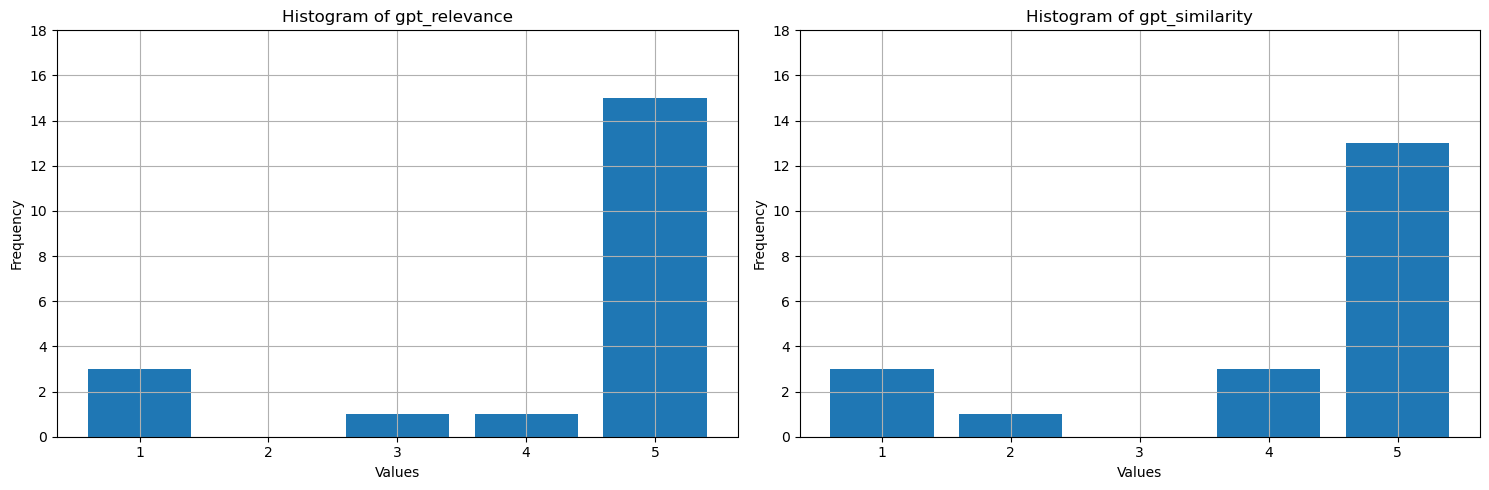
Bu değerler neleri gösterir? Yorumlanmalarını kolaylaştırmak için topraklanmışlık, ilgi ve benzerlik histogramlarını çizin. LLM, benzerlik ölçümünü azaltan insanların doğru kabul edilen yanıtlarından daha ayrıntılıdır - yanıtların yaklaşık yarısı anlamsal olarak doğrudur ama büyük ölçüde benzer oldukları için dört yıldız alırlar. Üç ölçümün de çoğu değeri 4 veya 5'tir ve bu da RAG performansının iyi olduğunu gösterir. Birkaç aykırı değer vardır; örneğin, soru How many species of otter are there? için modelin oluşturduğu There are 13 species of otter, yüksek ilgili ve benzerlik derecesi (5) ile doğrudur. Bazı nedenlerden dolayı GPT, sağlanan bağlamda zayıf zemine sahip olduğunu düşündü ve bir yıldız verdi. Bir yıldızın en az bir yapay zeka destekli ölçümü olan diğer üç durumda düşük puan kötü bir yanıta işaret ediyor. LLM bazen yanlış puanlar verir ancak genellikle doğru puanlar verir.
# Convert Spark DataFrame to Pandas DataFrame
pandas_df = df.toPandas()

selected_columns = ['gpt_groundedness', 'gpt_relevance', 'gpt_similarity']
trimmed_df = pandas_df[selected_columns].astype(int)

# Define a function to plot histograms for the specified columns
def plot_histograms(dataframe, columns):
    # Set up the figure size and subplots
    plt.figure(figsize=(15, 5))
    for i, column in enumerate(columns, 1):
        plt.subplot(1, len(columns), i)
        # Filter the dataframe to only include rows with values 1, 2, 3, 4, 5
        filtered_df = dataframe[dataframe[column].isin([1, 2, 3, 4, 5])]
        filtered_df[column].hist(bins=range(1, 7), align='left', rwidth=0.8)
        plt.title(f'Histogram of {column}')
        plt.xlabel('Values')
        plt.ylabel('Frequency')
        plt.xticks(range(1, 6))
        plt.yticks(range(0, 20, 2))


# Call the function to plot histograms for the specified columns
plot_histograms(trimmed_df, selected_columns)

# Show the plots
plt.tight_layout()
plt.show()
Hücre çıkışı:StatementMeta(, 21cb8cd3-7742-4c1f-8339-265e2846df1d, 24, Finished, Available, Finished)
Son adım olarak, karşılaştırma sonuçlarını göl evinizdeki bir tabloya kaydedin. Bu adım isteğe bağlıdır ancak kesinlikle önerilir; bulgularınızı daha kullanışlı hale getirir. RAG'de bir şeyi değiştirdiğinizde (örneğin, istemi değiştirdiğinizde, dizini güncelleştirdiğinizde veya yanıt oluşturucuda farklı bir GPT modeli kullandığınızda), etkiyi ölçün, iyileştirmeleri ölçün ve regresyonları algılayın.
# create name of experiment that is easy to refer to
friendly_name_of_experiment = "rag_tutorial_experiment_1"

# Note the current date and time
time_of_experiment = current_timestamp()

# Generate a unique GUID for all rows
experiment_id = str(uuid.uuid4())

# Add two new columns to the Spark DataFrame
updated_df = df.withColumn("execution_time", time_of_experiment) \
                        .withColumn("experiment_id", lit(experiment_id)) \
                        .withColumn("experiment_friendly_name", lit(friendly_name_of_experiment))

# Store the updated DataFrame in the default lakehouse as a table named 'rag_experiment_runs'
table_name = "rag_experiment_run_demo1"
updated_df.write.format("parquet").mode("append").saveAsTable(table_name)
Hücre çıkışı:StatementMeta(, 21cb8cd3-7742-4c1f-8339-265e2846df1d, 28, Finished, Available, Finished)
Deneme sonuçlarını gözden geçirmek, yeni denemelerle karşılaştırmak ve üretim için en uygun yapılandırmayı seçmek için istediğiniz zaman deneme sonuçlarına geri dönün.
Özet
Yapay zeka destekli ölçümler ve top-N alma oranını kullanarak alma destekli üretim (RAG) çözümünüzü oluşturun.