Poznámka:
Přístup k této stránce vyžaduje autorizaci. Můžete se zkusit přihlásit nebo změnit adresáře.
Přístup k této stránce vyžaduje autorizaci. Můžete zkusit změnit adresáře.
Important
Tato funkce je ve verzi Public Preview.
Important
Pro nové případy použití doporučuje Databricks nasazovat agenty v Databricks Apps, aby bylo možné plně řídit kód agenta, konfiguraci serveru a pracovní postup nasazení. Viz Vytvoření agenta AI a jeho nasazení v Databricks Apps. Pokud chcete migrovat existujícího agenta, přečtěte si téma Migrace agenta z modelové obsluhy do Databricks Apps.
Paměť umožňuje agentům umělé inteligence pamatovat si informace z dřívější konverzace nebo z předchozích konverzací. To umožňuje agentům poskytovat odpovědi na kontext a vytvářet přizpůsobené prostředí v průběhu času. Ke správě stavu a historie konverzací použijte Databricks Lakebase, plně spravovanou databázi Postgres OLTP.
Požadavky
- Instance Lakebase, viz Vytvoření a správa instance databáze.
Krátkodobá a dlouhodobá paměť
Krátkodobá paměť zachycuje kontext v jedné relaci konverzace, zatímco dlouhodobá paměť extrahuje a ukládá klíčové informace napříč několika konverzacemi. Agenta můžete sestavit pomocí obou typů paměti.
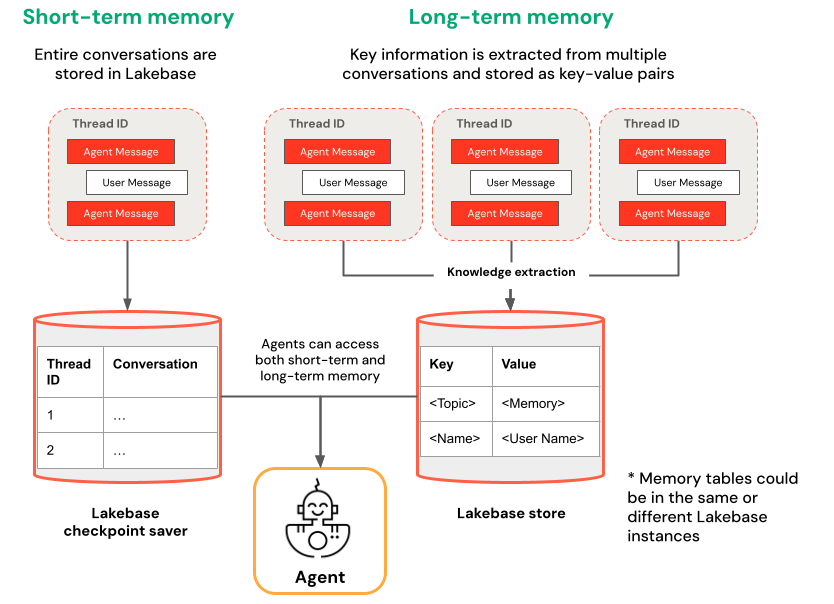
| Krátkodobá paměť | Dlouhodobá paměť |
|---|---|
| Zachycení kontextu v rámci jedné konverzační relace pomocí ID vláken a vytváření kontrolních bodů Zachování kontextu pro následné otázky v rámci relace Ladění a testování toků konverzací pomocí časového cestování |
Automatické extrahování a ukládání klíčových přehledů napříč několika relacemi Přizpůsobení interakcí na základě minulých předvoleb Vytvoření znalostní báze o uživatelích, kteří v průběhu času vylepšují odpovědi |
Příklady poznámkových bloků
Agent s krátkodobou pamětí
Agent s dlouhodobou pamětí
Dotazovat nasazeného agenta
Po nasazení agenta do koncového bodu nasazení modelu najdete pokyny pro dotazování agenta nasazeného v Azure Databricks
Pokud chcete předat ID vlákna, použijte extra_body parametr. Následující příklad ukazuje, jak předat ID vlákna koncovému ResponsesAgent bodu:
   response1 = client.responses.create(
    model=endpoint,
    input=[{"role": "user", "content": "What are stateful agents?"}],
    extra_body={
        "custom_inputs": {"thread_id": thread_id}
    }
)
Pokud používáte klienta, který automaticky předává ChatContext , jako je aplikace Playground nebo Review, ID konverzace a ID uživatele se automaticky předá v případě krátkodobého nebo dlouhodobého použití paměti.
Krátkodobé cestování v paměti
Pro agenty s krátkodobou pamětí použijte k obnovení provádění z kontrolních bodů LangGraph time-travel. Konverzaci můžete přehrát znovu nebo ji upravit a prozkoumat alternativní cesty. Při každém obnovení z kontrolního bodu vytvoří LangGraph novou větev v historii konverzací, zachová původní a umožní experimentování.
V kódu agenta vytvořte funkce, které načítají historii kontrolních bodů a aktualizují stav kontrolního
LangGraphResponsesAgentbodu ve třídě:from typing import List, Dict def get_checkpoint_history(self, thread_id: str, limit: int = 10) -> List[Dict[str, Any]]: """Retrieve checkpoint history for a thread. Args: thread_id: The thread identifier limit: Maximum number of checkpoints to return Returns: List of checkpoint information including checkpoint_id, timestamp, and next nodes """ config = {"configurable": {"thread_id": thread_id}} with CheckpointSaver(instance_name=LAKEBASE_INSTANCE_NAME) as checkpointer: graph = self._create_graph(checkpointer) history = [] for state in graph.get_state_history(config): if len(history) >= limit: break history.append({ "checkpoint_id": state.config["configurable"]["checkpoint_id"], "thread_id": thread_id, "timestamp": state.created_at, "next_nodes": state.next, "message_count": len(state.values.get("messages", [])), # Include last message summary for context "last_message": self._get_last_message_summary(state.values.get("messages", [])) }) return history def _get_last_message_summary(self, messages: List[Any]) -> Optional[str]: """Get a snippet of the last message for checkpoint identification""" return getattr(messages[-1], "content", "")[:100] if messages else None def update_checkpoint_state(self, thread_id: str, checkpoint_id: str, new_messages: Optional[List[Dict]] = None) -> Dict[str, Any]: """Update state at a specific checkpoint (used for modifying conversation history). Args: thread_id: The thread identifier checkpoint_id: The checkpoint to update new_messages: Optional new messages to set at this checkpoint Returns: New checkpoint configuration including the new checkpoint_id """ config = { "configurable": { "thread_id": thread_id, "checkpoint_id": checkpoint_id } } with CheckpointSaver(instance_name=LAKEBASE_INSTANCE_NAME) as checkpointer: graph = self._create_graph(checkpointer) # Prepare the values to update values = {} if new_messages: cc_msgs = self.prep_msgs_for_cc_llm(new_messages) values["messages"] = cc_msgs # Update the state (creates a new checkpoint) new_config = graph.update_state(config, values=values) return { "thread_id": thread_id, "checkpoint_id": new_config["configurable"]["checkpoint_id"], "parent_checkpoint_id": checkpoint_id }Aktualizujte funkce
predictapredict_stream, aby podporovaly předávání kontrolních bodů.Predict
def predict(self, request: ResponsesAgentRequest) -> ResponsesAgentResponse:
    """Non-streaming prediction"""
    # The same thread_id is used by BOTH predict() and predict_stream()
    ci = dict(request.custom_inputs or {})
    if "thread_id" not in ci:
        ci["thread_id"] = str(uuid.uuid4())
    request.custom_inputs = ci

    outputs = [
        event.item
        for event in self.predict_stream(request)
        if event.type == "response.output_item.done"
    ]

    # Include thread_id and checkpoint_id in custom outputs
    custom_outputs = {
        "thread_id": ci["thread_id"]
    }
    if "checkpoint_id" in ci:
        custom_outputs["parent_checkpoint_id"] = ci["checkpoint_id"]

    try:
        history = self.get_checkpoint_history(ci["thread_id"], limit=1)
        if history:
            custom_outputs["checkpoint_id"] = history[0]["checkpoint_id"]
    except Exception as e:
        logger.warning(f"Could not retrieve new checkpoint_id: {e}")

    return ResponsesAgentResponse(output=outputs, custom_outputs=custom_outputs)
Predict_stream
def predict_stream(
    self,
    request: ResponsesAgentRequest,
) -> Generator[ResponsesAgentStreamEvent, None, None]:
    """Streaming prediction with PostgreSQL checkpoint branching support.

    Accepts in custom_inputs:
    - thread_id: Conversation thread identifier for session
    - checkpoint_id (optional): Checkpoint to resume from (for branching)
    """
    # Get thread ID and checkpoint ID from custom inputs
    custom_inputs = request.custom_inputs or {}
    thread_id = custom_inputs.get("thread_id", str(uuid.uuid4()))  # generate new thread ID if one is not passed in
    checkpoint_id = custom_inputs.get("checkpoint_id")  # Optional for branching

    # Convert incoming Responses messages to LangChain format
    langchain_msgs = self.prep_msgs_for_cc_llm([i.model_dump() for i in request.input])

    # Build checkpoint configuration
    checkpoint_config = {"configurable": {"thread_id": thread_id}}
    # If checkpoint_id is provided, we're branching from that checkpoint
    if checkpoint_id:
        checkpoint_config["configurable"]["checkpoint_id"] = checkpoint_id
        logger.info(f"Branching from checkpoint: {checkpoint_id} in thread: {thread_id}")

    # DATABASE CONNECTION POOLING LOGIC FOLLOWS
    # Use connection from pool
Pak otestujte větvení kontrolních bodů:
Spusťte konverzační vlákno a přidejte několik zpráv:
from agent import AGENT
# Initial conversation - starts a new thread
response1 = AGENT.predict({
    "input": [{"role": "user", "content": "I'm planning for an upcoming trip!"}],
})
print(response1.model_dump(exclude_none=True))
thread_id = response1.custom_outputs["thread_id"]

# Within the same thread, ask a follow-up question - short-term memory will remember previous messages in the same thread/conversation session
response2 = AGENT.predict({
    "input": [{"role": "user", "content": "I'm headed to SF!"}],
    "custom_inputs": {"thread_id": thread_id}
})
print(response2.model_dump(exclude_none=True))

# Within the same thread, ask a follow-up question - short-term memory will remember previous messages in the same thread/conversation session
response3 = AGENT.predict({
    "input": [{"role": "user", "content": "Where did I say I'm going?"}],
    "custom_inputs": {"thread_id": thread_id}
})
print(response3.model_dump(exclude_none=True))
Načtěte historii kontrolních bodů a vytvořte fork konverzace s jinou zprávou:
# Get checkpoint history to find branching point
history = AGENT.get_checkpoint_history(thread_id, 20)
# Retrieve checkpoint at index - indices count backward from most recent checkpoint
index = max(1, len(history) - 4)
branch_checkpoint = history[index]["checkpoint_id"]

# Branch from node with next_node = `('__start__',)` to re-input message to agent at certain part of conversation
# I want to update the information of which city I am going to
# Within the same thread, branch from a checkpoint and override it with different context to continue the conversation in a new fork
response4 = AGENT.predict({
    "input": [{"role": "user", "content": "I'm headed to New York!"}],
    "custom_inputs": {
        "thread_id": thread_id,
        "checkpoint_id": branch_checkpoint # Branch from this checkpoint!
    }
})
print(response4.model_dump(exclude_none=True))

# Thread ID stays the same even though it branched from a checkpoint:
branched_thread_id = response4.custom_outputs["thread_id"]
print(f"original thread id was {thread_id}")
print(f"new thread id after branching is the same as original: {branched_thread_id}")

# Continue the conversation in the same thread and it will pick up from the information you tell it in your branch
response5 = AGENT.predict({
    "input": [{"role": "user", "content": "Where am I going?"}],
    "custom_inputs": {
        "thread_id": thread_id,
    }
})
print(response5.model_dump(exclude_none=True))