Poznámka:
Přístup k této stránce vyžaduje autorizaci. Můžete se zkusit přihlásit nebo změnit adresáře.
Přístup k této stránce vyžaduje autorizaci. Můžete zkusit změnit adresáře.
Toto téma poskytuje souhrn komunikace mezi ovladači v rámci více zásobníků Audio Class eXtensions (ACX).
Obecné informace o ACX naleznete v přehledu rozšíření audio třídy ACX a souhrn objektů ACX.
Základní informace o cílech ACX najdete v tématech ACX cíle a synchronizace ovladačů a požadavky IRP paketů vstupně-výstupních operací ACX.
ovladače zvuku Single-Stack
Historické ovladače audio třídy PortCls a KS podporují pouze jednostohové zvukové ovladače. Starší zvuková architektura komunikuje a je propojena pouze s jedním ovladačem miniportu. Ovladač miniportu je zodpovědný za správu komunikace a synchronizace s jinými zásobníky ovladačů v případě potřeby.
ACX plně podporuje jednostackové zvukové ovladače. Vývojáři zvuku můžou nahradit aktuální ovladač Portcls a miniport KS ovladačem založeným na ACX a zároveň zachovat stejné chování ve vztahu k ostatním vrstvám. I když zvukový subsystém používá více zvukových zásobníků, lepší přístup by se použil k použití podpory více zásobníků v ACX a nechat ACX synchronizovat všechny tyto zásobníky dohromady, jak je popsáno v další části tohoto tématu.
Ovladače zvuku s více stacky – komponentizace
Je velmi běžné, že zvuková cesta prochází několika hardwarovými komponentami, které jsou zpracovávány různými ovladačovými zásobníky, aby se vytvořil kompletní zvukový zážitek. Je typické, že systém má funkce DSP, CODEC a AMP implementované různými dodavateli zvukových technologií, jak je znázorněno v následujícím diagramu.

V architektuře s více sadami bez dobře definovaného standardu je každý dodavatel nucen definovat vlastní proprietární rozhraní a komunikační protokol. Cílem ACX je usnadnit vývoj vícevrstvých zvukových ovladačů zajištěním synchronizace mezi těmito úrovněmi a poskytováním jednoduchého opakovaně použitelného vzoru pro vzájemnou komunikaci ovladačů.
Pomocí ACX může být ukázkový systém DSP, KODEK a návrh hardwaru AMP podporován s následující softwarovou architekturou.
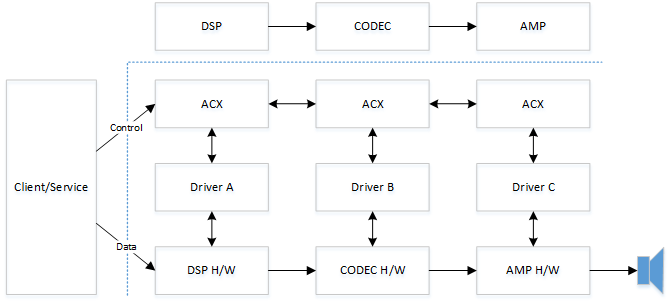
Všimněte si, že lze použít jakýkoli typ součásti místo zobrazeného DSP, KODEK a AMP, protože ACX nezávisí na žádném konkrétním typu součásti ani na konkrétních uspořádáních součástí.
Ovladače třetích stran vzájemně komunikují prostřednictvím ACX s dobře definovaným protokolem. Jednou z výhod tohoto přístupu je, že jeden zásobník může být nahrazen jiným od jiného dodavatele bez nutnosti změn sousedních softwarových zásobníků. Jedním z hlavních cílů architektury rozšíření zvukových tříd (ACX) je zjednodušit úsilí potřebné k vývoji vícesložkových zvukových ovladačů sestavených z komponent od různých dodavatelů.
AcX cílí na příklad komunikace – Okruh
Tento ukázkový kód ukazuje použití AcxTargetCircuit a AcxTargetCircuitGetWdfIoTarget ke komunikaci se vzdáleným obvodem, který je zpřístupněn jiným zásobníkem. Další informace o obvodech ACX naleznete v tématu acxcircuit.h.
Tento poměrně složitý agregátor vyhledá obvody a poté vytvoří ioTarget pomocí AcxTargetCircuitGetWdfIoTarget. Potom nastaví vlastní možnosti odesílání WDF a asynchronně odešle požadavek. Nakonec zkontroluje stav odeslání, aby potvrdil odeslání požadavku.
NTSTATUS
Aggregator_SendModuleCommand(
    _In_ PAGGREGATOR_RENDER_CIRCUIT_CONTEXT CircuitCtx,
    _In_ ACX_REQUEST_PARAMETERS             Params,
    _Out_ ULONG_PTR *                       OutSize
    )
{
    NTSTATUS                    status = STATUS_NOT_SUPPORTED;
    PKSAUDIOMODULE_PROPERTY     moduleProperty = nullptr;
    ULONG                       aggregationDeviceIndex = 0;
    PLIST_ENTRY                 ple;

    *OutSize = 0;

    moduleProperty = CONTAINING_RECORD(Params.Parameters.Property.Control, KSAUDIOMODULE_PROPERTY, ClassId);
    aggregationDeviceIndex = AUDIOMODULE_GET_AGGDEVICEID(moduleProperty->InstanceId);

    ple = CircuitCtx->AggregatorCircuit->AggregatorEndpoint->AudioPaths[aggregationDeviceIndex]->TargetCircuitList.Flink;
    while (ple != &CircuitCtx->AggregatorCircuit->AggregatorEndpoint->AudioPaths[aggregationDeviceIndex]->TargetCircuitList)
    {
        PAUDIO_CIRCUIT circuit = (PAUDIO_CIRCUIT)CONTAINING_RECORD(ple, AUDIO_CIRCUIT, ListEntry);

        if (circuit->Modules)
        {
            for(ULONG i = 0; i < circuit->Modules->Count; i++)
            {
                PACX_AUDIOMODULE_DESCRIPTOR descriptor = ((PACX_AUDIOMODULE_DESCRIPTOR)(circuit->Modules + 1) + i);

                // we've identified which aggregation device this call is targeting,
                // now locate which circuit implements this module. Within an aggregated device,
                // the module class id + instance id must uniquely identify a module. There should
                // never be duplicates.
                if (IsEqualGUIDAligned(descriptor->ClassId, moduleProperty->ClassId) &&
                    descriptor->InstanceId == moduleProperty->InstanceId)
                {
                    WDFREQUEST                  request = NULL;
                    WDF_REQUEST_SEND_OPTIONS    sendOptions;
                    WDF_OBJECT_ATTRIBUTES       attributes;
                    WDFIOTARGET                 ioTarget;

                    // We've now identified which aggregated device this call is targeting.
                    // The cached module information contains the ID adjusted with the aggregation device
                    // index. remove the aggregation device index before forwarding the call to the aggregated circuit.
                    moduleProperty->InstanceId = AUDIOMODULE_GET_INSTANCEID(moduleProperty->InstanceId);

                    ioTarget = AcxTargetCircuitGetWdfIoTarget(circuit->AcxTargetCircuit);

                    WDF_OBJECT_ATTRIBUTES_INIT(&attributes);
                    attributes.ParentObject = CircuitCtx->AggregatorCircuit->Circuit;
                    status = WdfRequestCreate(&attributes, ioTarget, &request);
                    if (!NT_SUCCESS(status))
                    {
                        goto exit;
                    }

                    status = AcxTargetCircuitFormatRequestForProperty(circuit->AcxTargetCircuit, request, &Params);
                    if (!NT_SUCCESS(status))
                    {
                        goto exit;
                    }

                    WDF_REQUEST_SEND_OPTIONS_INIT(&sendOptions, WDF_REQUEST_SEND_OPTION_SYNCHRONOUS);
                    WDF_REQUEST_SEND_OPTIONS_SET_TIMEOUT(&sendOptions, WDF_REL_TIMEOUT_IN_SEC(REQUEST_TIMEOUT_SECONDS));

                    // Whether WdfRequestSend succeeds or fails, we return the status & information, so
                    // there's no need to inspect the result.
                    WdfRequestSend(request, ioTarget, &sendOptions);
                    status = WdfRequestGetStatus(request);
                    *OutSize = WdfRequestGetInformation(request);

                    WdfObjectDelete(request);
                    goto exit;
                }
            }
        }

        ple = ple->Flink;
    }

    status = STATUS_SUCCESS;

exit:
    return status;
}
ACX se zaměřuje na příklad komunikace – Špendlík
Tento ukázkový kód ukazuje použití AcxTargetPin ke komunikaci s kolíkem vzdáleného okruhu, který je řízen jiným zásobníkem. Další informace o pinu ACX naleznete v tématu acxpin.h.
Vybere poslední prvky hlasitosti a ztlumení, které jsou oba přítomné ve stejném okruhu v cestě ke koncovému bodu.
NTSTATUS FindDownstreamVolumeMute(
_In_ ACXCIRCUIT Circuit,
_In_ ACXTARGETCIRCUIT TargetCircuit
)
{
NTSTATUS status;
PDSP_CIRCUIT_CONTEXT circuitCtx;
ACX_REQUEST_PARAMETERS params;
WDF_REQUEST_SEND_OPTIONS sendOptions;
WDF_OBJECT_ATTRIBUTES attributes;
WDF_REQUEST_REUSE_PARAMS reuseParams;
circuitCtx = GetDspCircuitContext(Circuit);
//
// Note on behavior: This search algorithm will select the last Volume and Mute elements that are both
// present in the same circuit in the Endpoint Path.
// This logic could be updated to select the last Volume and Mute elements, or the first or last
// Volume or the first or last Mute element.
//
//
// First look through target's pins to determine if there's another circuit downstream.
// If there is, we'll look at that circuit for volume/mute.
//
for (ULONG pinIndex = 0; pinIndex < AcxTargetCircuitGetPinsCount(TargetCircuit); ++pinIndex)
{
ACXTARGETPIN targetPin = AcxTargetCircuitGetTargetPin(TargetCircuit, pinIndex);
ULONG targetPinFlow = 0;
ACX_REQUEST_PARAMETERS_INIT_PROPERTY(¶ms,
KSPROPSETID_Pin,
KSPROPERTY_PIN_DATAFLOW,
AcxPropertyVerbGet,
AcxItemTypePin,
AcxTargetPinGetId(targetPin),
nullptr, 0,
&targetPinFlow,
sizeof(targetPinFlow));
RETURN_NTSTATUS_IF_FAILED(SendProperty(targetPin, ¶ms, nullptr));
//
// Searching for the downstream pins. For Render, these are the dataflow out pins
//
if (circuitCtx->IsRenderCircuit && targetPinFlow != KSPIN_DATAFLOW_OUT)
{
continue;
}
else if (!circuitCtx->IsRenderCircuit && targetPinFlow != KSPIN_DATAFLOW_IN)
{
continue;
}
// Get the target pin's physical connection. We'll do this twice: first to get size and allocate, second to get the connection
PKSPIN_PHYSICALCONNECTION pinConnection = nullptr;
auto connection_free = scope_exit([&pinConnection]()
{
if (pinConnection)
{
ExFreePool(pinConnection);
pinConnection = nullptr;
}
});
ULONG pinConnectionSize = 0;
ULONG_PTR info = 0;
for (ULONG i = 0; i < 2; ++i)
{
ACX_REQUEST_PARAMETERS_INIT_PROPERTY(¶ms,
KSPROPSETID_Pin,
KSPROPERTY_PIN_PHYSICALCONNECTION,
AcxPropertyVerbGet,
AcxItemTypePin,
AcxTargetPinGetId(targetPin),
nullptr, 0,
pinConnection,
pinConnectionSize);
status = SendProperty(targetPin, ¶ms, &info);
if (status == STATUS_BUFFER_OVERFLOW)
{
// Pin connection already allocated, so how did this fail?
RETURN_NTSTATUS_IF_TRUE(pinConnection != nullptr, status);
pinConnectionSize = (ULONG)info;
pinConnection = (PKSPIN_PHYSICALCONNECTION)ExAllocatePool2(POOL_FLAG_NON_PAGED, pinConnectionSize, DRIVER_TAG);
// RETURN_NTSTATUS_IF_NULL_ALLOC causes compile errors
RETURN_NTSTATUS_IF_TRUE(pinConnection == nullptr, STATUS_INSUFFICIENT_RESOURCES);
}
else if (!NT_SUCCESS(status))
{
// There are no more connected circuits. Continue with processing this circuit.
break;
}
}
if (!NT_SUCCESS(status))
{
// There are no more connected circuits. Continue handling this circuit.
break;
}
ACXTARGETCIRCUIT nextTargetCircuit;
RETURN_NTSTATUS_IF_FAILED(CreateTargetCircuit(Circuit, pinConnection, pinConnectionSize, &nextTargetCircuit));
auto circuit_free = scope_exit([&nextTargetCircuit]()
{
if (nextTargetCircuit)
{
WdfObjectDelete(nextTargetCircuit);
nextTargetCircuit = nullptr;
}
});
RETURN_NTSTATUS_IF_FAILED_UNLESS_ALLOWED(FindDownstreamVolumeMute(Circuit, nextTargetCircuit), STATUS_NOT_FOUND);
if (circuitCtx->TargetVolumeMuteCircuit == nextTargetCircuit)
{
// The nextTargetCircuit is the owner of the volume/mute target elements.
// We will delete it when the pin is disconnected.
circuit_free.release();
// We found volume/mute. Return.
return STATUS_SUCCESS;
}
// There's only one downstream pin on the current targetcircuit, and we just processed it.
break;
}
//
// Search the target circuit for a volume or mute element.
// This sample code doesn't support downstream audioengine elements.
//
for (ULONG elementIndex = 0; elementIndex < AcxTargetCircuitGetElementsCount(TargetCircuit); ++elementIndex)
{
ACXTARGETELEMENT targetElement = AcxTargetCircuitGetTargetElement(TargetCircuit, elementIndex);
GUID elementType = AcxTargetElementGetType(targetElement);
if (IsEqualGUID(elementType, KSNODETYPE_VOLUME) &&
circuitCtx->TargetVolumeHandler == nullptr)
{
// Found Volume
circuitCtx->TargetVolumeHandler = targetElement;
}
if (IsEqualGUID(elementType, KSNODETYPE_MUTE) &&
circuitCtx->TargetMuteHandler == nullptr)
{
// Found Mute
circuitCtx->TargetMuteHandler = targetElement;
}
}
if (circuitCtx->TargetVolumeHandler && circuitCtx->TargetMuteHandler)
{
circuitCtx->TargetVolumeMuteCircuit = TargetCircuit;
return STATUS_SUCCESS;
}
//
// If we only found one of volume or mute, keep searching for both
//
if (circuitCtx->TargetVolumeHandler || circuitCtx->TargetMuteHandler)
{
circuitCtx->TargetMuteHandler = circuitCtx->TargetVolumeHandler = nullptr;
}
return STATUS_NOT_FOUND;
}
AcX cílí na příklad komunikace – Stream
Tento ukázkový kód ukazuje použití AcxTargetStream ke komunikaci s datovým proudem vzdáleného okruhu. Další informace o streamech ACX naleznete v tématu acxstreams.h.
    NTSTATUS                        status;
    PRENDER_DEVICE_CONTEXT          devCtx;
    WDF_OBJECT_ATTRIBUTES           attributes;
    ACXSTREAM                       stream;
    STREAM_CONTEXT *                streamCtx;
    ACXELEMENT                      elements[2] = {0};
    ACX_ELEMENT_CONFIG              elementCfg;
    ELEMENT_CONTEXT *               elementCtx;
    ACX_STREAM_CALLBACKS            streamCallbacks;
    ACX_RT_STREAM_CALLBACKS         rtCallbacks;
    CRenderStreamEngine *           streamEngine = NULL;

    PAGED_CODE();
    UNREFERENCED_PARAMETER(Pin);
    UNREFERENCED_PARAMETER(SignalProcessingMode);
    UNREFERENCED_PARAMETER(VarArguments);

    // This unit-test added support for RAW and DEFAULT.
    ASSERT(IsEqualGUID(*SignalProcessingMode, AUDIO_SIGNALPROCESSINGMODE_RAW) ||
           IsEqualGUID(*SignalProcessingMode, AUDIO_SIGNALPROCESSINGMODE_DEFAULT));

    devCtx = GetRenderDeviceContext(Device);
    ASSERT(devCtx != NULL);

    //
    // Init streaming callbacks.
    //
    ACX_STREAM_CALLBACKS_INIT(&streamCallbacks);
    streamCallbacks.EvtAcxStreamPrepareHardware         = EvtStreamPrepareHardware;
    streamCallbacks.EvtAcxStreamReleaseHardware         = EvtStreamReleaseHardware;
    streamCallbacks.EvtAcxStreamRun                     = EvtStreamRun;
    streamCallbacks.EvtAcxStreamPause                   = EvtStreamPause;
    streamCallbacks.EvtAcxStreamAssignDrmContentId      = EvtStreamAssignDrmContentId;

    status = AcxStreamInitAssignAcxStreamCallbacks(StreamInit, &streamCallbacks);
    if (!NT_SUCCESS(status))
    {
        ASSERT(FALSE);
        goto exit;
    }

    //
    // Init RT streaming callbacks.
    //
    ACX_RT_STREAM_CALLBACKS_INIT(&rtCallbacks);
    rtCallbacks.EvtAcxStreamGetHwLatency                = EvtStreamGetHwLatency;
    rtCallbacks.EvtAcxStreamAllocateRtPackets           = EvtStreamAllocateRtPackets;
    rtCallbacks.EvtAcxStreamFreeRtPackets               = EvtStreamFreeRtPackets;
    rtCallbacks.EvtAcxStreamSetRenderPacket             = R_EvtStreamSetRenderPacket;
    rtCallbacks.EvtAcxStreamGetCurrentPacket            = EvtStreamGetCurrentPacket;
    rtCallbacks.EvtAcxStreamGetPresentationPosition     = EvtStreamGetPresentationPosition;

    status = AcxStreamInitAssignAcxRtStreamCallbacks(StreamInit, &rtCallbacks);
    if (!NT_SUCCESS(status))
    {
        ASSERT(FALSE);
        goto exit;
    }

    //
    // Create the stream.
    //
    WDF_OBJECT_ATTRIBUTES_INIT_CONTEXT_TYPE(&attributes, STREAM_CONTEXT);
    attributes.EvtCleanupCallback = EvtStreamCleanup;
    attributes.EvtDestroyCallback = EvtStreamDestroy;
    status = AcxRtStreamCreate(Device, Circuit, &attributes, &StreamInit, &stream);
    if (!NT_SUCCESS(status))
    {
        ASSERT(FALSE);
        goto exit;
    }

    // START-TESTING: inverted create-stream sequence.
    {
        ACXSTREAMBRIDGE             bridge          = NULL;
        ACXPIN                      bridgePin       = NULL;
        ACXTARGETSTREAM             targetStream    = NULL;
        ACX_STREAM_BRIDGE_CONFIG    bridgeCfg;

        ACX_STREAM_BRIDGE_CONFIG_INIT(&bridgeCfg);
        bridgeCfg.InModesCount = 0;     // no in-modes. this stream-bridge is manually managed.
        bridgeCfg.InModes      = NULL;
        bridgeCfg.OutMode      = NULL;  // no mode, i.e., default (1st) and raw (2nd).
        bridgeCfg.Flags |= AcxStreamBridgeInvertChangeStateSequence;

        WDF_OBJECT_ATTRIBUTES_INIT(&attributes);
        attributes.ParentObject = WdfGetDriver(); // bridge is deleted by driver obj in case of error.

        status = AcxStreamBridgeCreate(Circuit, &attributes, &bridgeCfg, &bridge);
        if (!NT_SUCCESS(status))
        {
            ASSERT(FALSE);
            goto exit;
        }

        ...

        status = AcxStreamBridgeAddStream(bridge, stream);
        if (!NT_SUCCESS(status))
        {
            ASSERT(FALSE);
            goto exit;
        }

        // Get the Target Stream
        targetStream = AcxStreamBridgeGetTargetStream(bridge, stream);
        if (targetStream == NULL)
        {
            ASSERT(FALSE);
            goto exit;
        }
AcX cílí na příklad komunikace – Element
Tento ukázkový kód ukazuje použití AcxTargetElement ke komunikaci s prvkem okruhu. Další informace o cílech ACX naleznete v tématu acxtargets.h.
    _In_    ACXCIRCUIT          Circuit,
    _In_    ACXTARGETCIRCUIT    TargetCircuit

...

    //
    // Search the target circuit for a volume or mute element.
    // This sample code doesn't support downstream audioengine elements.
    //
    for (ULONG elementIndex = 0; elementIndex < AcxTargetCircuitGetElementsCount(TargetCircuit); ++elementIndex)
    {
        ACXTARGETELEMENT targetElement = AcxTargetCircuitGetTargetElement(TargetCircuit, elementIndex);
        GUID elementType = AcxTargetElementGetType(targetElement);

        if (IsEqualGUID(elementType, KSNODETYPE_VOLUME) &&
            circuitCtx->TargetVolumeHandler == nullptr)
        {
            // Found Volume
            circuitCtx->TargetVolumeHandler = targetElement;
        }
        if (IsEqualGUID(elementType, KSNODETYPE_MUTE) &&
            circuitCtx->TargetMuteHandler == nullptr)
        {
            // Found Mute
            circuitCtx->TargetMuteHandler = targetElement;
        }
    }
Viz také
Přehled rozšíření zvukových tříd ACX
referenční dokumentace ACX
Pakety žádostí o vstupně-výstupní operace ACX IRP
Cíle ACX a synchronizace ovladačů
referenční dokumentace ACX