Bemærk
Adgang til denne side kræver godkendelse. Du kan prøve at logge på eller ændre mapper.
Adgang til denne side kræver godkendelse. Du kan prøve at ændre mapper.
A function app runs on a specific version of the Azure Functions runtime. By default, you create function apps in the latest 4.x version of the Functions runtime. Your function apps are supported only when they run on a supported major version. This article explains how to configure a function app in Azure to target, or pin to, a specific version of the Functions runtime, when required.
Considerations
Keep these considerations in mind when targeting a specific runtime version:
- The Flex Consumption plan only runs on version 4.x of the runtime. Because the Flex Consumption plan doesn't support the
FUNCTIONS_EXTENSION_VERSIONapp setting, your app can't target a specific runtime version when running in this plan. - The way that you target a specific version depends on whether you're running Windows or Linux.
- This article is specific to either Windows or Linux. Choose your operating system at the top of the article.
- When possible, always run your app on the latest supported runtime version. Pin your app to a specific version only if you're instructed to do so due to an issue with the latest version. Always move up to the latest runtime version as soon as your functions can run correctly.
- During local development, your installed version of Azure Functions Core Tools must match the major runtime version used by the function app in Azure. For more information, see Core Tools versions.
Update your runtime version
When possible, always run your function apps on the latest supported version of the Azure Functions runtime. If your function app is currently running on an older version of the runtime, migrate your app to version 4.x.
When your app has existing functions, you must take precautions before moving to a later major runtime version. The following articles detail breaking changes between major versions, including language-specific breaking changes. They also provide you with step-by-step instructions for a successful migration of your existing function app.
To determine your current runtime version, see View the current runtime version.
View the current runtime version
You can view the current runtime version of your function app in one of these ways:
To view and update the runtime version currently used by a function app, follow these steps:
In the Azure portal, browse to your function app.
Expand Settings, and then select Configuration.
In the Function runtime settings tab, note the Runtime version. In this example, the version is set to
~4.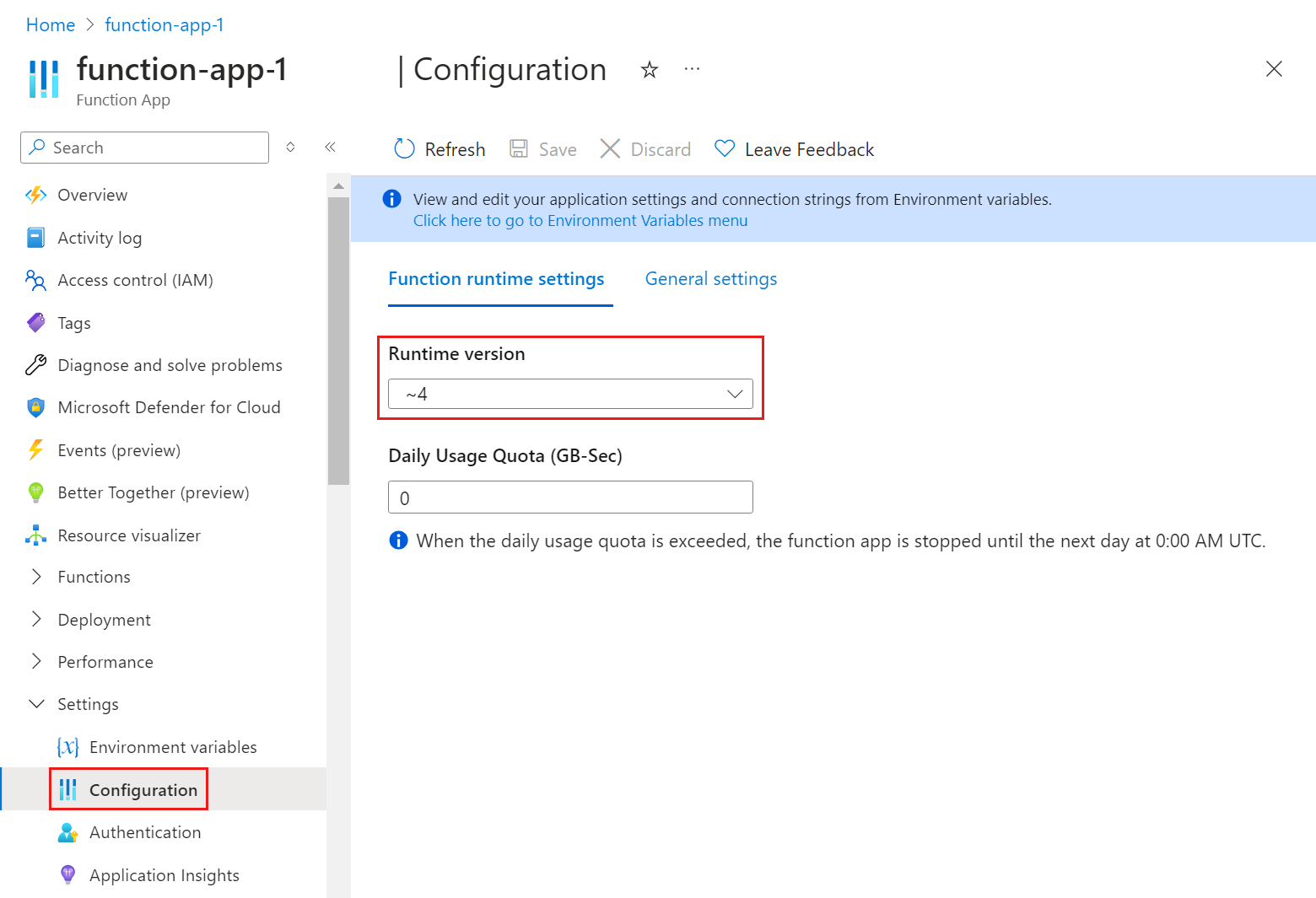
Pin to a specific version
Azure Functions lets you use the FUNCTIONS_EXTENSION_VERSION app setting to target the runtime version used by a given function app. If you specify only the major version (~4), the function app automatically updates to new minor versions of the runtime as they become available. Minor version updates are automatic because new minor versions aren't likely to introduce changes that break your functions.
Linux apps use the linuxFxVersion site setting along with FUNCTIONS_EXTENSION_VERSION to determine the correct Linux base image in which to run your functions. When you create a new function app on Linux, the runtime automatically chooses the correct base image for you based on the runtime version of your language stack.
Pinning to a specific runtime version restarts your function app.
When you specify a specific minor version (such as 4.0.12345) in FUNCTIONS_EXTENSION_VERSION, you pin the function app to that specific version of the runtime until you explicitly choose to move back to automatic version updates. Only pin to a specific minor version long enough to resolve any issues with your function app that prevent you from targeting the major version. Older minor versions are regularly removed from the production environment. When your function app is pinned to a minor version that is later removed, your function app runs on the closest existing version instead of the version set in FUNCTIONS_EXTENSION_VERSION. App Service announcements announce minor version removals.
Note
When you try to publish from Visual Studio to an app that is pinned to a specific minor version of the runtime, a dialog prompts you to update to the latest version or cancel the publish. To avoid this check when you must use a specific minor version, add the <DisableFunctionExtensionVersionUpdate>true</DisableFunctionExtensionVersionUpdate> property in your .csproj file.
Use one of these methods to temporarily pin your app to a specific version of the runtime:
To view and update the runtime version currently used by a function app, follow these steps:
In the Azure portal, browse to your function app.
Expand Settings, and then select Configuration.
In the Function runtime settings tab, note the Runtime version. In this example, the version is set to
~4.
To pin your app to a specific minor version, in the left pane, expand Settings, and then select Environment variables.
From the App settings tab, select FUNCTIONS_EXTENSION_VERSION, change Value to your required minor version, and then select Apply.
Select Apply, and then select Confirm to apply the changes and restart the app.
The function app restarts after the change is made to the application setting.
To pin your function app to a specific runtime version on Linux, set a version-specific base image URL in the linuxFxVersion site setting in the format DOCKER|<PINNED_VERSION_IMAGE_URI>.
Important
Pinned function apps on Linux don't receive regular security and host functionality updates. Unless recommended by a support professional, use the FUNCTIONS_EXTENSION_VERSION setting and a standard linuxFxVersion value for your language and version, such as Python|3.12. For valid values, see the linuxFxVersion reference article.
Pinning to a specific runtime isn't currently supported for Linux function apps running in a Consumption plan.
The following example shows the linuxFxVersion value required to pin a Node.js 22 function app to a specific runtime version of 4.14.0.3:
DOCKER|mcr.microsoft.com/azure-functions/node:4.14.0.3-node22
When needed, a support professional can provide you with a valid base image URI for your application.
Use the following Azure CLI commands to view and set the linuxFxVersion. You can't currently set linuxFxVersion in the portal or by using Azure PowerShell:
To view the current runtime version, use the az functionapp config show command:
az functionapp config show --name <function_app> \
--resource-group <my_resource_group> --query 'linuxFxVersion' -o tsv
In this code, replace
<function_app>with the name of your function app. Also, replace<my_resource_group>with the name of the resource group for your function app. The current value oflinuxFxVersionis returned.To update the
linuxFxVersionsetting in the function app, use the az functionapp config set command:az functionapp config set --name <FUNCTION_APP> \ --resource-group <RESOURCE_GROUP> \ --linux-fx-version <LINUX_FX_VERSION>Replace
<FUNCTION_APP>with the name of your function app. Also, replace<RESOURCE_GROUP>with the name of the resource group for your function app. Finally, replace<LINUX_FX_VERSION>with the value of a specific image provided to you by a support professional.
You can run these commands from the Azure Cloud Shell by choosing Open Cloud Shell in the preceding code examples. You can also use the Azure CLI locally to execute this command after executing az login to sign in.
The function app restarts after the change is made to the site config.
Update the managed Linux image
This section applies only to existing Python 3.11 and Java 8, 11, or 17 apps on Linux Elastic Premium or Dedicated (App Service) plans that use a Debian Bullseye managed image. If your app doesn't meet all of these conditions, you don't need to follow this procedure.
The newer managed image provides a temporary path for an affected app to remain on its current language version while moving to a supported Linux distribution. This procedure doesn't apply to Flex Consumption or custom container apps. For an app on the Linux Consumption plan, migrate to the Flex Consumption plan.
This update selects the Linux distribution for the existing language version by using a three-part linuxFxVersion value. It doesn't pin the Functions host to a specific DOCKER|<IMAGE_URI> image.
Choose a Bookworm or Noble linuxFxVersion value
First, determine whether you can update the language version or need to retain the current language version and select a newer Linux distribution.
Consider updating the app to a newer supported language version. After a language update, the app uses the current default managed image for that language version.
If the app must remain on its current language version, choose the corresponding newer image value:
Language version Debian Bullseye value Newer distribution Newer image value Python 3.11 Python\|3.11\|2.0Debian Bookworm Python\|3.11\|3.0Java 8 Java\|8\|2.0Ubuntu Noble Java\|8\|4.0Java 11 Java\|11\|2.0Ubuntu Noble Java\|11\|4.0Java 17 Java\|17\|2.0Ubuntu Noble Java\|17\|4.0These three-part values explicitly select the managed Linux image for these Bullseye-era images. They aren't returned by the
az functionapp list-runtimescommand.
Test the newer managed Linux image
Test your app and its dependencies on the newer image before you update the production app.
Create a separate test app or create a deployment slot.
Deploy the same code and configuration that your production app uses to the test app or slot.
Set the newer image value by following the steps in Update the image value. When you use a slot, include
--slot <SLOT_NAME>in each Azure CLI command.Invoke each function and verify that the app starts successfully, triggers run as expected, and native or operating-system dependencies load correctly.
Update the image value
Changing the image value restarts the function app. Update production during a maintenance window, or use a deployment slot.
View the current
linuxFxVersionvalue:az functionapp config show --name <APP_NAME> \ --resource-group <RESOURCE_GROUP> \ --query linuxFxVersion --output tsvThis command returns the value stored in the site configuration. The returned value might contain only the language and language version, such as
Python|3.11, rather than the three-part value that identifies the Linux distribution. If the value doesn't include the image version, follow the steps in Verify the Linux distribution to confirm that the app currently uses Debian Bullseye.Set
linuxFxVersionto the newer image value:az functionapp config set --name <APP_NAME> \ --resource-group <RESOURCE_GROUP> \ --linux-fx-version "<LANGUAGE|VERSION|IMAGE_VERSION>"For Python 3.11 on Debian Bookworm, use
Python|3.11|3.0. For Java on Ubuntu Noble, useJava|8|4.0,Java|11|4.0, orJava|17|4.0.Wait for the app to restart.
Verify the Linux distribution
Verify both the configured value and the Linux distribution that runs your app.
Confirm the updated
linuxFxVersionvalue:az functionapp config show --name <APP_NAME> \ --resource-group <RESOURCE_GROUP> \ --query linuxFxVersion --output tsvBecause you explicitly set a three-part value, this command returns the exact Bookworm or Noble value that you selected.
Open the app's Kudu site at
https://<APP_NAME>.scm.azurewebsites.net.Select Environment and review
KUDU_ENV, or open an SSH session and run:cat /etc/os-releaseConfirm that the output identifies Debian Bookworm for Python 3.11 or Ubuntu Noble for Java 8, 11, or 17.
Invoke each function and confirm that triggers and dependencies continue to work as expected.
Roll back the managed Linux image update
If the updated image causes a compatibility issue, temporarily restore the previous linuxFxVersion value while you fix the problem.
Warning
Debian Bullseye is no longer supported after its end-of-life date and doesn't receive security updates. Use rollback only as a temporary mitigation, and return to a supported image as soon as possible.
From the table in Choose a Bookworm or Noble
linuxFxVersionvalue, find the Debian Bullseye value for your language version.Set
linuxFxVersionto that Bullseye value:az functionapp config set --name <APP_NAME> \ --resource-group <RESOURCE_GROUP> \ --linux-fx-version "<BULLSEYE_LINUX_FX_VERSION>"Wait for the app to restart, and then repeat the checks in Verify the Linux distribution.