Bemærk
Adgang til denne side kræver godkendelse. Du kan prøve at logge på eller ændre mapper.
Adgang til denne side kræver godkendelse. Du kan prøve at ændre mapper.
Azure API Center enables you to track all your APIs in a centralized location for discovery, reuse, and governance. Use an API center to develop and maintain a structured and organized inventory of your organization's APIs - regardless of their type, lifecycle stage, or deployment location - along with related information such as version details, API definition files, and common metadata.
By using an API center, stakeholders throughout your organization, including API program managers, IT administrators, application developers, and API developers can design, discover, reuse, and govern APIs.
Note
Azure API Center is a solution for design-time API governance and centralized API discovery. Azure also offers complementary services such as Azure API Management, a solution for runtime API governance and observability by using an API gateway. Review the differences and see how they can work together.
Benefits
Azure API Center offers the following benefits:
Create and maintain an organizational inventory: Build a complete inventory of APIs available in your organization. Register APIs managed in all your API management solutions, including Azure API Management and platforms from other providers. Also include your unmanaged APIs and APIs under development. Foster communication and let API program managers and developers collaborate for increased API reuse, quality, security, compliance, and developer productivity.
Govern your organization's APIs: Access more complete visibility into the APIs being developed and used within your organization. API program managers and IT administrators can govern this inventory to ensure it meets organizational standards by defining custom metadata and analyzing API definitions to enforce conformance to API style guidelines.
Easy API discovery: Promote API reuse to maximize developer productivity and ensure developers are using the right APIs. Azure API Center helps program managers and developers discover the API inventory and filter by using built-in and custom metadata.
Accelerate API consumption: Maximize developer productivity when consuming APIs and ensure they're consumed in a secure manner consistent with organizational standards.
Key capabilities
Create and use an API center for the following capabilities:
API inventory management: Enable API developers and API program managers to register all of the organization's APIs for inclusion in a centralized inventory. They can use the Azure portal, the Azure CLI, developer tooling like CI/CD pipelines, and links to API sources like Azure API Management services.
API design and development: Allow developers to use the Azure API Center extension for Visual Studio Code to register APIs directly from the same development environment where they create their APIs and apps.
Developers can take advantage of the extension's integration with GitHub Copilot to create API definitions from code and GitHub Copilot for Azure to design APIs with AI assistance.
Real-world API representation: Add real-world information about each API including versions and definitions such as OpenAPI definitions. Create a list of API deployments and associate them with runtime environments, for example, represent Azure API Management or other API management solutions.
API governance: Organize and filter APIs and related resources by using built-in and custom metadata, to help with API governance and discovery by API consumers. Set up linting and analysis to enforce API definition quality.
API developers can shift-left API design conformance checks into Visual Studio Code by using integrated linting support and breaking change detection. Integrate with tools such as Dev Proxy to ensure apps don't use unregistered shadow APIs or APIs that don't meet organizational standards.
API discovery and reuse: Enable enterprise developers and API program managers to discover APIs through an Azure API Center portal. You can also enable the portal by using the Azure API Center Visual Studio Code extension.
For more information about the entities you can manage and the capabilities in Azure API Center, see Key concepts.
API Center plans and features
Azure API Center is offered in a Free plan and Standard plan, which are designed to meet different needs as summarized in the following table. For feature availability and limits, see Azure API Center limits.
| Capability | Free plan | Standard plan |
|---|---|---|
| Use cases | Evaluation and small-scale use | Enterprise and production workloads |
| Inventory and governance features | Limited1 | Expanded for enterprise use cases |
| Upgrade path | Upgradable to Standard | N/A |
| Time constraints | None | None |
Important
Microsoft support isn't available for the Azure API Center Free plan. Support cases submitted by Free plan customers can't be investigated and are closed. To receive Microsoft support, upgrade to the Standard plan.
1 For details, see Azure API Center limits.
Standard plan benefit when API Center linked to API Management
If you link your API Management instance to your Azure API Center, you can use or upgrade to the API Center Standard plan at no extra cost. This benefit applies to customers with the following API Management tiers and continues as long as at least one eligible API Management instance remains linked.
- Standard
- Standard v2
- Premium
- Premium v2
For more information, see Azure API Management pricing.
Available regions
Azure API Center is currently available in the following Azure regions:
- Australia East
- Canada Central
- Central India
- East US
- France Central
- Sweden Central
- UK South
- West Europe
Azure API Center and the API ecosystem
Azure API Center can serve a key role in an organization's API ecosystem. Consider the hypothetical Contoso organization, which adopts an API-first strategy, emphasizing the importance of APIs in their software development and integration.
Contoso's API developers, app developers, API program managers, and API managers collaborate through Azure API Center to develop and use the organization's API inventory. The following diagram and explanation demonstrate this scenario:
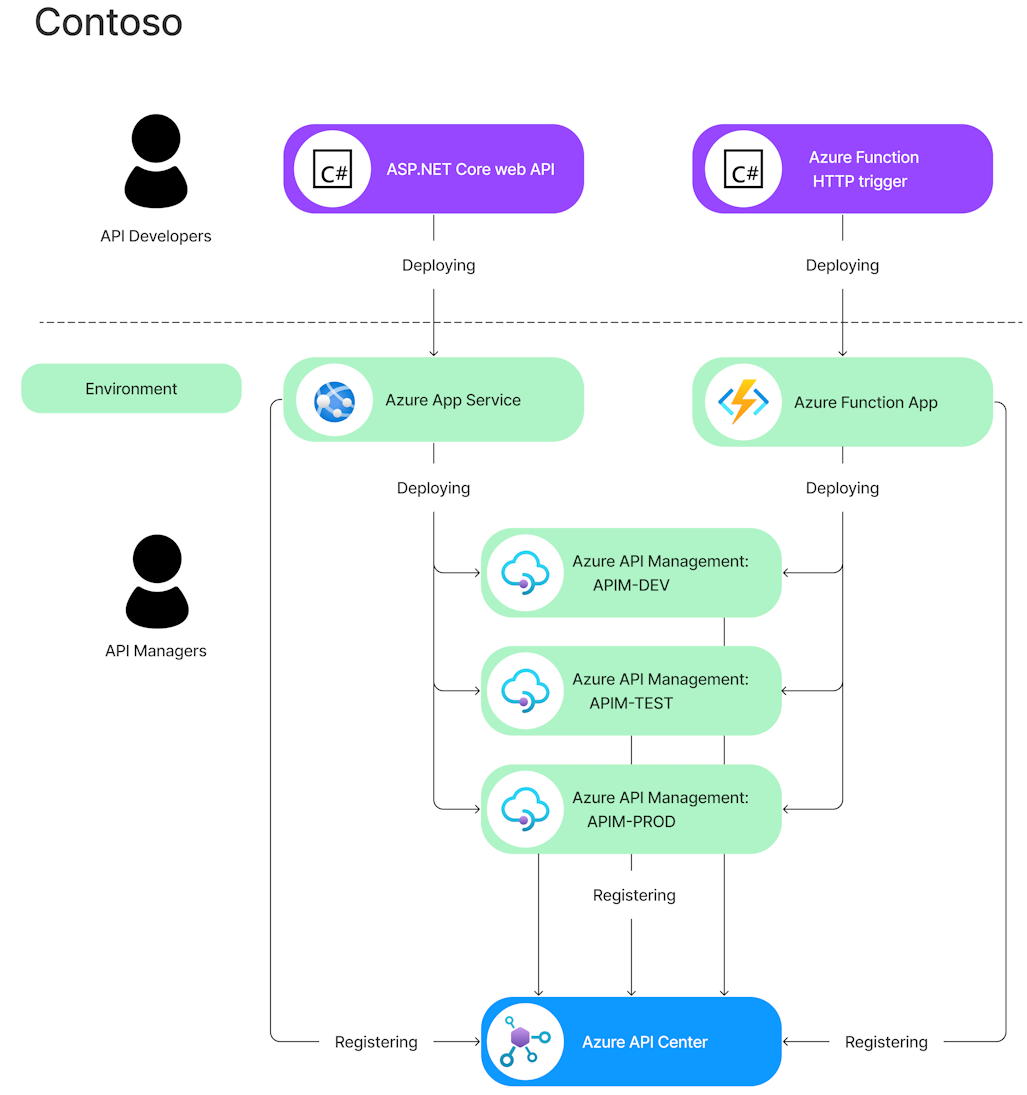
Contoso's API ecosystem includes the following features:
API development: Contoso's developers regularly build ASP.NET web APIs. They also create Azure Functions with HTTP triggers.
API deployment environments: Contoso deploys a portion of their APIs to Azure App Service. They deploy another subset of their APIs to an Azure Function app.
Azure API Management: Contoso uses the Azure API Management service to manage, publish, and secure their APIs. They use separate instances for development, test, and production, each with a distinct name.
Azure API Center: Contoso adopts Azure API Center as their centralized hub for API discovery, governance, and consumption. Azure API Center serves as a structured and organized API hub that provides comprehensive information about all organizational APIs, maintaining related information including versions and associated deployments.