InlineUIContainer.Child Eigenschaft
Definition
Wichtig
Einige Informationen beziehen sich auf Vorabversionen, die vor dem Release ggf. grundlegend überarbeitet werden. Microsoft übernimmt hinsichtlich der hier bereitgestellten Informationen keine Gewährleistungen, seien sie ausdrücklich oder konkludent.
Dient zum Abrufen oder Festlegen des UIElement gehosteten von der InlineUIContainer.
public:
 property System::Windows::UIElement ^ Child { System::Windows::UIElement ^ get(); void set(System::Windows::UIElement ^ value); };
public System.Windows.UIElement Child { get; set; }member this.Child : System.Windows.UIElement with get, setPublic Property Child As UIElementEigenschaftswert
Die UIElement von der InlineUIContainer.
Beispiele
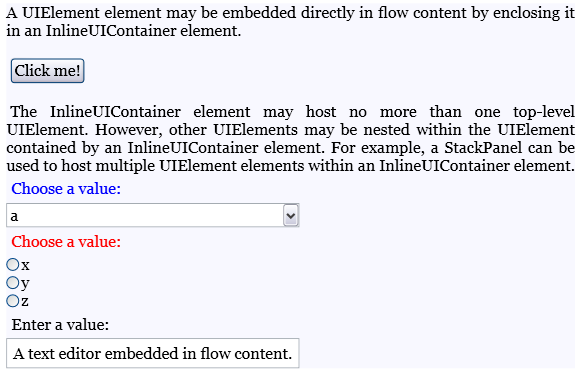
Das folgende Beispiel zeigt, wie Sie die InlineUIContainer Elemente zum Hosten UIElement von Elementen innerhalb von Flussinhalten verwenden.
<FlowDocument ColumnWidth="400">
  <Paragraph Background="GhostWhite">
    <Run>
      A UIElement element may be embedded directly in flow content
      by enclosing it in an InlineUIContainer element.
    </Run>
    <LineBreak/>
    <LineBreak/>
    <InlineUIContainer>
      <Button>Click me!</Button>
    </InlineUIContainer>
    <LineBreak/>
    <LineBreak/>
    <Run>
      The InlineUIContainer element may host no more than one top-level
      UIElement.  However, other UIElements may be nested within the
      UIElement contained by an InlineUIContainer element.  For example,
      a StackPanel can be used to host multiple UIElement elements within
      an InlineUIContainer element.
    </Run>
    <InlineUIContainer>
      <StackPanel>
        <Label Foreground="Blue">Choose a value:</Label>
        <ComboBox>
          <ComboBoxItem IsSelected="True">a</ComboBoxItem>
          <ComboBoxItem>b</ComboBoxItem>
          <ComboBoxItem>c</ComboBoxItem>
        </ComboBox>
        <Label Foreground ="Red">Choose a value:</Label>
        <StackPanel>
          <RadioButton>x</RadioButton>
          <RadioButton>y</RadioButton>
          <RadioButton>z</RadioButton>
        </StackPanel>
        <Label>Enter a value:</Label>
        <TextBox>
          A text editor embedded in flow content.
        </TextBox>
      </StackPanel>
    </InlineUIContainer>
  </Paragraph>
</FlowDocument>
Die folgende Abbildung zeigt, wie dieses Beispiel gerendert wird.
Das folgende Beispiel zeigt, wie die Child Eigenschaft programmgesteuert verwendet wird.
Paragraph parx = new Paragraph();
Run run1 = new Run(" Text to precede the button... ");
Run run2 = new Run(" Text to follow the button... ");

// Create a new button to be hosted in the paragraph.
Button buttonx = new Button();
buttonx.Content = "Click me!";

// Create a new InlineUIContainer, and assign the button
// as the UI container's child.
InlineUIContainer uiCont = new InlineUIContainer();
uiCont.Child = buttonx;

// Add the text runs and UI container to the paragraph, in order.
parx.Inlines.Add(run1);
parx.Inlines.Add(uiCont);
parx.Inlines.Add(run2);
Dim parx As New Paragraph()
Dim run1 As New Run(" Text to precede the button... ")
Dim run2 As New Run(" Text to follow the button... ")

' Create a new button to be hosted in the paragraph.
Dim buttonx As New Button()
buttonx.Content = "Click me!"

' Create a new InlineUIContainer, and assign the button
' as the UI container's child.
Dim uiCont As New InlineUIContainer()
uiCont.Child = buttonx

' Add the text runs and UI container to the paragraph, in order.
parx.Inlines.Add(run1)
parx.Inlines.Add(uiCont)
parx.Inlines.Add(run2)
Hinweise
Ein InlineUIContainer Kann nicht mehr als ein UIElement Kind direkt hosten. Das untergeordnete Element, das von einem InlineUIContainer hosten wird, kann jedoch untergeordnete Elemente selbst hosten.
In XAML entspricht der Umbruch eines UIElement Ins InlineUIContainer dem Festlegen des UIElement Werts der Child Eigenschaft.
