Note
Access to this page requires authorization. You can try signing in or changing directories.
Access to this page requires authorization. You can try changing directories.
This article describes how to configure backup for Azure Database for PostgreSQL - Flexible Server using Azure portal.
Prerequisites
Before you configure backup for Azure Database for PostgreSQL - Flexible Server, ensure the following prerequisites are met:
- Review the supported scenarios and known limitations of Azure Database for PostgreSQL Flexible server backup.
- Identify or create a Backup vault in the same region where you want to back up the Azure Database for PostgreSQL Server instance.
- Check that Azure Database for PostgreSQL Server is named in accordance with naming guidelines for Azure Backup. Learn about the naming conventions.
- Allow access permissions for PostgreSQL - Flexible Server. Learn about the access permissions.
- Create a back up policy.
Configure backup
To configure backup for Azure Database for PostgreSQL – flexible server using Azure Backup, you can use one of the following methods:
- Azure Database for PostgreSQL – flexible server: Database manage pane
- Backup vault
- Resiliency
To configure backup on the Azure Database for PostgreSQL - Flexible Server via Resiliency, follow these steps:
Go to Resiliency, and then select Overview > + Configure protection.
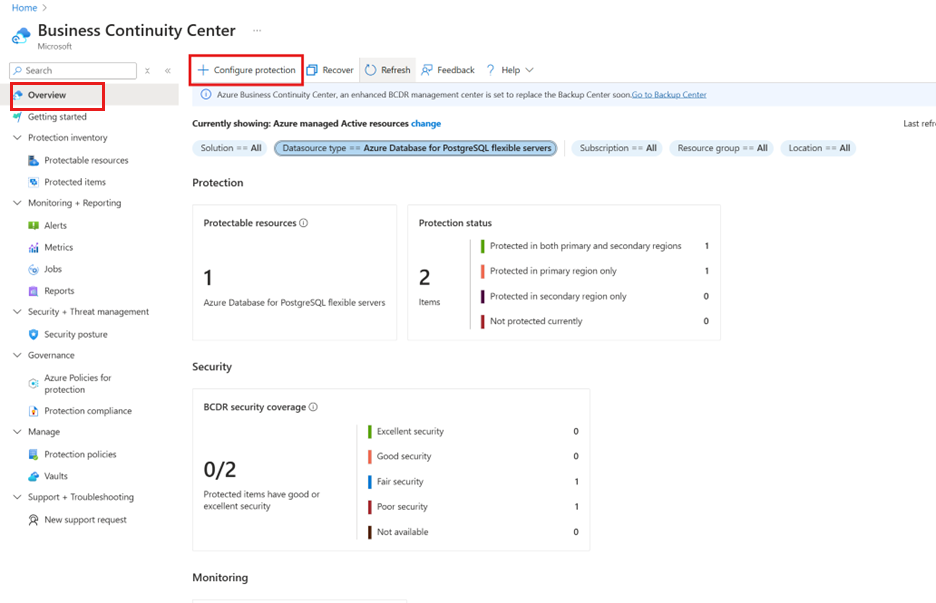
Alternatively, for configuring backup from the Backup vault pane, go to the Backup vault > Overview, and then select + Backup.
To configure backup from the Database manage pane, go to the PostgreSQL - flexible server pane, and then select Settings > LTR (Vaulted Backups).
On the Configure protection pane, select Resource managed by as Azure, Datasource type as Azure PostgreSQL flexible server/elastic cluster, and Solution as Azure Backup, and then select Continue.
On the Configure Backup pane, on the Basics tab, check if Datasource type appears as Azure PostgreSQL flexible server/elastic cluster, select Select vault under Vault and choose an existing Backup vault from the dropdown list, and then select Next.
If you don't have a Backup vault, create a new one.
On the Backup policy tab, select a Backup policy that defines the backup schedule and the retention duration, and then select Next.
If you don't have a Backup policy, create one on the go.
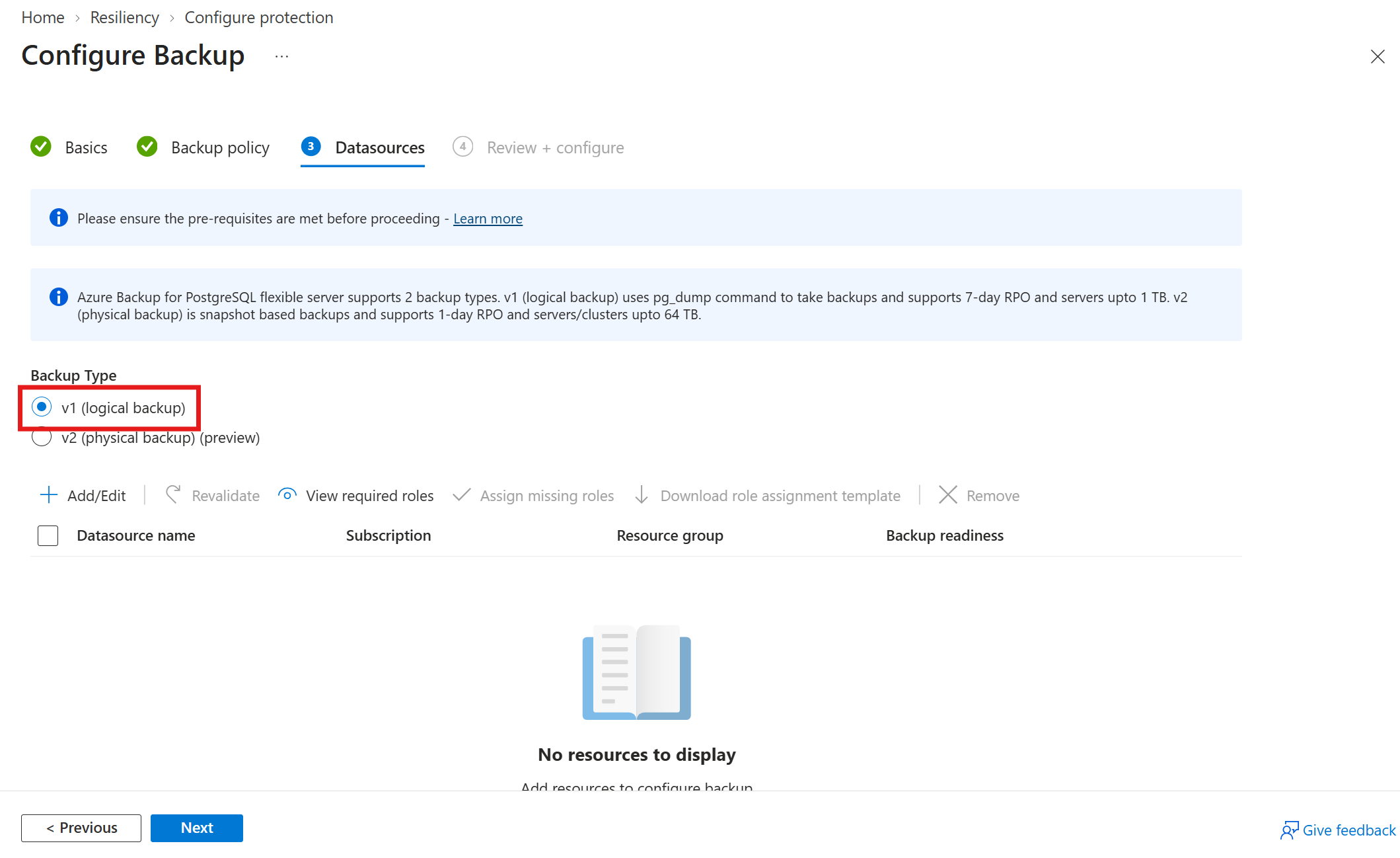
On the Datasources tab, select the backup type v1 (logical backups).
Note
The backup type determines which stack protects the datasource. v1 (logical backups) uses the
pg_dumpbased solution described in this article. A datasource can be protected by only one stack at a time, because multiple protection isn't supported.On the Select resources to backup pane, select the flexible server to protect, and then select Select.
Note
- Flexible servers larger than 1 TB aren't supported.
- Flexible servers on Premium SSD v2 storage aren't supported.
- Elastic clusters aren't supported.
Tip
Azure Backup for PostgreSQL flexible server and elastic cluster (v2) takes physical backups from managed disk snapshots instead of logical (
pg_dumpbased) backups, and addresses the limitations of the generally available v1 solution.- It protects both PostgreSQL flexible servers and elastic clusters.
- It supports flexible servers and elastic clusters up to 32 TB on Premium SSD v1 and up to 64 TB on Premium SSD v2, instead of the 1-TB limit.
Once you're on the Datasources tab, the Azure Backup service validates if it has all the necessary access permissions to connect to the server. If one or more access permissions are missing, one of the following error messages appears – User cannot assign roles or Role assignment not done.
User cannot assign roles: This message appears when you (the backup admin) don’t have the write access on the PostgreSQL - flexible Server as listed under View details. To assign the necessary permissions on the required resources, select Download role assignment template to fetch the ARM template, and run the template as a PostgreSQL database administrator. Once the template is run successfully, select Revalidate.
Role assignment not done: This message appears when you (the backup admin) have the write access on the PostgreSQL – flexible Server to assign missing permissions as listed under View details. To grant permissions on the PostgreSQL - flexible Server inline, select Assign missing roles.
Once the process starts, the missing access permissions on the PostgreSQL – flexible servers are granted to the backup vault. You can define the scope at which the access permissions must be granted. When the action is complete, revalidation starts.
Once the role assignment validation shows Success, select Next to proceed to last step of submitting the operation.
On the Review + configure tab, select Configure backup.
Create a backup policy
You can create a backup policy on the go during the backup configuration flow.
To create a backup policy, follow these steps:
On the Configure Backup pane, select the Backup policy tab.
On the Backup policy tab, select Create new under Backup policy.
On the Create Backup Policy pane, on the Basics tab, enter a name for the new policy in Policy name.
On the Schedule + retention tab, under Backup schedule, define the backup frequency as Weekly.
Note
The generally available v1 (
pg_dumpbased) solution supports only weekly frequencies. If you choose daily frequency, only the first backup operation of the week runs, and the subsequent backup jobs in the same week fail.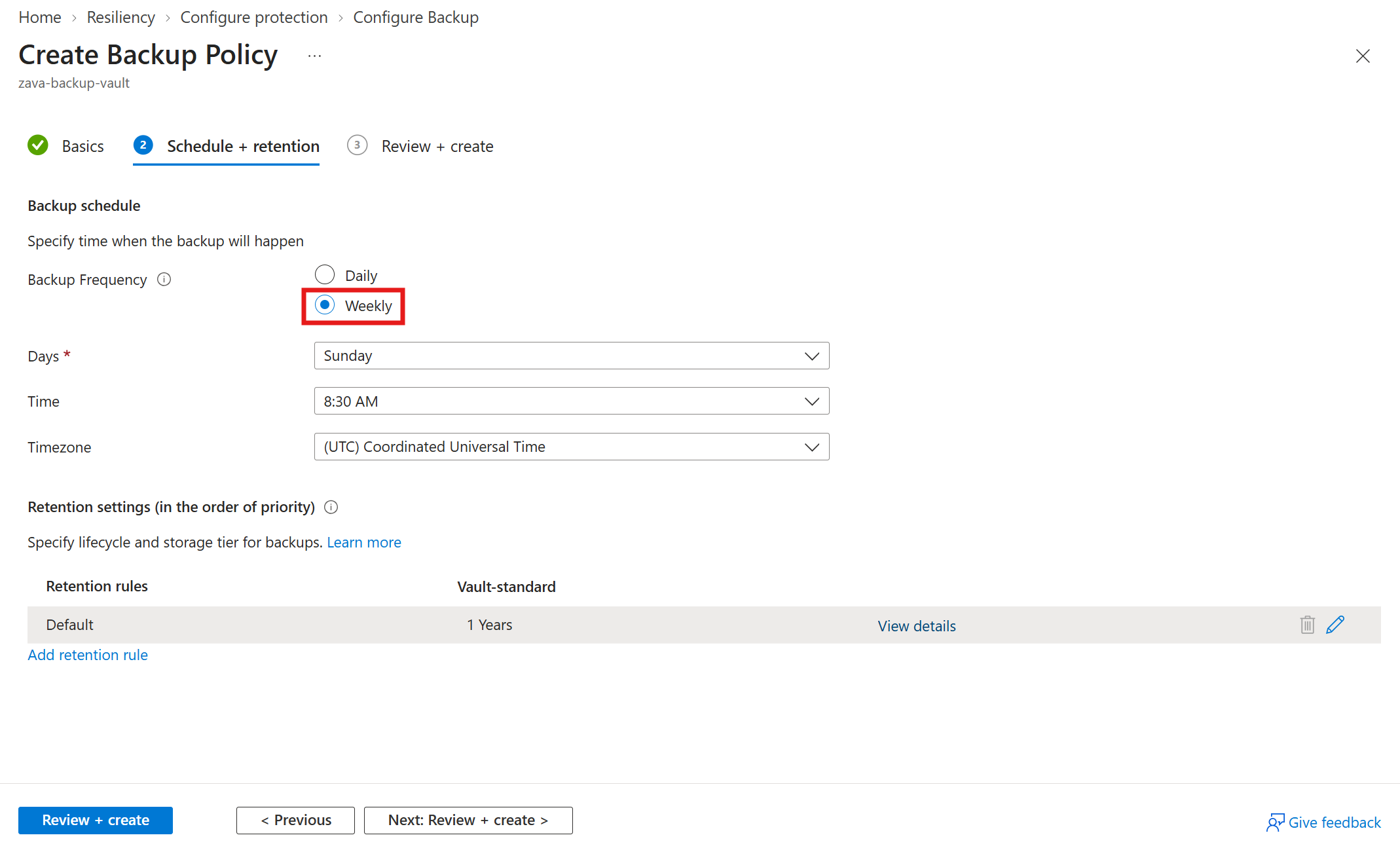
Tip
For daily backup schedules with a recovery point objective of one day, instead of one backup per week, try Azure Backup for PostgreSQL flexible server and elastic cluster (v2) which is in preview. The v2 solution takes physical backups from managed disk snapshots instead of logical (
pg_dumpbased) backups.Under Retention settings, select Add retention rule.
On the Add retention pane, define the retention period, and then select Add.
When you return to the Create Backup Policy pane, select Review + create.
Note
The retention rules are evaluated in a predetermined order of priority. The priority is the highest for the yearly rule, followed by the monthly rule, and then the weekly rule. Default retention settings apply when no other rules qualify. For example, the same recovery point might be the first successful backup taken every week as well as the first successful backup taken every month. However, because the monthly rule has higher priority than the weekly rule, the retention corresponding to the first successful backup taken every month applies.
When the backup configuration is complete, you can run an on-demand backup and track the progress of the backup operation.
Next steps
Restore Azure Database for PostgreSQL - Flexible Server using Azure portal.