Note
Access to this page requires authorization. You can try signing in or changing directories.
Access to this page requires authorization. You can try changing directories.
Get started with GitHub Copilot for Azure to streamline your development workflow and enhance your productivity on the Azure platform. This guide walks you through prerequisites, installation, and writing your first prompt in Visual Studio Code, Visual Studio 2022, or Visual Studio 2026. After setup, you can use Agent mode to query Azure resources, generate infrastructure code, and troubleshoot applications directly from your IDE.
Prerequisites
To complete the steps in this article, make sure that you have:
An Azure account and access to an Azure subscription. For details on how to set them up, see the pricing page for Azure accounts.
A GitHub account and a GitHub Copilot subscription. For details on how to set them up, see Creating an account on GitHub and Quickstart for GitHub Copilot, respectively.
Visual Studio Code. For details on how to download and install it, see Setting up Visual Studio Code.
The GitHub Copilot extension and the GitHub Copilot Chat extension. For instructions on how to install these extensions, see Set up GitHub Copilot in VS Code and Getting started with GitHub Copilot Chat in VS Code, respectively.
Important
GitHub Copilot is a separate subscription managed by GitHub. For questions regarding GitHub Copilot subscriptions and Support, see Getting started with a GitHub Copilot plan.
By default, Copilot in Azure is available to all users in a tenant. However, Global Administrators can manage access to Copilot in Azure for their organization. Access can also be optionally granted to specific Microsoft Entra users or groups. For more information, see Manage access to Microsoft Copilot in Azure.
Install GitHub Copilot for Azure
- In Visual Studio Code, select the Extensions icon.
- In the Extensions Marketplace, search for GitHub Copilot for Azure. When the GitHub Copilot for Azure extension appears, select Install.
Sign in to Azure and choose your subscription
If you work with multiple tenants and subscriptions, make sure you're signed in to the correct one:
How do I log into my Azure tenant and choose an Azure subscription I want to work with?
GitHub Copilot responds with steps similar to:
- Open a terminal.
- Sign in to Azure:
az login - List available subscriptions:
az account list --output table - Set the subscription:
az account set --subscription "SUBSCRIPTION_NAME_OR_ID"
Follow these instructions. If you're ever unsure about which tenant and subscription you're working with, you can ask:
Which tenant and subscription am I working with?
When agent mode asks to execute a terminal command, select Continue or Always allow to let it proceed.
Write your first prompt
Ensure that the extension is installed, that you're properly authenticated, and that the extension is working correctly.
If the Chat window isn't already open, make sure it's open by either selecting the Toggle Chat button in the menu bar, or select the dropdown list next to the Toggle Chat button and select Open Chat (Ctrl+Alt+I).

In the chat pane's mode selector, select Agent.
In the chat text area at the bottom of the chat pane, enter the following prompt:
Do I have any Azure resources currently running?The answer to your question depends on what's currently running in Azure in your subscription.
Next, use the following prompt:
What are your tools?The completion response displays a list of GitHub Copilot for Azure specific tools available to GitHub Copilot. The response provides a good overview of the kinds of functionality now available to you:
I'll ask the Azure development helper to recommend custom modes relevant to listing and explaining the GitHub Copilot for Azure tools in VS Code; expected outcome: a short set of recommended modes or tips to tailor the tools explanation.

Progress update: I queried the Azure development helper to get recommended custom modes for this topic. Next, I'll list and briefly explain the tools I have available (grouped and with example prompts and common uses) so you can copy/paste or use them directly in VS Code.

Tools I can use (concise overview)

1. Search & navigation

   - Capabilities: semantic code/documentation search, file search with globs, text search (grep), list directory contents, read file contents, find usages/references.
   - Example prompts:
      - "Find all usages of MyService in this workspace."
      - "Search for connectionString in **/*.config files."
   - When to use: locating code, docs, or examples quickly inside your repo.

2. Code editing & analysis
   - Capabilities: insert edits into files, create or modify files, suggest refactors, report code errors, find test files.
   - Example prompts:
      - "Add a function to validate input in src/utils.js."
      - "Refactor this function to use async/await and update its tests."
   - When to use: implementing features, fixing bugs, generating or updating code.

3. Terminal & Git operations

   - Capabilities: run shell commands, read terminal output, show git diffs and changed files.
   - Example prompts:
      - "Run npm test and show me failing tests."
      - "Stage and commit the changes with message 'fix: update README'."
   - When to use: run builds/tests, inspect outputs, perform git workflows (if enabled).

4. Project creation & workspace setup

   - Capabilities: create new workspaces, scaffold projects (templates), install VS Code extensions, create notebooks.
   - Example prompts:
      - "Generate a Node.js express app scaffold in a new folder."
      - "Add recommended extensions for Python development."
   - When to use: bootstrapping projects or adding project-level config.

5. Web & API tools

   - Capabilities: fetch web pages, retrieve API docs (for example VS Code API references), gather remote content for research.
   - Example prompts:
      - "Fetch the Azure CLI docs for az storage account list."
      - "Get the VS Code extension API docs for commands."
   - When to use: look up official docs or examples during work.

6. Azure-specific tools

   - Capabilities: Azure development best practices guidance, Microsoft Learn documentation lookup, query Azure Resource Graph (when authenticated), manage Azure auth context (change tenant, sign out), generate Azure CLI / Bicep / ARM snippets, Bicep schemas, and guidance for deploying models and services.
   - Example prompts:
      - "What are Azure best practices for deploying this function app?"
      - "What Azure account am I signed in with?"
      - "Generate a Bicep template for an App Service and a Storage Account."
   - When to use: any task that touches Azure resources, deployment, or configuration.

7. Documentation & learning

   - Capabilities: search and extract Microsoft Learn articles, provide code samples from official docs, show relevant how-to steps.
   - Example prompts:
      - "Show official docs for configuring Key Vault access policies."
      - "Give me a short tutorial on using Azure App Configuration."
   - When to use: learn or reference official Microsoft guidance.

How I present results

- Short answers or step-by-step instructions.
- Full edits (I can create or modify files if you allow the extension to act).
- Commands and code snippets you can paste into your terminal.
- Checks (like running tests or linters) when terminal access is allowed.

Example: Quick copy-paste prompts you can use in the VS Code chat

- "What are your tools?" - lists the tools (this reply).
- "Find all TODO comments in this repo and open a summary."
- "Generate an az CLI command to list storage accounts sorted by region."
- "Which Azure tenant and subscription am I working with?" - checks the current Azure authentication context.

Notes and privacy/permissions

- Some capabilities (like querying your Azure resources or running commands) require you to be signed in and to enable those tools in the extension (you can enable/disable specific tools in the chat pane tool list).
- I won't perform actions that need elevated permissions without verifying your explicit consent.

If you'd like, I can:

- Expand any tool section with more example prompts and exact commands.
- Show a short step-by-step for enabling/disabling tools in the chat pane.
- Generate a one-page cheatsheet you can paste into an internal docs file. Which would you like next?
The contents of the reply might vary and can change over time as new capabilities and tools are added.
To test out prompts about Azure-specific tooling, try the following prompt:
What is the az command to list all my storage accounts ordered by location?The completion to that prompt might generate:
I'll show the exact az CLI commands (sorted ascending/descending) plus a few useful output variants and a quick note about prerequisites.

Commands

- Sorted by location (ascending), full JSON:

   az storage account list --query "sort_by(@, &location)" -o json

- Sorted by location, show only name and location in a readable table:

   az storage account list --query "sort_by(@, &location)[].[name,location]" -o table

- Sorted by location (descending):

   az storage account list --query "reverse(sort_by(@, &location))" -o json

- Sorted by location and include resource group and SKU in table:

   az storage account list --query "sort_by(@, &location)[].[name,resourceGroup,sku.name,location]" -o table

Notes

- Run az login first and ensure the correct subscription is selected (e.g., az account set -s "<subscription-id-or-name>").
- You need permission to list storage accounts in the chosen subscription.
- The query uses JMESPath (sort_by/reverse) to order results client-side.

Would you like a version that groups counts by region or that queries across all subscriptions?
Enable and disable tools in agent mode
You might want to disable or re-enable certain tools available by GitHub Copilot for Azure.
Select the tool icon in the chat pane.

Use the checkbox next to the list of tools to enable / disable tools (or groups of tools).

Set your default tenant
If you have multiple Microsoft Entra ID tenants, you can set a default tenant in the extension settings:
In Visual Studio Code, on the Activity Bar, select Extensions. Then scroll down to GitHub Copilot for Azure.

Select the gear icon in the corner of the extension's entry, and then select Settings from the pop-up menu.

On the Settings tab, set the Azure Resource Graph tenant to your Microsoft Entra tenant ID. You can find your Microsoft Entra tenant ID in the Azure portal.

View the GitHub Copilot for Azure instructions file
The instructions file (also referred to as "Azure Copilot Guidelines") contains high-level guidance for GitHub Copilot that is added to the context window when sending prompts to GitHub Copilot for Azure tools and Azure MCP Server tools. The guidance in this file is intended to be global in nature, meaning, it's intended for all interactions across GitHub Copilot for Azure across all projects. This file is located in a hidden folder location and isn't intended to be modified. You shouldn't modify this file because it could degrade or disable GitHub Copilot for Azure, and your changes might be overwritten with new updates to GitHub Copilot for Azure.
Viewing the "Azure Copilot Guidelines" can provide an insight into how the GitHub Copilot for Azure tools and the Azure MCP Server tools are introduced to GitHub Copilot helping you develop a deeper understanding of how it all works.
Important
You shouldn't modify this file.
Select
ctrl+shift+pto open the command palette.Type
Chat: Configure Instructionsand select the entry.
In the next step, select
AzureCopilotGuidelines.
A new tab opens containing the instructions file.

Important
You shouldn't modify this file.
Prerequisites
To complete the steps in this article, make sure that you have:
A GitHub account and a GitHub Copilot subscription. For details on how to set them up, see Creating an account on GitHub and Quickstart for GitHub Copilot, respectively.
Visual Studio 2022 version 17.14.30 or later (any edition). For details on how to download and install it, see Install Visual Studio.
Important
GitHub Copilot is a separate subscription managed by GitHub. For questions regarding GitHub Copilot subscriptions and Support, see Getting started with a GitHub Copilot plan.
By default, Copilot in Azure is available to all users in a tenant. However, Global Administrators can manage access to Copilot in Azure for their organization. Access can also be optionally granted to specific Microsoft Entra users or groups. For more information, see Manage access to Microsoft Copilot in Azure.
Install GitHub Copilot for Azure
Azure MCP is built in to Visual Studio 2022. No separate GitHub Copilot for Azure extension is required; the Azure MCP tools are included with the Azure development workload.
If you already installed Visual Studio 2022 and want to add GitHub Copilot for Azure after initial install, open Visual Studio Installer and select the Modify button, which displays the available workloads.
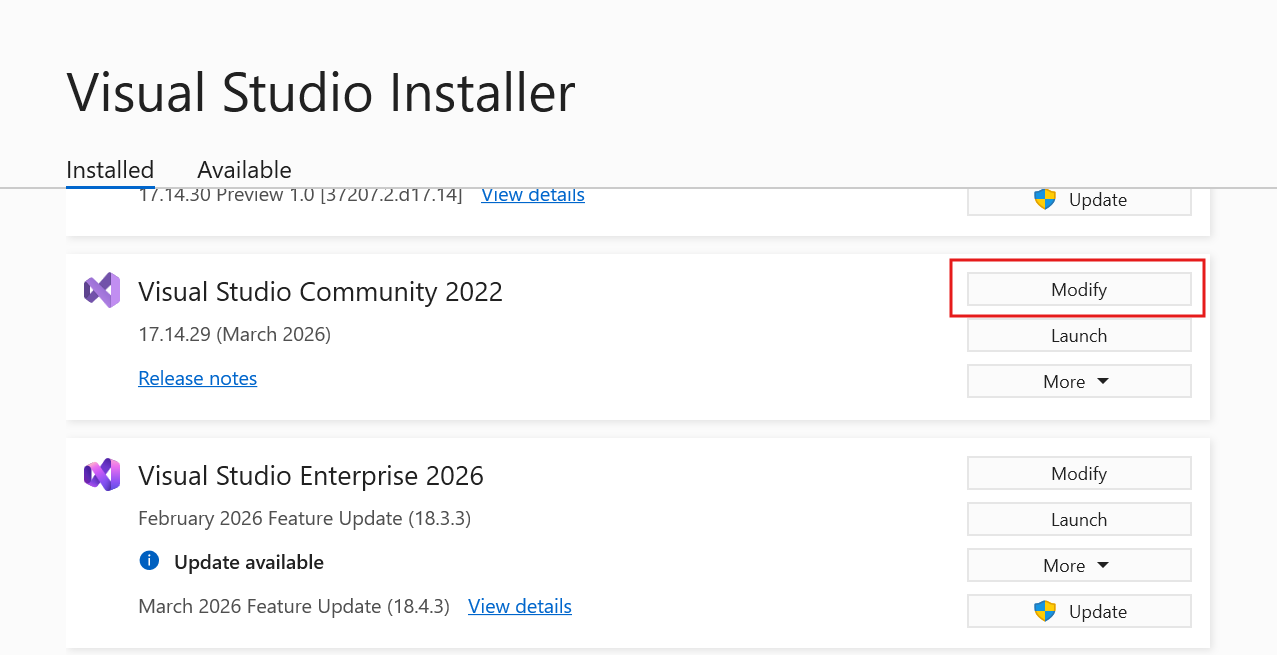
If you're installing Visual Studio 2022 for the first time, the Visual Studio Installer automatically displays the available workloads.
On the Workloads tab, make sure the Azure development workload is selected.
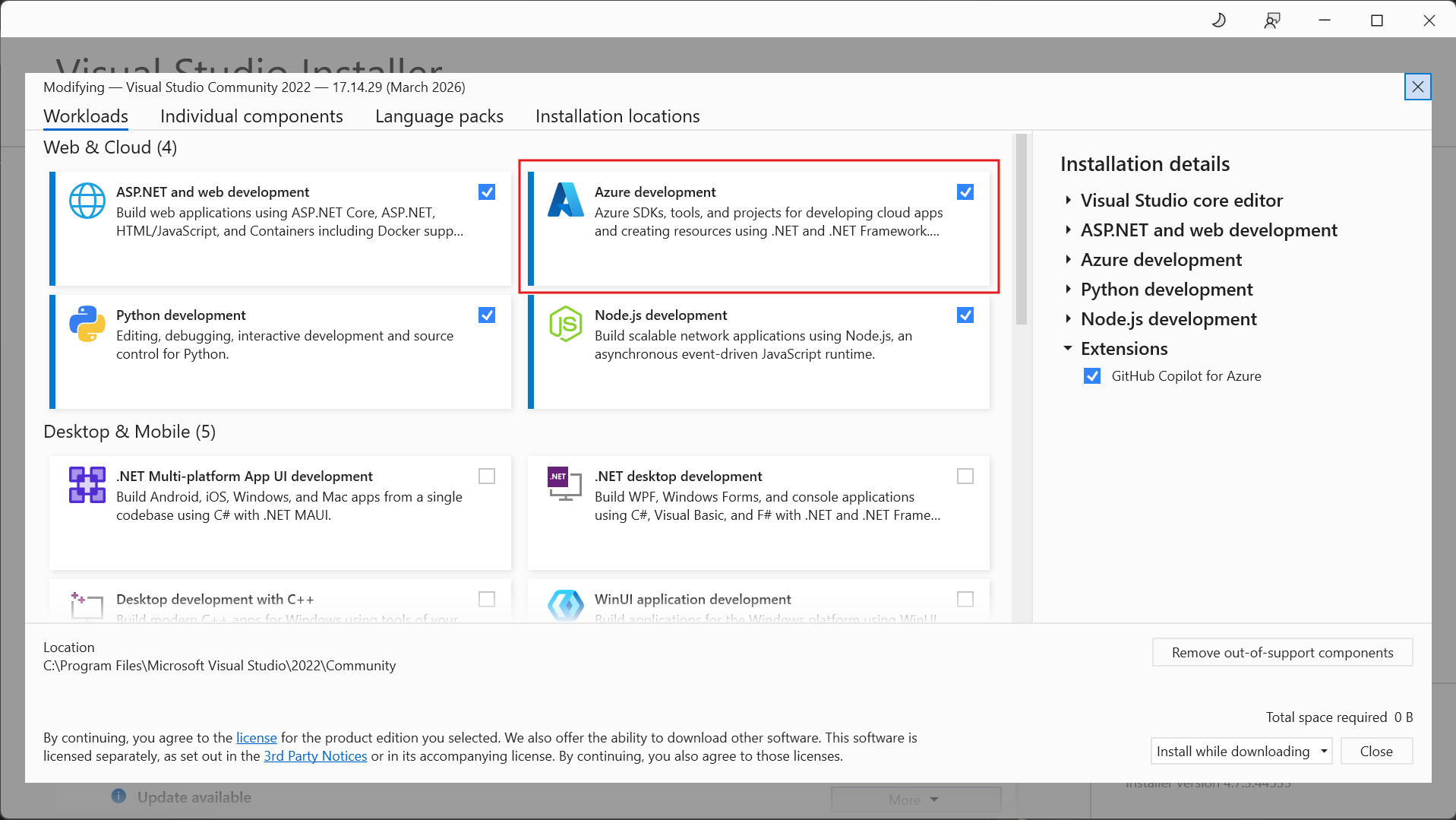
Select the Install button to complete the installation.
Note
Azure MCP tools are serviced with regular Visual Studio updates. To get updates, use the Visual Studio Installer (Modify or Update) and ensure you're on the latest Visual Studio 2022 version.
Launch Visual Studio 2022 and create or load a project.
Open GitHub Copilot Chat.
If prompted, sign in to your GitHub account.
If prompted, sign in to your Azure account.
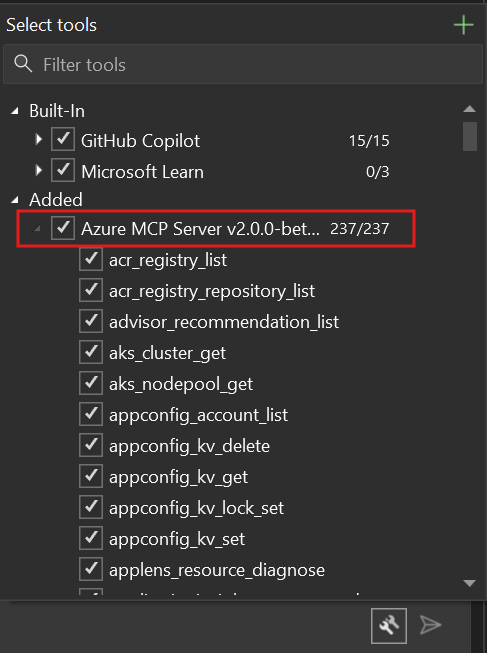
In the chat area, select the Select tools button (two wrenches icon) to display a list of available tools. Enable all Azure tools by checking the top nodes for Azure MCP Server v.x.x.x.
Note
The Azure MCP tools are disabled by default in Visual Studio 2022 and need to be manually enabled before use. Once enabled from the Select tools dialog, your Azure MCP tool selections persist across sessions. Visual Studio 2026-specific tools aren't available in Visual Studio 2022.
Write your first prompt
If the Chat window isn't already open, make sure it's open by selecting the View > GitHub Copilot Chat menu option. You should see chat window docked to the right side by default.

In the chat text area at the bottom of the chat pane, enter the following prompt:
Do I have any resources currently running?
By default, GitHub Copilot uses ask mode. Ask mode provides answers to your prompts in the chat pane. Agent mode enables GitHub Copilot to take action in your workspace.
The answer to your question depends on what's currently running in Azure in your subscription.
Agent mode
In Agent mode, GitHub Copilot can perform tasks across your entire Visual Studio workspace, making edits, executing terminal commands, and so on.
GitHub Copilot for Azure provides "tools" to GitHub Copilot to enhance the agentic experience through deep integration with Azure.
To switch, between ask and agent mode, select the down chevron next to the Ask option in the chat area and select the desired mode.

Enable and disable tools in agent mode
You might want to disable or re-enable certain tools available by GitHub Copilot for Azure.
Select the "Select tools" icon in the chat pane.

Use the checkbox next to the list of tools to enable / disable tools (or groups of tools).
Prerequisites
To complete the steps in this article, make sure that you have:
An Azure account and access to an Azure subscription. For details on how to set them up, see the pricing page for Azure accounts.
A GitHub account and a GitHub Copilot subscription. For details on how to set them up, see Creating an account on GitHub and Quickstart for GitHub Copilot, respectively.
Visual Studio 2026 (Any edition). For details on how to download and install it, see Install Visual Studio.
Important
GitHub Copilot is a separate subscription managed by GitHub. For questions regarding GitHub Copilot subscriptions and Support, see Getting started with a GitHub Copilot plan.
By default, Copilot in Azure is available to all users in a tenant. However, Global Administrators can manage access to Copilot in Azure for their organization. Access can also be optionally granted to specific Microsoft Entra users or groups. For more information, see Manage access to Microsoft Copilot in Azure.
Install GitHub Copilot for Azure
If you already installed Visual Studio 2026 and want to add GitHub Copilot for Azure after initial install, open Visual Studio Installer and select the Modify button, which displays the available workloads.

If you're installing Visual Studio 2026 for the first time, the Visual Studio Installer automatically displays the available workloads.
On the Workloads tab, make sure "Azure AI development" is selected.

Select the Install button to complete the installation.
Launch Visual Studio 2026 and create or load a project.
Open GitHub Copilot Chat.
If prompted, sign in to your GitHub account.
If prompted, sign in to your Azure account.
In the chat area, select the Select tools button (two wrenches icon) to display a list of available tools. If you installed the Azure and AI development workload, built-in Azure skills and tools also appear in this picker. Enable all Azure tools by checking the top nodes for Azure.

Also select the top node for Azure MCP Server.

Note
Azure MCP tools and Azure skills are off by default in Visual Studio 2026. You need to manually enable them before first use. Once you enable them from the Select tools dialog, your selections persist across sessions.
Write your first prompt
If the Chat window isn't already open, make sure it's open by selecting the View > GitHub Copilot Chat menu option. You should see chat window docked to the right side by default.

In the chat text area at the bottom of the chat pane, enter the following prompt:
Do I have any resources currently running?
By default, GitHub Copilot uses ask mode. Ask mode provides answers to your prompts in the chat pane. Agent mode enables GitHub Copilot to take action in your workspace.
The answer to your question depends on what's currently running in Azure in your subscription.
Agent mode
In Agent mode, GitHub Copilot can perform tasks across your entire Visual Studio workspace, making edits, executing terminal commands, and so on.
GitHub Copilot for Azure provides "tools" to GitHub Copilot to enhance the agentic experience through deep integration with Azure.
To switch, between ask and agent mode, select the down chevron next to the Ask option in the chat area and select the desired mode.

Enable and disable tools in agent mode
You might want to disable or re-enable certain tools available by GitHub Copilot for Azure.
Select the "Select tools" icon in the chat pane.

Use the checkbox next to the list of tools to enable / disable tools (or groups of tools).
Related content
- What is GitHub Copilot for Azure?
- Example prompts for learning about Azure and your application with GitHub Copilot for Azure
- Example prompts for designing and developing your application with GitHub Copilot for Azure
- Example prompts for deploying your application with GitHub Copilot for Azure
- Troubleshoot Azure applications with GitHub Copilot for Azure
- Quickstart: Deploy your application to Azure with agent mode in GitHub Copilot for Azure
- Generate Bicep files using GitHub Copilot for Azure
- Quickstart: Create and deploy an app using Azure Cache for Redis by using GitHub Copilot for Azure and Azure MCP Server