Note
Access to this page requires authorization. You can try signing in or changing directories.
Access to this page requires authorization. You can try changing directories.
Mirroring views replicate logical views from your source system instead of full physical tables. You can bring source filters, joins, and transformations into OneLake without building separate engineering pipelines.
- Replicates view logic from the source system without requiring you to rebuild queries in Fabric.
- Eliminates the need to build separate Spark or SQL pipelines to reshape source data.
- Helps downstream users query shaped, filtered, or joined data directly in OneLake.
Note
Currently, views are supported only in preview for mirroring for Snowflake.
Prerequisites
- A Microsoft Fabric capacity (F2 or higher) or Fabric trial.
- A Snowflake data source configured for mirroring.
Enable mirroring views
You can enable views in two ways:
- During the creation experience for a new mirrored database.
- For an existing mirrored database, through the configuration dashboard on the mirroring monitoring page.
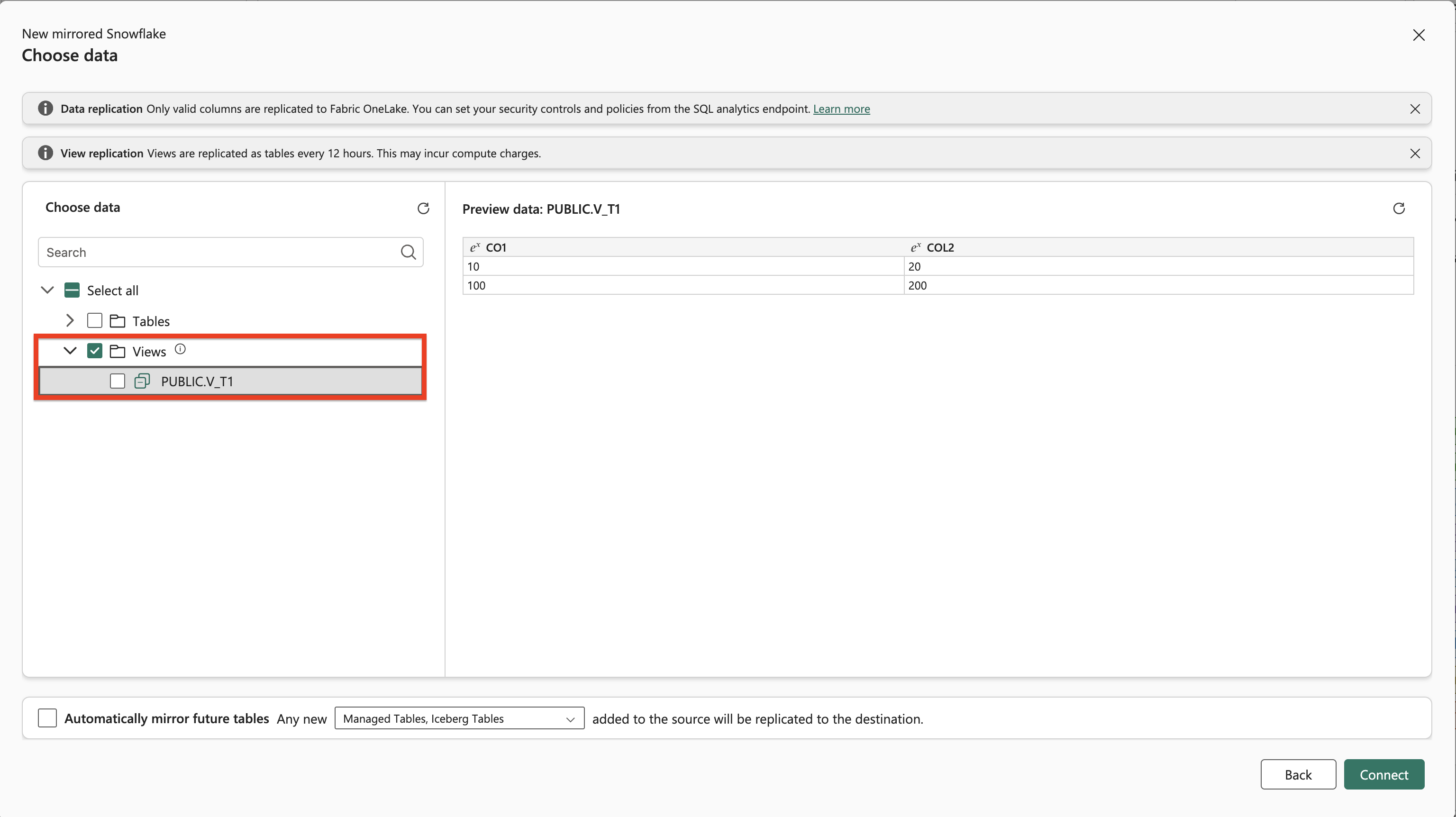
After you connect to your Snowflake database, Views appears on the table selection screen. (This example enables views for a Snowflake source.)
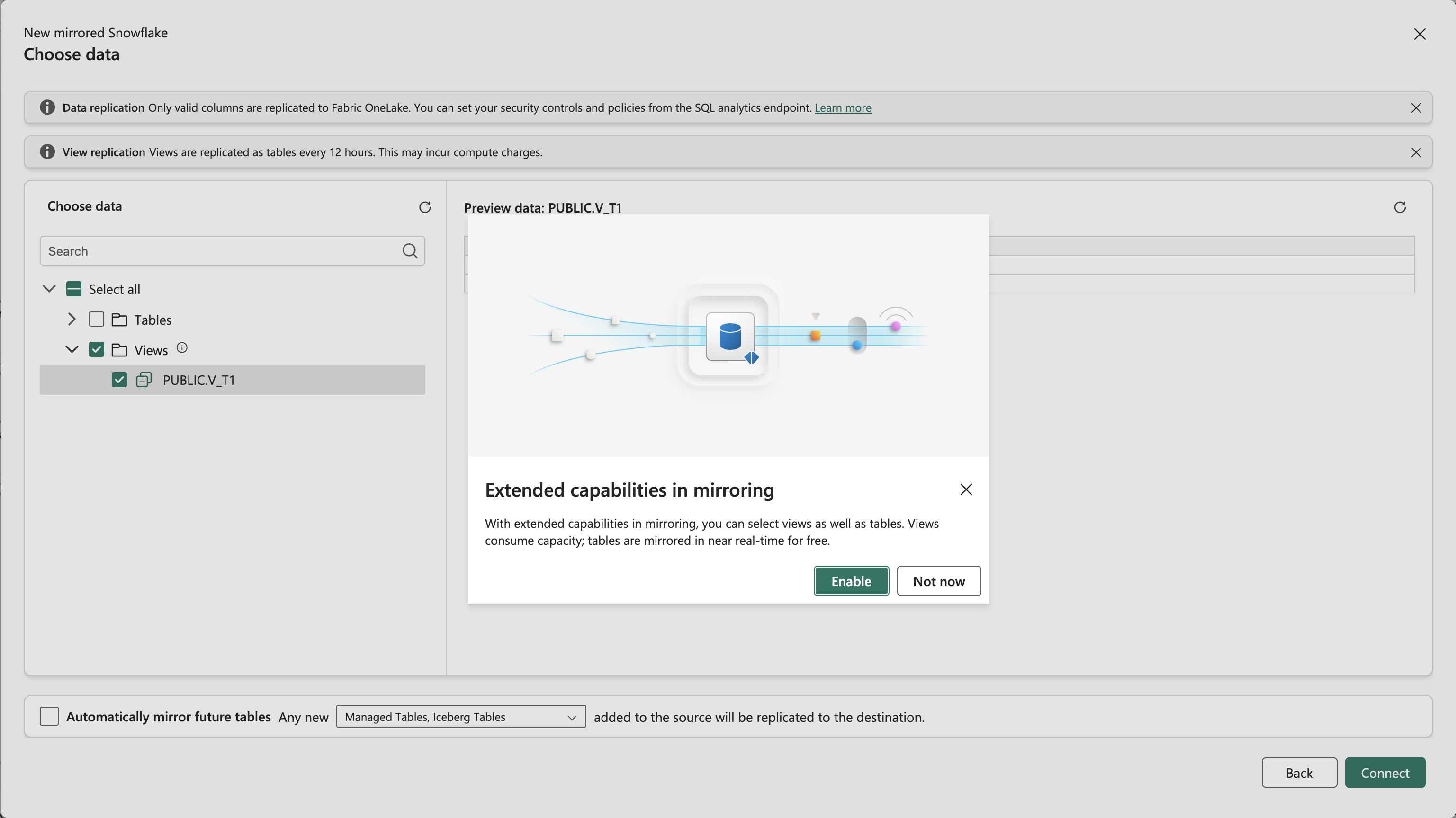
After you select the views that you want to replicate, a dialog box prompts you to acknowledge that enabling extended capabilities incurs billing charges before you proceed.
How mirroring views work
When you enable views for a mirrored database, Fabric materializes the view results into OneLake as Delta tables on a scheduled cadence. The replication process works as follows:
- Fabric reads the view definition from the source system (Snowflake).
- Fabric materializes the view—it runs the query and stores the results as a Delta table in OneLake.
- You can query the materialized view through the SQL analytics endpoint, Spark, and Direct Lake.
- Fabric refreshes the view every 12 hours to keep the data current.
Pricing
Note
Billing for extended capabilities resumed to all regions as of the week of May 25. 2026. UX support for enabling extended capabilities is also reenabled, though you can also extend capabilities via APIs.
Mirroring without extended capabilities is free.
Mirroring views requires extra compute to materialize and periodically refresh view results. Pricing is based on the actual compute work performed during each refresh cycle.
For the full pricing model, metering details, and billing scope, see Billing for extended capabilities in mirroring.
Limitations
- Snowflake is the only source that supports views.
- Fabric refreshes views every 12 hours, rather than in near real time as it does for table mirroring.
- Complex views with nested subqueries or unsupported functions might not replicate successfully.