Note
Access to this page requires authorization. You can try signing in or changing directories.
Access to this page requires authorization. You can try changing directories.
Applies only to:  Foundry (classic) portal. This article isn't available for the new Foundry portal. Learn more about the new portal.
Note
Links in this article might open content in the new Microsoft Foundry documentation instead of the Foundry (classic) documentation you're viewing now.
Warning
Prompt flow in Microsoft Foundry and Azure Machine Learning will be retired on April 20, 2027. Prompt flow is no longer recommended for new development. Migrate existing Prompt flow applications and deployments to Microsoft Agent Framework before April 20, 2027.
Prompt flow container images are no longer receiving updates, including security and package updates. This applies to Prompt
flow runtime images, including promptflow-runtime, promptflow-runtime-stable, and promptflow-python.
After April 20, 2027, Prompt flow, including the web authoring experience in Microsoft Foundry and Azure Machine Learning, the VS Code extensions, and related Prompt flow container images, will no longer be supported or available.
If your application depends on Prompt flow deployments or runtime images, plan to move those workloads to supported alternatives such as Microsoft Agent Framework before the retirement date. For migration guidance, see the Prompt flow migration guide and migration code samples.
The prompt flow Embedding tool converts text into dense vector representations for various natural language processing tasks.
Tip
For chat and completion tools, see the large language model (LLM) tool.
Prerequisites
Important
This article provides legacy support for hub-based projects. It will not work for Foundry projects. See How do I know which type of project I have?
SDK compatibility note: Code examples require a specific Microsoft Foundry SDK version. If you encounter compatibility issues, consider migrating from a hub-based to a Foundry project.
- An Azure account with an active subscription. If you don't have one, create a free Azure account, which includes a free trial subscription.
- If you don't have one, create a hub-based project.
Build with the Embedding tool
Create or open a flow in Microsoft Foundry. For more information, see Create a flow.
Select + More tools > Embedding to add the Embedding tool to your flow.
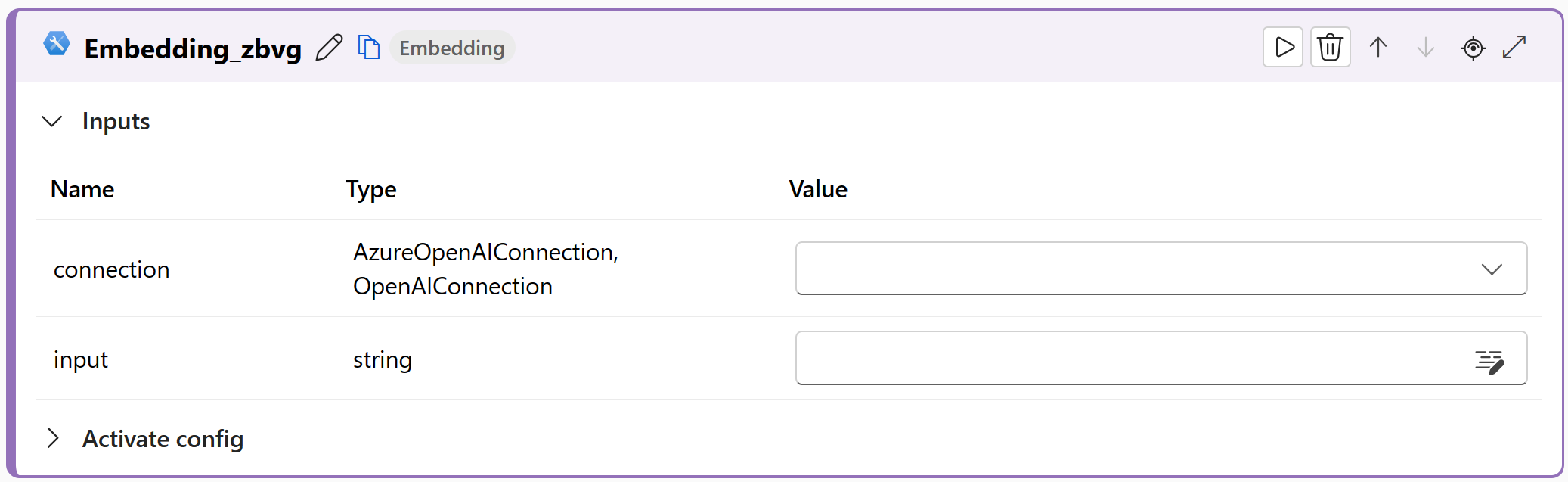
Select the connection to one of your provisioned resources. For example, select Default_AzureOpenAI.
Enter values for the Embedding tool input parameters described in the Inputs table.
Add more tools to your flow, as needed. Or select Run to run the flow.
The outputs are described in the Outputs table.
Inputs
The following input parameters are available.
| Name | Type | Description | Required |
|---|---|---|---|
| input | string | The input text to embed. | Yes |
| model, deployment_name | string | The instance of the text-embedding engine to use. | Yes |
Outputs
The output is a list of vector representations for the input text. For example:
[
  0.123,
  0.456,
  0.789
]