Maybe shrinking drive C by 1 MB would work, preferably in disk management? :)
This browser is no longer supported.
Upgrade to Microsoft Edge to take advantage of the latest features, security updates, and technical support.
' cx='32' cy='32' r='32' /%3E%3Ctext x='50%25' y='55%25' dominant-baseline='middle' text-anchor='middle' fill='%23FFF' %3ES%3C/text%3E%3C/svg%3E)
Hi,
I wanted to upgrade to Windows 11 but I needed to change my BIOS mode from legacy to UEFI. However when I went to advanced startup to follow the instructions on how to change it I got the 0xc0000017 error when I clicked on the command prompt. I basically had the same issue the user had from [this](https://learn.microsoft.com/en-us/answers/questions/2338992/having-trouble-fixing-error-0xc0000017-(advanced-s) post up to the most recent response which still didn't get resolved. I also want to point out that when I typed >bcdedit/delete {badmemory}, I didn't get an error but an access denied message which is below here.
C:\windows\system32>bcdedit/enum all
Windows Boot Manager
--------------------
identifier              {bootmgr}
device                  partition=U:
description             Windows Boot Manager
locale                  en-US
inherit                 {globalsettings}
default                 {current}
resumeobject            {57615d88-34bd-11eb-b184-1803733bf2bc}
displayorder            {current}
toolsdisplayorder       {memdiag}
timeout                 30
Windows Boot Loader
-------------------
identifier              {current}
device                  partition=C:
path                    \windows\system32\winload.exe
description             Windows 10
locale                  en-US
inherit                 {bootloadersettings}
recoverysequence        {57615d8a-34bd-11eb-b184-1803733bf2bc}
displaymessageoverride  CommandPrompt
recoveryenabled         Yes
allowedinmemorysettings 0x15000075
osdevice                partition=C:
systemroot              \windows
resumeobject            {57615d88-34bd-11eb-b184-1803733bf2bc}
nx                      OptIn
bootmenupolicy          Standard
Windows Boot Loader
-------------------
identifier              {57615d8a-34bd-11eb-b184-1803733bf2bc}
device                  ramdisk=[C:]\Recovery\WindowsRE\Winre.wim,{57615d8b-34bd-11eb-b184-1803733bf2bc}
path                    \windows\system32\winload.exe
description             Windows Recovery Environment
locale                  en-us
inherit                 {bootloadersettings}
displaymessage          Recovery
osdevice                ramdisk=[C:]\Recovery\WindowsRE\Winre.wim,{57615d8b-34bd-11eb-b184-1803733bf2bc}
systemroot              \windows
nx                      OptIn
bootmenupolicy          Standard
winpe                   Yes
Resume from Hibernate
---------------------
identifier              {57615d88-34bd-11eb-b184-1803733bf2bc}
device                  partition=C:
path                    \windows\system32\winresume.exe
description             Windows Resume Application
locale                  en-US
inherit                 {resumeloadersettings}
recoverysequence        {57615d8a-34bd-11eb-b184-1803733bf2bc}
recoveryenabled         Yes
allowedinmemorysettings 0x15000075
filedevice              partition=C:
filepath                \hiberfil.sys
bootmenupolicy          Standard
debugoptionenabled      No
Windows Memory Tester
---------------------
identifier              {memdiag}
device                  partition=U:
path                    \boot\memtest.exe
description             Windows Memory Diagnostic
locale                  en-US
inherit                 {globalsettings}
badmemoryaccess         Yes
EMS Settings
------------
identifier              {emssettings}
bootems                 No
Debugger Settings
-----------------
identifier              {dbgsettings}
debugtype               Local
RAM Defects
-----------
identifier              {badmemory}
Global Settings
---------------
identifier              {globalsettings}
inherit                 {dbgsettings}
                        {emssettings}
Boot Loader Settings
--------------------
identifier              {bootloadersettings}
inherit                 {globalsettings}
                        {hypervisorsettings}
Hypervisor Settings
-------------------
identifier              {hypervisorsettings}
hypervisordebugtype     Serial
hypervisordebugport     1
hypervisorbaudrate      115200
Resume Loader Settings
----------------------
identifier              {resumeloadersettings}
inherit                 {globalsettings}
Device options
--------------
identifier              {57615d8b-34bd-11eb-b184-1803733bf2bc}
description             Windows Recovery
ramdisksdidevice        partition=C:
ramdisksdipath          \Recovery\WindowsRE\boot.sdi
C:\windows\system32>bcdedit/delete {badmemory}
This entry cannot be deleted unless the /f switch is specified on the command
line.  Run bcdedit /? for more information.
Access is denied.
Then I followed the rest of the instructions on the post then used the >list partition command, no EFI system partition was located on any of the disks. When I opened Disk Management there isn't a EFI located and I don't know what to do to get the EFI back. Screenshot (394).png
' cx='32' cy='32' r='32' /%3E%3Ctext x='50%25' y='55%25' dominant-baseline='middle' text-anchor='middle' fill='%23FFF' %3EVZ%3C/text%3E%3C/svg%3E)
Maybe shrinking drive C by 1 MB would work, preferably in disk management? :)

msinfo32.exe, and click System Summary. Resize the columns in the right pane to make the entries visible, and post a screenshot.mbr2gpt /validate /disk:2 /allowFullOS
Post the output.
Here is the screenshot and output
C:\windows\system32>mbr2gpt /validate /disk:2 /allowFullOS
MBR2GPT: Attempting to validate disk 2
MBR2GPT: Retrieving layout of disk
MBR2GPT: Validating layout, disk sector size is: 512 bytes
Disk layout validation failed for disk 2
Run:
bcdboot C:\Windows /s U: /f ALL

mbr2gpt /validate /disk:2 /allowFullOS
Post the output.
C:\windows\system32>bcdboot C:\Windows /s U: /f ALL
Boot files successfully created.

C:\windows\system32>mbr2gpt /validate /disk:2 /allowFullOS
MBR2GPT: Attempting to validate disk 2
MBR2GPT: Retrieving layout of disk
MBR2GPT: Validating layout, disk sector size is: 512 bytes
Disk layout validation failed for disk 2
Please upload the "C:\Windows\Logs\WinREAgent\setupact.log" file.
I can not upload the file, it is saying the log file is more then 3GB.
Rename or delete the file if possible.
Then, rerun the commands I posted.
Upload the fresh log which will be smaller in size.
I deleted the file and redid the command this is what I got.
C:\windows\system32>C:\Windows\Logs\WinREAgent\setupact.log
'C:\Windows\Logs\WinREAgent\setupact.log' is not recognized as an internal or external command,
operable program or batch file.
I meant this command:
mbr2gpt /validate /disk:2 /allowFullOS
Did you run it again?
When the command fails, it creates a new setupact.log file. Upload it.
Run this command again:
mbr2gpt /validate /disk:2 /allowFullOS
Upload the fresh log.
ValidateLayout: Last partition too close to the end of the disk. Should end at offset 1000204869120 or below, found at 1000204886016
The above error was encountered.
Please try the method in this video. The fix starts from 9:00 onwards in this video. Be sure to backup the data first because I haven't tried the Align option before.
Tried to follow instructions from video and used the same disk tool but partition wizard says all partitions are already aligned.
Can you try the "Convert MBR Disk to GPT Disk" in MiniTool?
Detailed Instructions:
How to Convert MBR Disk to GPT Disk
https://www.partitionwizard.com/help/convert-mbr-disk-to-gpt-disk.html
Update:
You could try the shrink suggestion first → https://learn.microsoft.com/en-us/answers/a/12865382
because MiniTool free version can't convert the system disk to GPT.
If that doesn't help, try AOMEI Partition Assistant:
I'm confused on shrinking the disk to 1MB, when I entered the amount of space to shrink in MB to be 1 nothing happened so I did the Partition Assistant and that is also not free. I found that Disk Genius actually does it for free, should I do this instead? My only concern when looking at the guide is that I have to convert the disk to GUID partition table and I don't know how to check if the disk supports it. https://www.diskgenius.com/manual/convert-partition-table-style.php
Try the mbr2gpt command again.
If the same error occurs, shrink the volume by 250 MB or so.
when I entered the amount of space to shrink in MB to be 1 nothing happened
Try the mbr2gpt command again.
If the same error occurs, shrink the volume by 250 MB or so.
C:\Windows\system32>mbr2gpt /validate /disk:2 /allowFullOS
MBR2GPT: Attempting to validate disk 2
MBR2GPT: Retrieving layout of disk
MBR2GPT: Validating layout, disk sector size is: 512 bytes
MBR2GPT: Validation completed successfully
Ok. You can run the convert command now.
**Important: **After the disk has been converted to GPT, the system must be reconfigured to boot in UEFI mode.
C:\Windows\system32>mbr2gpt /convert
ERROR: MBR2GPT can only be used from the Windows Preinstallation Environment. Use /allowFullOS to override.
Run:
mbr2gpt /convert /disk:2 /allowFullOS
When I converted to gpt and tried to boot again I got a blue screen saying operating system couldn't be loaded becauae a required file is missing or contains errors with File: \Windows\system32\winload.efi
Error code: 0xc000000e
Did you check the boot mode to UEFI Only?
There's an option in boot settings for legacy + Uefi or Uefi. I choose the just Uefi option. There is also an option in advanced to set Bios CSM/UEFI Mode which is currently in CSM mode that I have not touched.
There is also an option in advanced to set Bios CSM/UEFI Mode which is currently in CSM mode that I have not touched.
Set it to UEFI mode.
Changed it and I still have the same blue screen error
If you have the Windows 10/11 USB setup disk, boot from it and access Windows RE.
In the WinRE Command Prompt, type the following commands:
bcdedit
diskpart
list disk
select disk 2
list part
list vol
exit
Take photos of the output screen using your phone and share the images here.
Note: In another case, we fixed the issue by rebuilding the EFI partition: How to fix error code 0xc000000e due to mbr2gpt? - Microsoft Q&A
Run:
diskpart
list  disk
select disk 2
select part 1
format quick fs=fat32 label=EFI
set id=c12a7328-f81f-11d2-ba4b-00a0c93ec93b override
gpt attributes=0x8000000000000000
assign letter=Y
list vol
exit
Post the output.
It might be due to the spelling mistake.
label vs lable.
label is correct.
Run:
bcdboot F:\Windows /s Y: /f UEFI

diskpart

select disk 2

list part

select part 3
Run:
del part override
select volume Y
remove
exit
Restart the system. Let me know if you can boot into Windows in UEFI mode.
Pc health check says I can upgrade, I followed the instructions to manually refresh security and updates but it still says doesn't meet minimum requirements.
Yeah, thought so. That's why I suggested running that compatibility telemetry scheduled task.
Please share your Farbar scan logs for analysis.
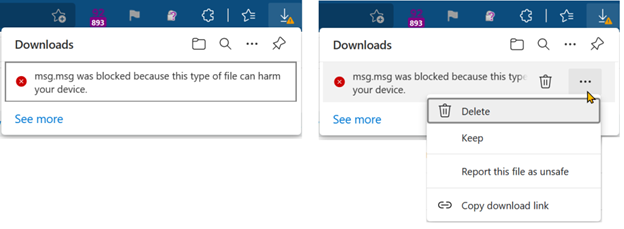
FRST64.exe to FRST64English.exe.Note: If Microsoft Edge or Chrome mislabels the Farbar Scanner executable as PUA/malware, choose to keep it by tapping … in the bottom bar, choosing Keep, and then choosing Keep anyway in the dialog that appears. See this screenshot. It's a safe tool used in most antimalware forums.
I was able to log in back to windows
Ok. Please follow the steps mentioned in this article.
Check if a device meets Windows 11 system requirements after changing device hardware | Microsoft Support: https://support.microsoft.com/en-us/windows/experience/compatibility/check-if-a-device-meets-windows-11-system-requirements-after-changing-device-hardware
I meet the system requirements and I can now upgrade to win 11.
Ok. The steps posted in that link is not just for checking the h/w requirements but also checks for gated blocks.
Also post the latest Disk Management screenshot if possible.
Pc health check says I can upgrade, I followed the instructions to manually refresh security and updates but it still says doesn't meet minimum requirements.
C:\Windows\system32>schtasks.exe /Run /TN "\Microsoft\Windows\Application Experience\Microsoft Compatibility Appraiser"
SUCCESS: Attempted to run the scheduled task "\Microsoft\Windows\Application Experience\Microsoft Compatibility Appraiser".
Never mind I had to press check for updates and now it says I can do it
From Page 34 of the MAG B660M MORTAR DDR4 manual.
https://download-2.msi.com/archive/mnu_exe/mb/MAGB660MMORTARWIFIDDR4_MAGB660MMORTARDDR4.pdf