Developer technologies | Transact-SQL
A Microsoft extension to the ANSI SQL language that includes procedural programming, local variables, and various support functions.
This browser is no longer supported.
Upgrade to Microsoft Edge to take advantage of the latest features, security updates, and technical support.
' cx='32' cy='32' r='32' /%3E%3Ctext x='50%25' y='55%25' dominant-baseline='middle' text-anchor='middle' fill='%23FFF' %3EN%3C/text%3E%3C/svg%3E)
Hi
In our datatable, we have a ton of values that contain # because typically in construction, fasteners are graded with a # like this
'#8 x 2-1/2in
When i try to search for this in a Stored Procedure to filter the fastener size down, it fails because of the hash. I know its because the # has a meaning in a SQL statement so how would i get around it and find the rows using the hash in the search criteria?
Thanks
Nacho
A Microsoft extension to the ANSI SQL language that includes procedural programming, local variables, and various support functions.
Additional SQL Server features and topics not covered by specific categories

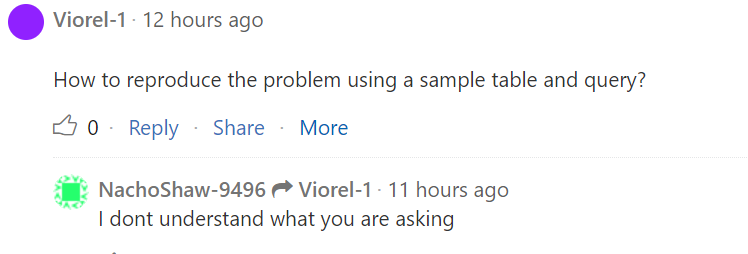
How to reproduce the problem using a sample table and query?
I dont understand what you are asking
' cx='32' cy='32' r='32' /%3E%3Ctext x='50%25' y='55%25' dominant-baseline='middle' text-anchor='middle' fill='%23FFF' %3EYK%3C/text%3E%3C/svg%3E)
While asking a question you need to provide a minimal reproducible example:
(1) DDL and sample data population, i.e. CREATE table(s) plus INSERT, T-SQL statements.
(2) What you need to do, i.e. logic, and your attempt implementation of it in T-SQL.
(3) Desired output based on the sample data in the #1 above.
(4) Your SQL Server version (SELECT @@version;)
' cx='32' cy='32' r='32' /%3E%3Ctext x='50%25' y='55%25' dominant-baseline='middle' text-anchor='middle' fill='%23FFF' %3EEM%3C/text%3E%3C/svg%3E)
Do you have any updates?
Please also remember to mark the replies as answers if they helped. Your action would be helpful to other users who encounter the same issue and read this thread.
Echo
Hi @NachitoMax ,
Welcome to TSQL Forum!Your question involves TSQL, so the engineer helped you add the TSQL tag.
Maybe you are not familiar with Q&A forums. Generally speaking,when you post a question, please share us a minimal example that can illustrate the problem, and your table structure (CREATE TABLE …) and some sample data(INSERT INTO …)along with your expected result. So that we’ll get a right direction and make some test.Of course, you posted relevant information in the subsequent answers.
I watched the full thread,thank you for posting the solution.It seems that null confuses you,the following instructions may be helpful to you:
To determine whether an expression is NULL, use IS NULL or IS NOT NULL instead of comparison operators (such as = or !=).
But when assigning values to variables, use comparison operators(such as = or !=).
For more details,please refer to:IS NULL (Transact-SQL)
If you have any question, please feel free to let me know.
If the response is helpful, please click "Accept Answer" and upvote it.
Regards
Echo
Note: Please follow the steps in our documentation to enable e-mail notifications if you want to receive the related email notification for this thread.
Hot issues November--What can I do if my transaction log is full?
Hot issues November--How to convert Profiler trace into a SQL Server table